


Quick Answer: What Does Bai Juyi Ask His Friend?
Asking Liu Shijiu (问刘十九, Wèn Liú Shí Jiǔ) by Bai Juyi (白居易, Bái Jū Yì) invites a friend to share a cup of new wine. A small stove and the prospect of snow make that simple offer feel especially welcoming.
- See the objects: Fresh wine and a little red-clay stove prepare the scene.
- Notice the weather: Evening approaches and the sky threatens snow.
- Hear the invitation: The final question turns the scene toward another person.
The poem ends before the friend answers. Its warmth lies in the offer of companionship, not a narrated drinking party.
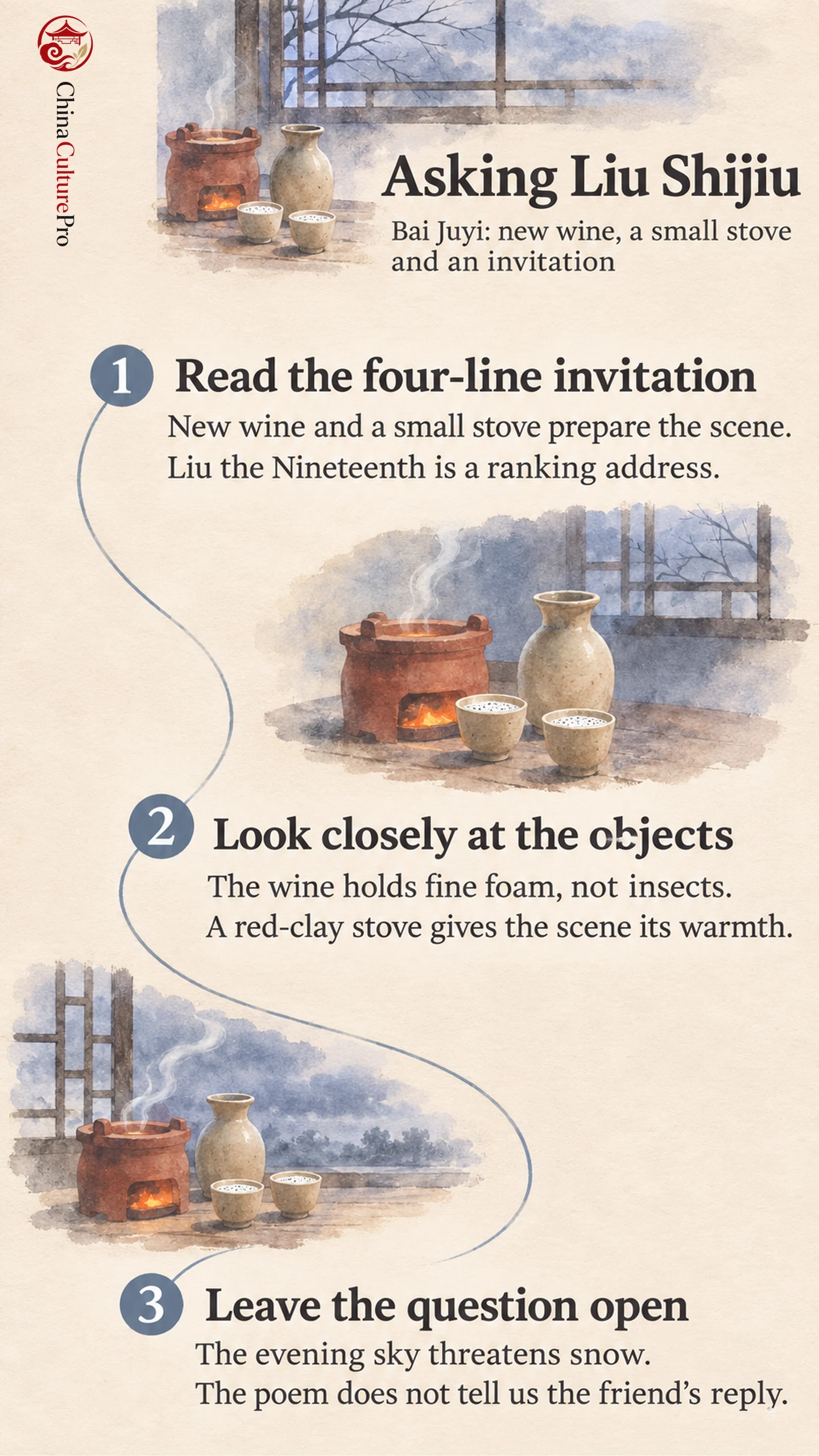
Twenty characters create a scene awaiting a friend’s answer. The details are modest, but their order matters: first the wine, then the stove, then the sky outside, and finally the question addressed to a friend.
Read the Four Lines and the Invitation in the Title
Liu Shijiu (刘十九, Liú Shí Jiǔ) means Liu the Nineteenth: the number is a ranking form of address, not his age. [2]
Here is the full five-character quatrain with an original, unrhymed English rendering. [1]
| Chinese line | Plain English rendering |
|---|---|
| 绿蚁新醅酒, | Fine green foam on newly brewed wine. [1] |
| 红泥小火炉。 | A little stove of red clay. [1] |
| 晚来天欲雪, | Evening comes; the sky is about to snow. [1] |
| 能饮一杯无? | Would you share a cup? [1] |
The Bai Juyi reading guide offers more of his work. For the form, use the regulated verse guide alongside Tang poetry. The forms of address guide provides wider context for respectful naming, though this historical numbered address should not become a rule for introducing people today.
Understand the Green Foam and the Red-Clay Stove
The phrase green ants (绿蚁, Lǜ Yǐ) names fine foam floating on the new rice wine, not insects in the drink. Newly brewed unfiltered wine (新醅酒, Xīn Pēi Jiǔ) supplies the material context. The tiny bubbles suggest the smallness of ants. [2]
The Chinese rice wine guide explains the broader drink category. This line is an image of new wine, rather than a label for a modern brand or a recipe to reproduce.
The green and red are paired before the weather appears. Fresh wine supplies one vivid detail; the clay stove supplies another. The stove’s small size makes the setting feel close and domestic rather than ceremonially grand. [1]
Try reading the opening couplet without adding a feast, a room full of guests or a host’s speech. The objects do the welcoming. The final question will give that prepared scene its human direction.
Stop at the Question before Adding an Arrival
The sky is about to snow. That prospect makes the stove more appealing, but the poem does not state that flakes have already begun falling. Anticipation belongs to both the weather and the invitation. [1]
The final character 无 functions as a question particle here. It does not turn the last line into a statement that there is no wine. [2]
The question is brief enough to sound conversational. Its modest offer allows us to feel a wish for company without a separate declaration of affection. Yet the friend’s reply remains outside the poem: accepting, arriving and spending the evening together would be continuations imagined by the reader. [1]
Compare Du Fu’s A Guest Arrives for a hospitality poem organized around a guest already welcomed into the scene. Bai Juyi’s four lines hold a different moment: the invitation is still open.
FAQs About Asking Liu Shijiu
Does the wine contain actual ants?
No. The image refers to small floating bubbles or foam on the new wine.
Is Liu Shijiu a nineteen-year-old?
The title uses a numbered ranking address. It does not state that Liu is nineteen years old.
Does the poem say that Liu accepted the invitation?
No. It closes with a question. The friend’s answer and any later gathering are left to the imagination.
Sources
[1] Bai Juyi, via Wikisource. Asking Liu Shijiu
[2] Commercial Press Hong Kong, via Chinese Classical Literature Close Reading. Asking Liu Shijiu: Notes and Commentary