


Quick Answer: What Message Does the Departing Friend Carry?
At Hibiscus Pavilion Seeing Xin Jian Off (芙蓉楼送辛渐, Fú Róng Lóu Sòng Xīn Jiàn) by Wang Changling (王昌龄, Wáng Chāng Líng) turns a farewell into a message for people far away. The departing friend is asked to convey the poet’s purity of character if they ask about him.
- Follow the time: Cold rain at night gives way to a dawn farewell.
- Notice the hills: Their solitude gives the parting a visible form.
- Read the final image: Ice held in jade expresses an unsullied heart.
The poem states a moral self-image. It does not supply evidence about a specific accusation or narrate the message’s eventual delivery.
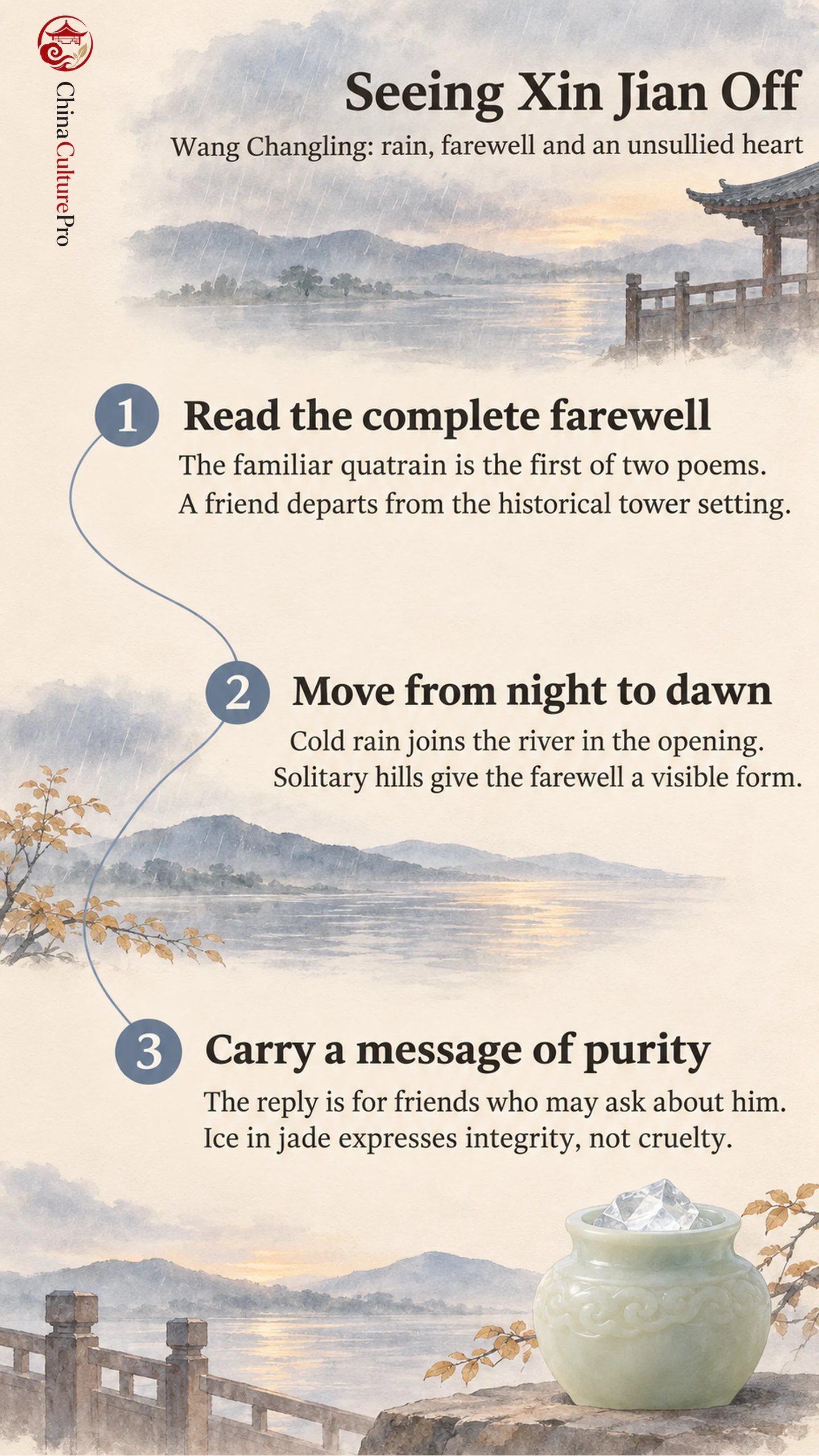
The opening fills a landscape with rain; the ending concentrates attention on a concentrated image of purity. Between them, the poem changes from seeing a friend off to imagining what that friend might say to others.
Read the Four Lines and Locate the Farewell
The title’s pavilion is also translated as Hibiscus Tower. Its historical location is in present-day Zhenjiang. This is the first of two poems under the same title. [2]
The geographical names below are Wu (吴, Wú), Chu (楚, Chǔ) and Luoyang (洛阳, Luò Yáng). The last line joins an ice heart (冰心, Bīng Xīn) with a jade vessel (玉壶, Yù Hú). [1]
The table follows the version beginning with rain joining the river, with an original, unrhymed English rendering. [1]
| Chinese line | Plain English rendering |
|---|---|
| 寒雨连江夜入吴, | Cold rain joins the river, entering Wu by night. [1] |
| 平明送客楚山孤。 | At dawn I see my guest off; the hills of Chu stand alone. [1] |
| 洛阳亲友如相问, | If family and friends in Luoyang should ask about me. [1] |
| 一片冰心在玉壶。 | One heart of ice within a vessel of jade. [1] |
The Wang Changling guide offers more of his work. Use Tang poetry and the regulated verse guide for the wider context of this seven-character quatrain.
Move from Night Rain to the Lonely Dawn
The first line makes rain and river seem continuous. The word cold gives that broad scene a felt quality; night makes its limits harder to distinguish. Dawn then marks the moment of parting, with the solitary hills as the line’s final focus. [1]
The hills do more than locate the view. Their loneliness allows the feeling of separation to enter the landscape. Read the second line with a pause before the hills, and notice how the farewell seems to leave their solitary form behind. [2]
Do not add a complete travel narrative to these two lines. They do not explicitly say that rain stopped, that the poet spent the whole night awake, or that the friend boarded a particular boat. Those details may be imaginable, but they are not necessary to understand the shift from night to dawn.
Read the Message of an Ice Heart in Jade
The third line opens a possible conversation in Luoyang. If people ask, the departing friend is entrusted with a reply. That conditional form matters: the questions have not already been asked within the poem. [1]
The final image expresses clarity and integrity. An ice heart here is pure, not emotionally unfeeling in the sense an English reader might give to cold-hearted. Jade reinforces the image of an unsullied character. [2]
The jade symbolism guide provides broader cultural context. Read the vessel as an image in the message rather than an object the poet literally hands over to his friend.
Notice the change of scale. A whole rain-darkened river occupied the opening; one concentrated image of the heart occupies the end. The reply does not list achievements or explain the speaker’s circumstances. It offers a way for distant friends to understand what he wishes to preserve about himself. [1]
For the wider convention, explore Chinese friendship and farewell poems.
FAQs About At Hibiscus Pavilion Seeing Xin Jian Off
Does an ice heart mean that Wang Changling is unfeeling?
Here it represents purity and integrity. Reading it as emotional cruelty would reverse the force of the image.
Who was Xin Jian?
He was Wang Changling’s friend and the departing guest. Details of his life are not securely established.
Is this the first of two poems with the same title?
Yes. The familiar rain-and-ice-heart quatrain is the first of the pair.
Sources
[1] Wang Changling, via Hong Kong Education Bureau. At Hibiscus Tower Seeing Xin Jian Off: Chinese Text
[2] Commercial Press Hong Kong and Qiu Zhenjing and Qiu Yiwen, via Chinese Classical Literature Close Reading. At Hibiscus Tower Seeing Xin Jian Off I: Notes and Commentary