


Quick Answer: What Is Chinese Rice Wine?
Chinese rice wine is a loose English label usually applied to rice-based fermented drinks. It can point to a bottled wine, a regional household preparation or sweet fermented rice with grains still present. The name alone does not establish sweetness, strength or intended use.
- Read the product: Check its Chinese name, ingredient list and alcohol percentage.
- Separate the processes: Fermented grain wine differs from a distilled spirit, even when both use rice.
- Check the purpose: A salted cooking wine is not the same product as a wine intended for drinking.
Use the English label as a starting point. Identify the particular bottle or preparation before choosing it for a meal or recipe.
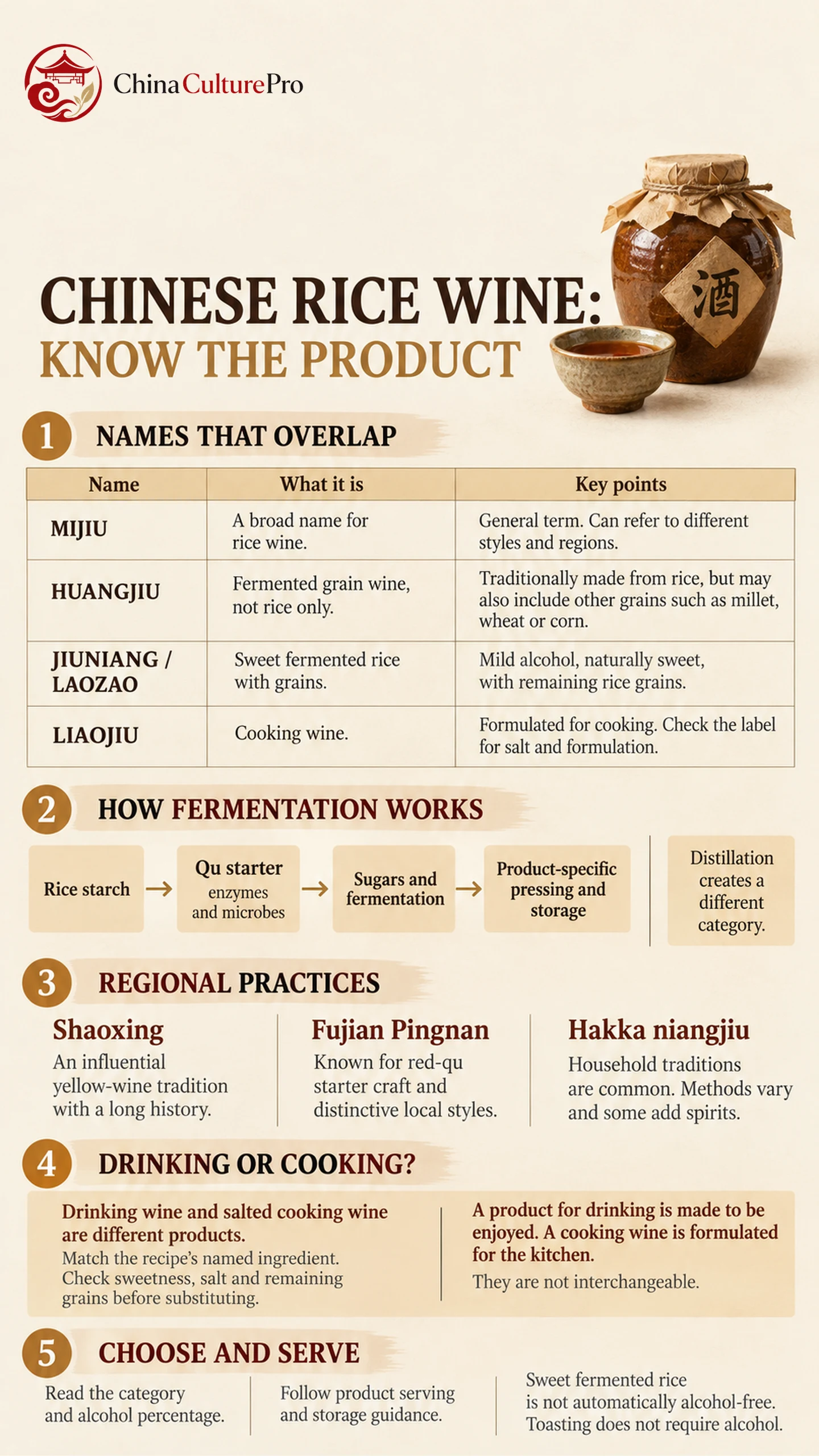
Much confusion comes from asking one translated name to do several jobs. An ingredient glossary, a supermarket label and a regional menu may each use “rice wine” differently. The most useful approach is to separate what the drink is called, how it was made and what you plan to do with it.
The Names Overlap but the Products Differ
Everyday language does not map neatly onto one product family. Formal Chinese food-production categories distinguish yellow wine from other fermented wines, while consumer descriptions also use rice-wine names for sweet fermented-rice products.[1][2]
| Name you may encounter | What to establish before choosing it |
|---|---|
| Mijiu (米酒, mǐjiǔ) | Literally rice wine; a broad everyday name whose exact product depends on regional and commercial context. |
| Huangjiu (黄酒, huángjiǔ) | A fermented grain-wine category; rice is important, but the category is not restricted to rice alone. |
| Jiuniang (酒酿, jiǔniàng), also called laozao (醪糟, láozāo) | Sweet fermented rice, often with grains and liquid together; identify whether the recipe wants this preparation or a strained bottled wine. |
| Cooking wine: liaojiu (料酒, liàojiǔ) | A kitchen-use category; check its base wine, salt and other ingredients rather than assuming it is a drinking wine. |
Huangjiu production definitions include rice and other grains.[7] These are useful distinctions, not a claim that every speaker uses each word identically. A clear rice wine, an aged amber wine and a spoonable fermented-rice preparation can all appear in English discussions of rice wine, yet they will behave differently in a glass or saucepan.
For deeper reading, the huangjiu guide owns the yellow-wine category and its styles. The jiuniang guide follows the sweet fermented-rice preparation. Neither should be reduced to an interchangeable synonym for every product bearing a rice-wine translation.
How Rice Becomes a Fermented Drink
Rice provides starch, which needs to be made available as fermentable sugars. Qu (曲, qū) is a fermentation starter that supplies enzymes and microorganisms for starch conversion and fermentation. Traditional Shaoxing craft combines prepared glutinous rice with starters and water, then proceeds through fermentation and later operations such as pressing, clarification and storage.[3]
That is a production map, not a home-brewing recipe. Starter composition, grain preparation, fermentation conditions and finishing choices vary. Retaining rice solids or pressing out a liquid produces visibly different preparations. Sweetness and alcohol develop through the process rather than being fixed by the fact that rice was used.
Distillation creates another distinction. A rice-based distilled spirit is not equivalent to the fermented wines discussed here. Local names can be broad, so look at the product description when a label is ambiguous. The baijiu guide explains the spirit side of that boundary.
Regional Traditions Beyond One Bottle
Shaoxing in Zhejiang is a major reference point for bottled huangjiu. Its documented craft links grain preparation, starters, seasonal work and storage, with several named wine styles. It is one influential regional tradition rather than a complete definition of every Chinese rice wine.[3]
Fujian offers another example through red qu (红曲, hóngqū), a red fermentation starter used in local yellow-wine traditions. The heritage record for Pingnan describes glutinous rice, handmade starter, fermentation, pressing and later handling, with family and workshop transmission central to the craft.[4]
In Hakka communities, niangjiu (娘酒, niángjiǔ) names a regional wine tradition associated with household knowledge and hospitality. Local wine vocabulary and procedures differ; some documented methods add a distilled spirit during processing. That variation is a reason to check the actual preparation rather than assigning every homemade rice wine one expected strength.[5]
These examples show why place matters. A region can contribute a starter tradition, a way of handling the fermented rice, a storage practice or a role at family gatherings. Look for the named regional practice and product details rather than relying on color or jar design.
Drinking Wine and Cooking Wine Are Different Choices
A wine intended for drinking can also be used in cooking, but a product sold specifically as cooking wine may have a different formulation. Official consumer guidance distinguishes cooking-wine products and describes cooking huangjiu with added salt and optional plant spices.[6]
Read the ingredient list before substituting. Added salt changes seasoning, sweetness affects balance and a darker aged wine can bring a different flavor from a clear rice wine. If a recipe specifies Shaoxing wine, replacing it with a sweet fermented-rice preparation changes more than the alcohol source: it may add sugar, solids and a different texture.
For Chinese home cooking, match the recipe’s named ingredient where possible. If you adapt, identify which function matters—aroma, sweetness, acidity or liquid volume—and adjust the dish deliberately. Rice vinegar belongs to a different ingredient category and is not an automatic replacement simply because rice appears in both names.
Serving and Choosing the Product You Need
For drinking, first confirm that the bottle is intended as a beverage and read its alcohol percentage. Then check its sweetness description, producer’s serving guidance and storage instructions. A regional custom of warming one style does not mean every rice wine must be warmed; a sweet cup and a dry aged wine also invite different expectations.
For a recipe, compare the exact product rather than only its English shelf label. Check whether it contains salt, whether rice solids remain and whether the recipe calls for a particular regional style. For a jar of sweet fermented rice, follow the package’s storage guidance and do not assume that a dessert-like flavor means there is no alcohol.[2]
At a shared table, explain whether you want to taste a little, sip with food or choose another drink. Chinese drinking etiquette varies with the occasion; a wine’s cultural role does not create an obligation to drink it. The wider Chinese drinks guide helps place these wines alongside tea, spirits and everyday non-alcoholic choices.
FAQs About Chinese Rice Wine
Is Chinese rice wine the same as rice vinegar?
No. They are different products with different flavors and kitchen roles. Follow the recipe’s intended ingredient rather than substituting solely because both names mention rice.
Can clear mijiu replace Shaoxing wine?
Sometimes a recipe can be adapted, but the flavor may change. Compare sweetness, salt and the role of the wine in that particular dish; the two names do not promise an identical ingredient.
Is sweet fermented rice alcohol-free?
Do not assume so. Fermentation can produce alcohol, and products vary. Check the label or producer’s information rather than judging by sweetness or its use in desserts.
Does every huangjiu use only rice?
No. Huangjiu is a fermented grain-wine category that can use grains other than rice. Rice-based examples explain why the English labels overlap, but they do not define the whole category.
Sources
[1] State Administration for Market Regulation. Food Production Licensing Classification Catalogue
[2] Shenzhen Institute of Standards and Technology. Rice Wine Consumer Information
[3] China Intangible Cultural Heritage Museum. Shaoxing Huangjiu Brewing Technique
[4] China Intangible Cultural Heritage Museum. Red-Qu Huangjiu Brewing Technique
[5] China Hakka Museum. Research on Hakka Language and Wine Culture
[6] State Administration for Market Regulation. Cooking Wine Consumer Information
[7] State Administration for Market Regulation. Liquor Production Licensing Review Rules