

Quick Answer: What Is Huangjiu?
Huangjiu (黄酒, huángjiǔ), often translated as Chinese yellow wine, is a fermented grain-wine category. Rice is important, but other grains can be used. It differs from distilled Chinese spirits, and its styles range from dry to distinctly sweet.[1]
- Choose by style: Sweetness is a useful first guide to the bottle.
- Read regional names: Shaoxing is a major tradition within the wider category.
- Separate serving choices: Warm, room-temperature and chilled service can suit different wines and preferences.
An amber color or a prominent age statement does not tell you everything. Check the named style, intended use and bottle guidance before choosing how to serve it.
Huangjiu sits between several English-language categories that can cause confusion: “rice wine,” “yellow wine” and “cooking wine.” Understanding the drink itself makes those translations easier to manage. This guide focuses on choosing and serving yellow wine; the broader Chinese rice wine guide handles the overlapping vocabulary.
A Grain Wine, Not a Distilled Spirit
Huangjiu is produced through grain preparation, starter addition and fermentation, followed by operations that can include pressing, filtering, heat treatment, storage and blending. Production definitions include rice and other grains, so “yellow rice wine” describes many familiar examples without covering every possible raw material.[1]
The contrast with baijiu is the category’s defining process: baijiu is a distilled spirit, whereas huangjiu belongs to fermented grain wines. Sweetness is a separate question. A sweet wine is not automatically low in alcohol, and a dry style is not automatically stronger. Use the actual alcohol-by-volume statement for that comparison.
For an English reader, “wine” here identifies a fermented alcoholic drink rather than promising grapes. Likewise, “yellow” is a conventional name rather than a precise color standard for every glass. Begin with the category and the particular product instead of treating either translated word as a complete description.
How Fermentation and Regional Craft Shape the Wine
Qu (曲, qū) is a fermentation starter that provides enzymes and microorganisms for starch conversion and fermentation. In Shaoxing, documented traditional craft brings together prepared glutinous rice, wheat-based starter, another starter preparation and water. Fermentation is followed by stages such as pressing, clarification, blending, heating and storage.[2]
The heritage account also describes a seasonal work cycle. That context connects the wine with accumulated skill, equipment and local production conditions; it is not a schedule that every modern producer or every region must reproduce identically.
Fujian’s red-starter huangjiu traditions provide a useful contrast. The Pingnan heritage record describes glutinous rice, handmade starter, family and workshop transmission, and particular fermentation and finishing practices.[3] Regional craft therefore belongs inside the definition of huangjiu’s diversity, rather than being an exception to a single Shaoxing recipe.
This is an explanation of the production logic, not a brewing procedure. When choosing a bottle, identify its region, raw materials and style before comparing the finished wine.
Dry to Sweet: Four Styles and Shaoxing Names
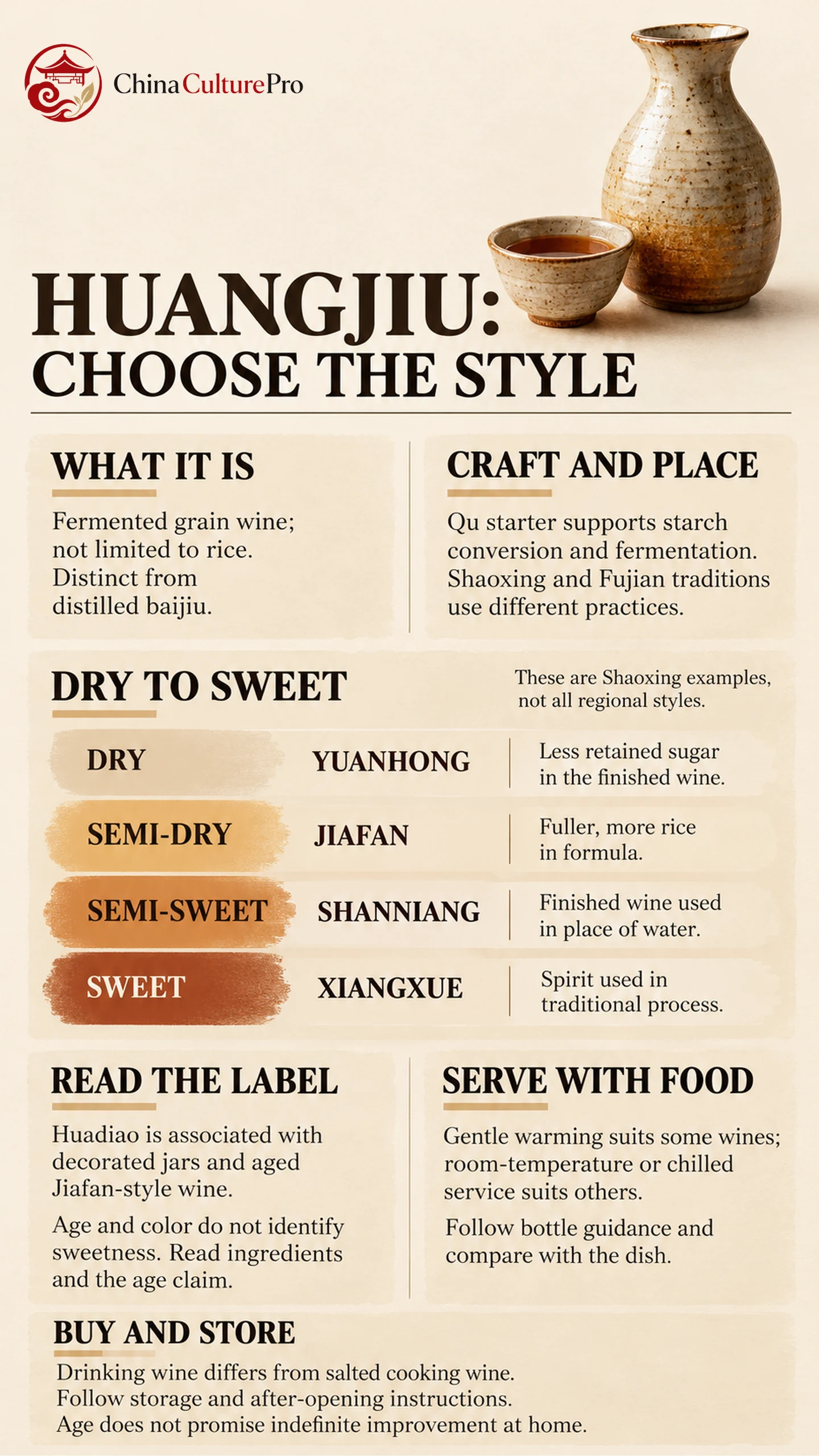
Dry, semi-dry, semi-sweet and sweet describe different sweetness classes. Four familiar Shaoxing names provide useful examples, while their associated production methods help explain why they are distinct wines.[4]
| Style and Shaoxing example | What makes the example useful to recognize |
|---|---|
| Dry: Yuanhong (元红, yuánhóng) | A comparatively dry reference point, associated with more complete fermentation and less remaining sugar. |
| Semi-dry: Jiafan (加饭, jiāfàn) | A fuller style whose name refers to adding more rice in the production formula. |
| Semi-sweet: Shanniang (善酿, shànniàng) | Traditionally uses finished wine in place of water, producing a different balance with more retained sweetness. |
| Sweet: Xiangxue (香雪, xiāngxuě) | A sweet style whose traditional method uses a distilled spirit in the process; sweetness does not establish low strength. |
Use this as an orientation map, not a claim that these four names exhaust huangjiu. A bottle from another region can state its own style and sweetness. Even within a class, aroma, acidity, texture and age affect the experience, so the table does not rank the wines from better to worse.
If you are choosing a first bottle, decide whether you want a drier meal accompaniment or a more overtly sweet taste. That gives the seller a concrete preference to work with and avoids using age as a substitute for style.
What Huadiao, Age and Color Can Tell You
Huadiao (花雕, huādiāo) is associated with decorated wine jars and commonly with aged Jiafan-style Shaoxing wine. It should not be treated as a fifth sweetness class alongside the four in the table.[5] On a contemporary bottle, read the stated product style as well as the prominent name.
Read the wording attached to an age statement and seek clarification if it is ambiguous. Ask what the declared number represents rather than assuming it also answers questions about sweetness, ingredients or serving temperature.
Color alone does not verify age or quality. Storage can affect appearance, and some products use permitted coloring; the ingredient list is more informative than assuming that the darkest wine must be the oldest.[5] Evaluate age, sweetness and ingredients separately rather than turning them into one score.
Serving Huangjiu with Food
Serving choices depend on style and preference. Gentle warming is a familiar approach for some fuller wines; other bottles can be enjoyed at room temperature or chilled. Sweet Xiangxue is one example discussed as suitable for cool service, so “huangjiu must always be hot” is too broad.[5]
For a first tasting, use a small pour and notice sweetness, acidity, aroma and texture before deciding whether to change the temperature. If you warm it, aim for gentle warming rather than boiling the wine as though it were a pot of water. Follow the producer’s guidance for the particular bottle instead of looking for one universal temperature.
Food pairing is also a comparison, not a fixed rule. Consider the dish’s richness and sweetness, then decide whether you want the wine to echo those qualities or provide a drier contrast. Keep the comparison manageable: one wine with a familiar dish teaches more about your preference than a long list of supposedly compulsory pairings.
At a shared meal, a small taste or a non-alcoholic choice is enough to take part socially. The Chinese drinking etiquette guide covers those interactions in more detail.
Buying and Storing a Bottle
Check whether the product is meant for drinking or sold as cooking wine. Cooking huangjiu can contain added salt and optional spices, so it is a different formulation rather than simply a cheaper label for the same beverage.[6] For Chinese home cooking, match the recipe’s named ingredient and account for seasoning.
For storage, follow the bottle’s instructions, including guidance after opening. An age statement does not promise that indefinite storage at home will improve it. The condition of the package and the product’s stated shelf life matter alongside its production history.[5]
A clear purchase request brings these decisions together: specify the sweetness you prefer, the intended meal or tasting, and whether the wine is for drinking or cooking. The Chinese drinks guide places huangjiu among the wider range of drinks you might choose.
FAQs About Huangjiu
Is huangjiu always yellow?
No. The translated name does not require every bottle to have the same shade. Color varies and does not independently prove age or quality.
Is Shaoxing wine the same as huangjiu?
Shaoxing wine is an important regional tradition within huangjiu. The wider category also includes wines from other regions and production traditions.
Does huangjiu have to be served warm?
No. Some styles suit gentle warming, while others can be served at room temperature or chilled. Start with the particular bottle’s guidance and your preference.
Can cooking huangjiu be treated as drinking wine?
Check the formulation. A cooking product may include salt and other seasoning ingredients, so it should not automatically be substituted for a beverage wine.
Sources
[1] State Administration for Market Regulation. Liquor Production Licensing Review Rules
[2] China Intangible Cultural Heritage Museum. Shaoxing Huangjiu Brewing Technique
[3] China Intangible Cultural Heritage Museum. Red-Qu Huangjiu Brewing Technique
[4] Zhejiang Guyue Longshan Shaoxing Wine. Huangjiu Craft
[5] Jiangnan University Research Center of Traditional Fermented Foods. How to Choose a Bottle of Huangjiu
[6] State Administration for Market Regulation. Cooking Wine Consumer Information