

Quick Answer: How Do Chinese New Year Traditions Differ Across the Three Regions?
Chinese New Year, or Spring Festival (春节, Chūnjié), shares themes of reunion, renewal and goodwill across mainland China, Hong Kong and Taiwan. Local customs give those themes different forms.
- Mainland China: Regional variety includes northern dumpling traditions, Shanghai lantern displays and Guangzhou flower markets.
- Hong Kong: Cantonese traditions include flower-market visits and Lai See (利是; Cantonese Jyutping: lai6 si6), alongside citywide public celebrations.
- Taiwan: New Year markets, family gatherings and local lantern events provide distinctive examples.
These are overlapping practices, not exclusive regional signatures. Household arrangements matter as much as the place name.
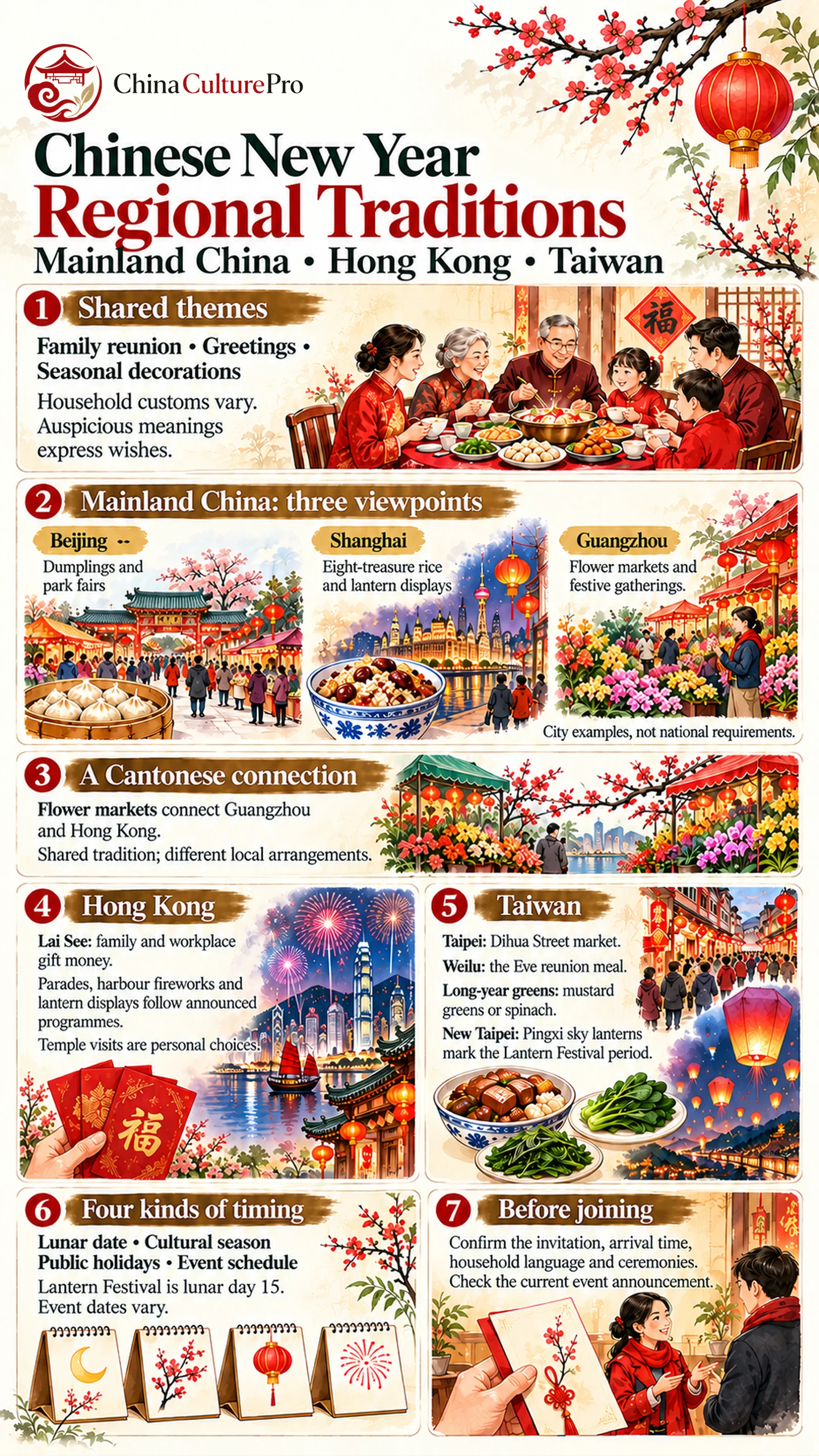
A flower market, a family dinner and a lantern-filled street can all belong to the same festival while reflecting different local traditions. This guide compares celebrations across mainland China, Hong Kong and Taiwan; our Chinese New Year overview introduces the wider season.
What Do the Three Celebrations Share?
All three observe New Year’s Day on the first day of the first month of the traditional Chinese lunisolar calendar. Guonian (过年, guònián) means celebrating the New Year. Common practices include preparing the home, gathering for an Eve meal, exchanging greetings and displaying auspicious decorations. The same custom can therefore look different in two homes on the same street.[1][3]
Reunion is a shared purpose, rather than a prescribed menu or compulsory sequence. One family may include ancestor remembrance; another may focus on dinner and conversation. A guest can join the social gathering without assuming that every religious observance is expected.
Four kinds of timing should stay separate: the lunar festival date, the broader cultural season, locally designated public holidays and each event’s announced schedule. A lantern display may run for several weeks, while a household dinner occupies one evening. Matching New Year’s Day dates therefore tell you neither how long people are off work nor when a particular market opens.
Mainland China, Hong Kong and Taiwan at a Glance
Read these as examples rather than a checklist. Mainland China covers many regional traditions; Hong Kong and Taiwan also contain substantial community and household variation.
| Dimension | Mainland examples | Hong Kong examples | Taiwan examples |
|---|---|---|---|
| Preparation and markets | Guangzhou flower markets; local food and decoration shopping | New Year flower fairs, including Victoria Park | Taipei’s Dihua Street New Year goods market |
| Reunion table | Northern dumplings (饺子, jiǎozi); Shanghai eight-treasure rice (八宝饭, bābǎofàn) | Family dinners may include poon choi (盆菜; Cantonese Jyutping: pun4 coi3), a shared basin dish.[17] | The Eve gathering is commonly called weilu (圍爐, wéilú), literally gathering around the stove |
| Gift money | Yasuiqian (压岁钱, yāsuìqián) commonly describes children’s New Year gift money | Lai See also appears in workplace relationships | Children’s gift money is also called yasuiqian, written 壓歲錢 |
| Public celebrations | Beijing park fairs; Shanghai lantern displays | Parades, lion dances and announced harbour fireworks | Local lantern festivals and community performances |
| Belief and remembrance | Ancestor or household observances in some families | Wong Tai Sin or other temple visits for some participants | Household and temple observances vary by community |
| Lantern season | Local displays with independently announced dates | Public lantern displays and carnivals have been held | Pingxi in New Taipei is one local example |
The Lantern Festival (元宵节, Yuánxiāo Jié) falls on lunar day 15, but an event bearing its name need not take place only that day. [4][5][6][14]
Mainland China: Regional Differences Within One Celebration
Beijing, Shanghai and Guangzhou offer three useful viewpoints. They do not divide the mainland into three complete cultural zones: family origins, migration and individual choices also shape what people do.
Beijing and Northern Examples: Dumplings and Temple Fairs
In Beijing, temple fairs (庙会, miàohuì) bring festive activity into public parks. Ditan and Longtan programmes have included performances, craft displays and entertainment. Ditan’s staged Earth Worship Ceremony presents a historical ceremonial tradition within a public cultural programme; watching it does not make religious participation compulsory.[7]
Dumplings are a familiar northern New Year food, including in many Beijing households. Preparing them together can be part of gathering for the holiday. Their association with the north does not make them every northern family’s required main course, or exclude them from southern tables.[1]
Shanghai and Jiangnan: Local Tables and Lantern Displays
Shanghai provides a different example from the lower Yangtze region. Eight-treasure rice is a sweet glutinous-rice dish with additions such as dried fruit and seeds, often presented as a festive dessert. It illustrates a local table tradition, not a rule for every household across Jiangnan.[8]
The Yuyuan Lantern Festival brings large illuminated figures and installations into the city’s public celebrations. Past editions have run across extended periods, showing why a lantern festival’s programme and the single lunar festival date must be distinguished. Themes and schedules change; a previous edition is evidence of the tradition, not next year’s itinerary.[9]
Guangzhou and Cantonese Communities: Flower-Market Traditions
Guangzhou’s flower-market visiting (行花街; Cantonese Jyutping: haang4 faa1 gaai1) combines browsing seasonal plants, meeting friends and enjoying festive surroundings. The Guangzhou project entered the national intangible cultural heritage representative list in 2021. The documented tradition extends through the Pearl River Delta, Hong Kong, Macao and overseas communities.[10][16]
This connection matters: flower markets are not uniquely Hong Kong customs, and a boundary between places does not neatly divide their cultural practices. Flowers express seasonal wishes, while the markets also function as social and commercial gatherings. Neither purpose makes one city’s celebration more authentic than another’s.
Hong Kong: Flower Markets, Lai See and Public Celebrations
Hong Kong’s New Year flower fairs are a prominent expression of its Cantonese cultural connections. Victoria Park is a major example, alongside fairs elsewhere in the city. People browse flowering branches and potted plants, choose decorations and meet others in a festive setting. A particular flower’s auspicious association expresses a wish; buying it does not change someone’s fortune.[2]
Lai See is a Cantonese name, not a Mandarin pronunciation. The Jyutping reading given above is distinct from its conventional English spelling. Married adults commonly give packets to children or younger unmarried relatives and friends, while employers may give them to employees. These are customary relationships, not a duty to give money to every unmarried person encountered. Nor do they establish a regionwide age cutoff or a universal amount.[11][12]
Public celebrations operate on another scale. Programmes have included the Tsim Sha Tsui night parade, lion dances and Victoria Harbour fireworks, often associated with the second lunar day. Future editions and dates need confirmation. A public fireworks display is also different from a family setting off firecrackers.[2]
Wong Tai Sin’s first-incense observance belongs to some devotees’ religious practice. It does not describe every resident’s Eve. Hong Kong also has public New Year lantern displays and a record of lantern carnivals; describing its lantern season as only small private decorations would be misleading.[2][6]
Taiwan: New Year Markets, Family Gatherings and Lantern Traditions
Taipei’s Dihua Street illustrates how preparing for the holiday becomes a public occasion. Its New Year market brings together dried goods and festive foods in an established trading neighbourhood, with stalls and displays adding to the seasonal atmosphere. This is a Taipei example, not the only place or method through which households across Taiwan prepare.[13]
At home, weilu names the Eve reunion meal. Its literal reference to gathering around a stove does not require a modern family to use a traditional stove. The gathering, rather than a mandatory cooking arrangement, carries the sense of reunion. Families choose their own menu and evening arrangements.[3][14]
One revealing food example is long-year greens (長年菜, chángniáncài). Long leaves express a wish for longevity, but even this named dish varies locally. Mustard greens are used in many northern and Hakka areas, while spinach is associated with parts of southern Taiwan. Neither the dish nor its symbolic wish establishes a compulsory menu or a promise of longer life.[15]
During the lantern season, the Pingxi Sky Lantern Festival in New Taipei offers a distinctive local celebration. It belongs to the period around the Lantern Festival, rather than being a standard New Year’s Eve activity. Other places have their own lantern displays; Pingxi does not represent every household’s celebration.[5]
Minnan and Hakka family traditions differ, and Indigenous communities have their own cultural calendars and practices. Temple visits, ancestor remembrance, gift money and staying awake depend on the household.
Joining a Celebration: What Should You Confirm?
An invitation gives more useful guidance than a regional stereotype. Before accepting, clarify the particular gathering:
- Date and scope: Ask when to arrive and whether the invitation covers dinner, an outing or both.
- Language and greetings: Check how the hosts prefer to be addressed and which language they commonly use.
- Household observances: Ask whether a ceremony is included and whether guests may observe or join only the social gathering.
- Public programmes: Check the organiser’s current announcement before assuming that a market, parade or lantern event follows last year’s arrangements.
These questions let you participate comfortably without treating a local custom as an obligation. A private dinner still requires an invitation, even when nearby public celebrations welcome visitors.
FAQs About Regional Chinese New Year Traditions
Do Mainland China, Hong Kong and Taiwan Celebrate on the Same Day?
New Year’s Day shares the same lunar-calendar date. Public holidays, family meals and individual events follow their own arrangements, so matching festival dates do not mean identical schedules.
Does Every Mainland Chinese Family Eat Dumplings?
No. Dumplings are especially associated with northern traditions, but household menus vary throughout the mainland. A regional food example is a useful introduction, not a requirement for every family.
Are Hong Kong’s New Year Traditions the Same as Guangdong’s?
They share important Cantonese traditions, including flower-market visits. Specific household practices and public programmes differ. There is no reliable rule that one place is uniformly more traditional or more generous.
Is the Pingxi Sky Lantern Festival on New Year’s Eve?
It is associated with the Lantern Festival period in New Taipei. It should not be presented as an islandwide Eve custom; check the organiser’s dates for the particular edition.
Are Temple Visits Required During Chinese New Year?
No. Religious participation is a personal choice. Guests can ask about observing respectfully or joining the social gathering without taking part in worship, according to the hosts’ arrangements.
Sources
[1] Shanghai Municipal Government. Chinese New Year’s Day
[2] Hong Kong Tourism Board. The Ultimate Guide to Chinese New Year in Hong Kong
[3] Taiwan Tourism Administration. Traditional Festivals
[4] Ministry of Education, Taiwan. 壓歲錢
[5] New Taipei City Travel. Pingxi Old Street
[6] Leisure and Cultural Services Department. Chinese New Year Lantern Display
[7] Beijing Municipal Government. Holiday Fun: Temple Fairs and Park Events You Can’t Miss
[8] Shanghai Municipal Government. A Taste of Shanghai: Traditional New Year Foods and Their Hidden Meanings
[9] Shanghai Municipal Government. Visual Journey through Past Yuyuan Lantern Festival Displays
[10] China Intangible Cultural Heritage Network. 春节(行花街)
[11] Words.hk. 利是/利市
[12] Hong Kong Talent Engage. Embrace Local Festivities: A Guide to Lunar New Year Customs and Etiquette in Hong Kong
[13] Taiwan Tourism Administration. Dihua Street: Lunar New Year Shopping Area
[14] Taiwan Tourism Administration. 年節習俗
[15] Ministry of Agriculture, Taiwan. 大芥菜:飲食文化
[16] Words.hk. 行花街
[17] Words.hk. 盆