

Quick Answer: What Are Chinese New Year Temple Fairs?
Miaohui (庙会, miàohuì), or temple fairs, are community festivals combining cultural entertainment, trading and, at some locations, religious observance. Chinese New Year fairs are their Spring Festival expression, rather than a single activity followed throughout China.[1]
- Performances: Folk dances, opera, acrobatics or historical reenactments may appear on the programme.
- Markets: Crafts, snacks, festive goods and contemporary souvenirs can share the same fairground.
- Community: Residents and visitors gather for a seasonal outing in settings that can include parks and streets.
You can enjoy a fair without worshipping. A temple visit or an ordinary New Year market is not automatically a temple fair.
A temple fair can bring together a drumbeat from a stage, a maker at a market stall and families meeting for a holiday outing. Within the wider Chinese New Year celebrations, these gatherings offer a way to encounter local culture. Knowing the setting helps you understand what you are seeing.
How Temple Fairs Developed into Community Festivals
Many temple fairs developed around religious gatherings: worship brought people together, while traders and entertainers found an audience. Over time, commerce, performance and neighbourhood social life became part of the occasion. This helps explain why the English word “temple” remains even where shopping and entertainment now dominate.[1]
The history belongs to individual fairs, not to one uninterrupted national tradition. Changdian Temple Fair (厂甸庙会, chǎngdiàn miàohuì), in Beijing (北京, Běijīng), has documented Ming-dynasty roots and developed a strong book, calligraphy (书法, shūfǎ) and cultural-market identity. It also experienced interruptions, returning in 2001 after a long absence. Its inclusion in China’s first national intangible cultural heritage list in 2006 recognizes that specific tradition; it does not confer the same status on every fair.[2]
Modern organizers can build festivals around parkland, historic streets or cultural attractions. New stages, digital installations and commercially produced gifts may coexist with older art forms. A modern addition does not need an invented ancient origin to belong to today’s celebration.
Religious participation also varies. Distinguish an active act of worship from a staged reconstruction and from ordinary shopping. That distinction makes these fairs easier to understand alongside other Chinese New Year traditions.
What to See at a Chinese New Year Temple Fair
Look at the programme as well as the stall list: performances, demonstrations and shopping offer different ways to experience a fair.
Folk Performances and Processions
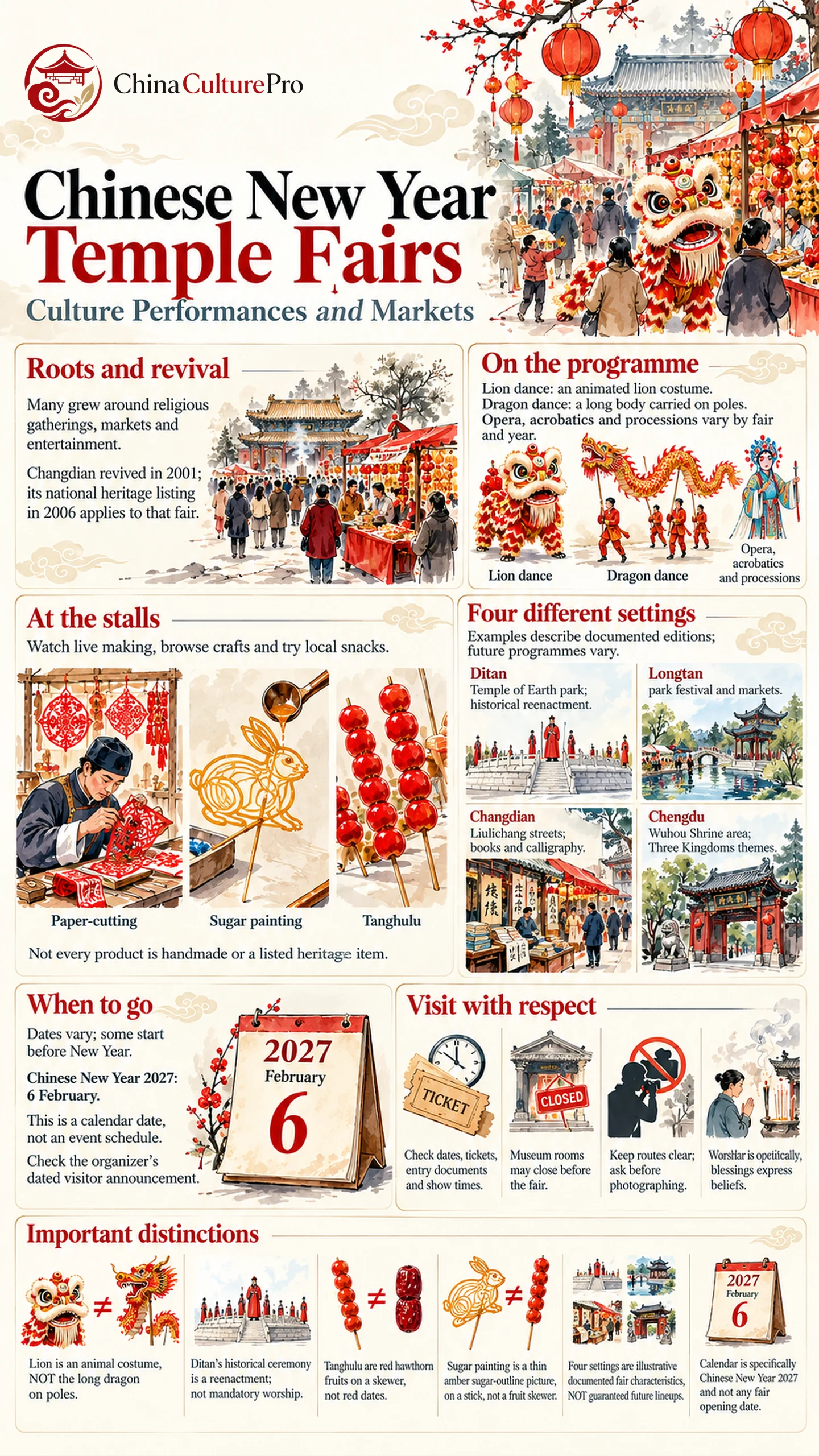
A lion dance (舞狮, wǔshī) animates a lion costume; a dragon dance (舞龙, wǔlóng) carries a long dragon body on poles. They are different performances, even when both appear in the same celebration.[11]
Other possibilities include yangge (秧歌, yāngge), a folk dance, stilt-walking, opera and acrobatics. Beijing’s 2026 programmes mixed such forms with robot performances and contemporary parades. The mix shows how contemporary programming can sit alongside folk arts.[4]
A performance may take place on a fixed stage or move along a procession route. Check its location and starting time: an admission ticket does not mean every show runs continuously or that every listed art form appears daily.
Craft Stalls and Live Demonstrations
Paper-cutting (剪纸, jiǎnzhǐ) creates designs by cutting paper; sugar painting (糖画, tánghuà) forms pictures from sugar. Calligraphy turns brush-written characters into an expressive art. Seasonal Beijing programmes have included live traditional-skill demonstrations and writing activities.[3][10]
Watching a maker work is different from browsing finished products. A demonstration may help you notice how a design takes shape, while a shop may sell reproductions or modern gifts alongside handmade pieces. Ask before photographing a maker closely, handling objects or joining a workshop.
Do not assume every craft stall represents a formally listed heritage project. Also distinguish a decorative display from an edible purchase: ask the vendor when the intended use is unclear.
Food Markets, Shopping and Games
Tanghulu (糖葫芦, tánghúlu), sugar-coated fruit skewers often made with hawthorns, is one recognizable Beijing example. A fair may also have regional snacks, packaged treats, cultural souvenirs and games. Beijing’s 2026 listings included themed tanghulu, food and cultural-product stalls, and interactive activities.[3]
Food choices vary with the fair and region. If you want the wider meal traditions, see Chinese New Year food.
Before buying, ask about ingredients if you have allergies or dietary restrictions. Check whether a displayed price covers the item, an activity or an additional purchase. Neither a traditional-looking stall nor a long queue guarantees suitability for your needs.
Representative Temple Fairs in Beijing and Beyond
These four examples show how the setting changes the experience. They compare Beijing fairs with one in Chengdu (成都, Chéngdū); they are not a national ranking. The programme examples below refer to documented editions, not promised 2027 lineups.
| Fair | Setting and cultural emphasis | What to check for your visit |
|---|---|---|
| Ditan Temple Fair (地坛庙会, Dìtán Miàohuì) | Ditan Park (地坛公园, Dìtán Gōngyuán), the Temple of Earth setting. The 2026 fair included historical earth-worship reenactment and stage performances.[4] | The reenactment timetable and viewing area; it is not a requirement to worship. |
| Longtan Temple Fair (龙潭庙会, Lóngtán Miàohuì) | Longtan Park (龙潭公园, Lóngtán Gōngyuán). Its 2026 edition combined folk culture, contemporary interactive features and market stalls.[3] | The programme and layout of the park-based event; “temple fair” does not mean entry to a working temple. |
| Changdian Temple Fair | Liulichang (琉璃厂, Liúlíchǎng) streets and a tradition associated with books, calligraphy and cultural commerce.[2][3] | That year’s street footprint and activities; historic descriptions do not establish the current layout. |
| Chengdu Grand Temple Fair (成都大庙会, Chéngdū Dà Miàohuì) | Wuhou Shrine (武侯祠, Wǔhóu Cí) and associated areas. The 2026 edition used Three Kingdoms (三国, Sānguó) themes, lantern installations, theatre and local performances.[5] | Which museum and festival areas are included, plus separate daytime and evening schedules. |
Choose according to what you want to understand: historical ceremonial display, a park outing, a cultural street market or a themed museum setting. If a particular show or workshop matters to you, confirm it in the programme before choosing.
When Are Chinese New Year Temple Fairs Held?
There is no nationwide opening period. Some fairs begin before New Year’s Day, some cover only part of the holiday, and others continue toward the Lantern Festival (元宵节, yuánxiāojié). The Lantern Festival falls on the fifteenth day of the first lunar month, but it is not a compulsory closing date for every fair.
For a documented comparison, Beijing’s Ditan, Longtan and Changdian fairs ran on February 17–23 in 2026. Chengdu’s 2026 Grand Temple Fair ran from February 13 to March 3, starting before that year’s New Year’s Day.[3][6]
Chinese New Year in 2027 falls on February 6. This calendar date does not establish any fair’s opening dates, ticket release or performance schedule.[7]
As of October 18, 2026, official preparations for the 2027 Ditan and Longtan fairs were underway, and Wuhou Shrine had published procurement-related notices for its 2027 fair. These are planning documents, not complete visitor programmes.[8][9] Complete 2027 visitor schedules for the four examples were not located in this review. Check the organizer’s dated visitor announcement before making plans; do not reuse 2026 dates or prices.
Temple fairs also occur at other times of year. The name alone does not identify a Chinese New Year event.[1]
How to Visit a Temple Fair Respectfully
Check these details on the organizer’s official website or official account before leaving:
- Event identity: Confirm the full name, year, venue and entry gate. A park’s ordinary opening information may not describe its holiday fair.
- Access: Check the current ticket price, reservation requirement, accepted identity documents and any timed entry. If using a foreign passport, verify the applicable booking instructions.
- Programme: Check show locations and start times, workshop arrangements, last entry and closing times for individual areas.
- Comfort: Consider the weather, crowd notices, rest areas and accessible routes. Ask about arrangements that matter to your group rather than assuming every venue provides the same facilities.
Different hours within one venue can matter. During the 2026 Chengdu fair, the overall event continued into the evening, but the museum’s statue halls and exhibition rooms closed earlier. Festival admission did not keep those rooms open after closing time. That example explains why you should check both the fair notice and the museum notice; it is not a statement of 2027 hours.[6]
At the fair, follow staff directions and keep procession paths, stage boundaries and exits clear. Do not step over barriers for a photograph or handle offerings and ceremonial displays. Where photography is restricted, follow the local rule rather than copying other visitors.
If worship is taking place, observe quietly or ask staff where visitors may stand. You do not need to burn incense, donate or buy a blessing object simply to appreciate the cultural setting. Auspicious displays express wishes or beliefs; they do not guarantee wealth or a change in fortune.
FAQs About Chinese New Year Temple Fairs
Are Chinese New Year temple fairs religious?
Some retain religious observances, while others emphasize performances, markets and community entertainment. A historical ritual reenactment is also different from worship. Look at the particular venue and programme; you can generally enjoy the public fair without taking part in religious activities.
Do all temple fairs take place inside temples?
No. Longtan is a park-based example, and Changdian has a street-market setting. The term describes a festival tradition, not a guarantee about the building you will enter. Check the actual location instead of assuming the event includes a working temple.
Are temple fairs held only during Chinese New Year?
No. Other local fairs follow different seasonal or religious calendars. Chinese New Year temple fairs are one part of that wider tradition. To identify a Spring Festival event, check its full name and dates rather than relying on the words “temple fair.”
Do you need tickets for a temple fair?
It depends on the event, year and area you want to enter. Check whether admission is free or paid, whether booking is required and what the ticket includes. Do not assume a normal park ticket or museum pass covers a special fair.
Sources
[1] Beijing Municipal Culture and Tourism Bureau. Celebrating Spring Festival | Culture: Will the temple fair become a carnival of Spring Festival in Beijing?
[2] China Intangible Cultural Heritage Network. 厂甸庙会
[3] Beijing Municipal Government. Holiday Fun | Temple Fairs & Park Events You Can’t Miss
[4] Beijing Municipal Government. 地坛、龙潭、厂甸、宛平、丫髻山一地一特色 大年初一五大庙会齐开锣
[5] Chengdu Wuhou Shrine Museum. 武侯祠简讯2026.9期:策马三国跃新春 数字华彩耀蓉城
[6] Chengdu Wuhou Shrine Museum. 2026武侯祠成都大庙会参观公告
[7] Hong Kong Observatory. Gregorian-Lunar Calendar Conversion Table of 2027
[8] Beijing Dongcheng District Government. 副区长胡异峰主持召开庙会工作专题会
[9] Chengdu Wuhou Shrine Museum. 关于2027武侯祠成都大庙会机器人乐队演出项目采购需求书价格调查的公告
[10] Beijing Municipal Government. Must-Visits Before Spring Festival! Recommendations for Beijing’s Chinese New Year Fairs
[11] ChinaCulture.org. Lantern Festival—Time for Fun