
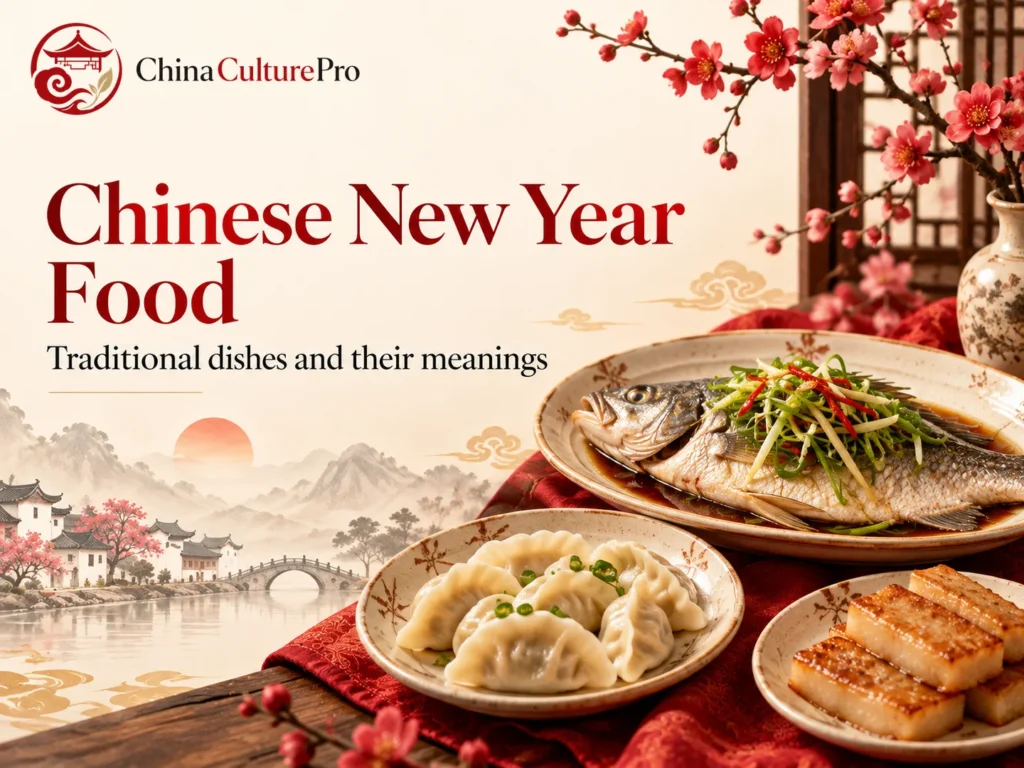

Quick Answer: What Foods Are Traditionally Eaten at Chinese New Year?
Traditional Chinese New Year foods often express wishes for abundance, progress, family unity and long life. Familiar examples fit four broad themes:
- Abundance: Fish (鱼, yú) suggests surplus through wordplay; dumplings (饺子, jiǎozi) resemble traditional ingots associated with wealth.
- Progress: Nian gao (年糕, niángāo), or New Year rice cake, carries a wish for improvement from one year to the next.
- Reunion: Tangyuan (汤圆, tāngyuán), round rice balls, and whole chicken (整鸡, zhěng jī) can express family togetherness and completeness.
- Long life: Longevity noodles (长寿面, chángshòumiàn) use the length of the strands to convey a wish for longevity.
These are cultural associations, not promises of wealth or health. Regional and family traditions determine the actual meal.
Chinese New Year food turns a shared meal into an occasion for family reunion and good wishes. Yet there is no single menu followed across China and its overseas communities. Knowing what a dish is, where it is eaten and how its meaning arises makes the table easier to understand.
Chinese New Year Foods at a Glance
This selection includes main dishes, staples, desserts and foods for visiting or sharing. The meanings are common associations, not definitions that apply to every serving. Chinese names and Mandarin pinyin help identify the foods even when a menu uses a regional name.
| Food | What it is | Associated wish | Typical context |
|---|---|---|---|
| Fish (鱼, yú) | Whole or cut fish dishes | Surplus and abundance | Many festive tables; preparation varies |
| Dumplings (饺子, jiǎozi) | Filled wheat-dough parcels | Wealth; shared family preparation | Especially prominent in northern China |
| Spring rolls (春卷, chūnjuǎn) | Thin wrappers around a filling, often fried | Wealth through a gold-bar resemblance | Festive snacks or meal dishes |
| Nian gao (年糕, niángāo) | Sweet or savory rice cakes | Progress and improvement | Regional forms across the festival season |
| Tangyuan (汤圆, tāngyuán) and yuanxiao (元宵, yuánxiāo) | Rice balls with different preparation methods | Reunion and completeness | Lantern Festival; other household occasions |
| Longevity noodles (长寿面, chángshòumiàn) | Long noodles, in broth or stir-fried | Long life | Birthdays and some New Year meals |
| Whole chicken (整鸡, zhěng jī) | A bird presented as a complete dish | Family completeness | Some festive main courses |
| Buddha’s delight (罗汉斋, luóhàn zhāi) | A vegetarian medley | Religious or family observance; good wishes | Some households and vegetarian meals |
| Citrus fruit (柑橘, gānjú), including kumquats (金橘, jīnjú) | Fruit for eating, giving or display | Luck and prosperity | Visiting, refreshments and seasonal displays |
| Eight-treasure rice (八宝饭, bābǎofàn) | Sweet rice with varied toppings or fillings | Abundance and a sweet year | Dessert on some southern tables |
| Turnip cake (萝卜糕, luóbo gāo) | Savory radish-and-rice cake | Favorable beginnings or progress | Cantonese and Taiwanese traditions differ |
| Poon choi (盆菜, péncài) | Separately prepared foods layered in a basin | Plenty and togetherness | Hong Kong and other Cantonese settings |
| Yusheng (鱼生, yúshēng) | A festive salad, often with sliced raw fish | Prosperity and shared celebration | Especially Singapore and Malaysia |
For symbols on packaging, table decorations or serving ware, the Chinese New Year symbols guide covers the visual side of the celebration.
The Reunion Dinner and the New Year Food Calendar
The reunion dinner (年夜饭, niányèfàn), also called 团圆饭 (tuányuánfàn), is the family meal associated with New Year’s Eve. Preparing food together, gathering relatives and sharing dishes are part of its significance, whether the meal takes place at home or elsewhere.[1]
Food traditions extend beyond that evening:
- New Year’s Eve: Families share a celebratory meal, drawing on familiar dishes and local preferences.
- New Year’s Day and later visits: Some households serve vegetarian food, rice cakes, dumplings or particular local specialties. Snacks and fruit welcome guests.
- The fifteenth day: The Lantern Festival is particularly associated with tangyuan and yuanxiao, although rice balls also appear on other occasions.[5]
A restaurant banquet, a home-cooked spread and a small gathering can all serve the reunion purpose. There is no national requirement to prepare a set number of dishes or eat every symbolic food. For the festival’s date and wider customs, see the Chinese New Year guide.
Fish and Whole Chicken: Abundance and Completeness
Fish carries one of the clearest food puns: 鱼 (yú) and 余 (yú), meaning “surplus,” are exact Mandarin homophones. The wish 年年有余 (niánnián yǒuyú) means “abundance year after year.” A fish dish gives that spoken blessing a place on the table.
Whole presentation can add another association: a complete fish suggests a good beginning and ending. Yet the dish need not always be a whole steamed fish. Shanghai-style smoked fish (熏鱼, xūnyú) is commonly made from fish pieces that are fried and soaked in a sweet-savory sauce. Despite its English name, this preparation does not depend on smoking.[2]
Whole chicken similarly appears as a symbol of family completeness, sometimes with the head and feet included.[3] Poaching, roasting and other preparations vary, and the cooked bird may be cut into serving pieces. Also, 鸡 (jī) and 吉 (jí), “auspicious,” have different Mandarin tones; calling them exact homophones is misleading.
The broader meaning of fish in Chinese culture also extends beyond eating it, including decorative pictures and other contexts.
Dumplings and Spring Rolls: Why Shape Suggests Wealth
Dumplings suggest wealth through their resemblance to boat-shaped gold or silver ingots. The curved parcel, rather than a requirement for one particular filling, carries this association. Making them together can be equally meaningful: relatives divide the work of preparing wrappers, filling and folding.
The New Year dumpling tradition is especially prominent in northern China.[1] Pork and cabbage or chives and egg are familiar fillings, while other versions suit different preferences. Boiling, steaming and pan-frying produce different textures. A northern wheat dumpling is also only one member of a much wider family of Chinese filled foods; it should not stand for every regional dumpling tradition.
Spring rolls offer a different visual comparison. Their golden, elongated form can resemble gold bars, making wealth a common festive association.[4] This is distinct from the ingot-shaped dumpling, even when both appear at one meal. Fillings and serving styles vary, so a symbolic description should not be mistaken for a fixed recipe. Neither dish requires a particular serving arrangement to express a family’s New Year wishes.
Rice Cakes, Rice Balls and Noodles: Three Different Wishes
Nian Gao: Sweet or Savory Wishes for Progress
The wordplay in nian gao centers on 糕 (gāo), “cake,” and 高 (gāo), “high.” It turns a rice cake into a wish for advancement or a better year. “Year high” explains the pun; “New Year rice cake” is the more useful food translation.
Nian gao is not one uniform dessert. Hong Kong-style versions are often sweet, while Shanghai cooking also uses sliced rice cakes in savory dishes, including soups or combinations with pork and vegetables.[2][10] The flour may be glutinous rice, regular rice or a combination, depending on the style.
When identifying it on a menu, ask whether it is a sweet steamed cake, a pan-fried slice or a savory rice-cake dish. The shared name does not tell you the flavor, ingredients or role in the meal.
Tangyuan and Yuanxiao: Reunion in Different Forms
Tangyuan and yuanxiao share a rounded appearance, but their usual preparation differs. Tangyuan are formed from a moist glutinous-rice-flour dough, often wrapped around a filling. Yuanxiao are typically built up by rolling pieces of filling in glutinous rice flour. Their surfaces and textures therefore differ.[5]
Tangyuan can be filled or unfilled, and versions may be sweet or savory. Their roundness makes reunion and completeness natural cultural associations. However, tāngyuán and 团圆 (tuányuán), “reunion,” are not exact Mandarin homophones.
The Lantern Festival is their best-known seasonal setting. Some families also serve rice balls on New Year’s Eve or at other gatherings. Calling them simply “soup dumplings” can cause confusion with wheat-wrapper dumplings filled with broth; “glutinous rice balls” identifies the food more clearly.
Longevity Noodles: A Wish Expressed Through Length
Long strands give longevity noodles their symbolic role: length stands for the wish for a long life.[3] The association belongs to the form and occasion, rather than one mandatory broth or topping. The noodles may be served in soup or as a stir-fried dish.
They are familiar at birthday celebrations and also appear at some New Year meals. Local calendars and family habits determine when they are served; New Year’s Day is not a nationwide noodle requirement.
Some diners prefer to keep the strands intact as part of the symbolism. That custom need not become a rule for every guest, and breaking a noodle does not determine anyone’s lifespan. Serving long noodles expresses the wish without requiring a difficult eating performance.
Vegetables and Vegetarian Dishes at Chinese New Year
Vegetarian food has a place at the festive table, rather than being an afterthought added to a meat-centered menu. Buddha’s delight can bring together mushrooms, wood ear fungus, bamboo shoots, bean-curd skin and greens. The combination changes with the cook and the family’s practice.
Some households observe a vegetarian meal on the first morning of the new year. A recorded example comes from Chung Uk Village in Hong Kong’s Tai Po area; it illustrates a local practice, not a rule for all Chinese families.[6]
Food taboos also depend on community. Singaporean Teochew traditions include pressed tofu as a festive food, which counters the blanket claim that all tofu must be avoided at New Year.[7]
For guests following a vegetarian or vegan diet, confirm the actual ingredients. A vegetable dish may use animal-based stock or sauce, and a vegetarian version of a familiar dish may need a deliberate substitution.
Citrus, Sweets and Eight-Treasure Rice
Citrus fruit, refreshments and desserts belong to different moments of the celebration. A bowl offered to visitors serves a different purpose from the sweet course at the end of dinner.
- Citrus and kumquats: Golden-orange fruit carries prosperity associations. Kumquat naming also has a Cantonese connection with gold and luck.[8] In Mandarin, 橘 (jú) and 吉 (jí) are not identical pronunciations: they have the same tone but different vowel sounds. Keep fruit intended for eating or gifting distinct from ornamental pots.
- Visiting sweets: Candies, seeds, cookies and other small foods welcome guests and create a sense of plenty. The selection follows local taste and family preference; there is no universal compartment count or required assortment.
Eight-treasure rice is a separate dessert: sweet glutinous rice combined with ingredients such as red dates, lotus seeds, longan and preserved fruit. The varied “treasures” suggest abundance and a sweet year.[2] Recipes differ, so the name should not be read as a requirement for one exact eight-ingredient list. It is also distinct from nian gao, despite both being rice-based festive foods.
Regional Tables: From Northern Dumplings to Yusheng
A north-versus-south comparison is a useful starting point, but it cannot explain every household. Region, dialect group and family tradition all shape the meal. These examples show different combinations rather than five prescribed menus.
| Region or community | Representative foods | What makes the setting distinctive |
|---|---|---|
| Northern China | Dumplings, wheat-based staples and family favorites | Shared preparation of filled wheat parcels can be central to the celebration |
| Jiangnan and Shanghai | Smoked fish, rice-cake dishes and sweet rice desserts | Familiar local preparations appear alongside auspicious names and family preferences |
| Guangdong and Hong Kong | Poon choi, festive cakes and preserved meats | A large shared basin or seasonal foods can bring several dishes together |
| Taiwan | Radish cakes and locally familiar festive dishes | Local-language associations matter alongside the food’s appearance |
| Singapore and Malaysia’s Chinese communities | Yusheng and dishes connected with different dialect groups | Communal celebration reflects local developments as well as inherited traditions |
Poon choi layers separately prepared foods in a communal basin, making abundance and sharing visible.[10] Turnip cake, despite its English name, commonly uses white radish. In Taiwan, the 菜头 (càitóu, a Mandarin reading) name is associated with 好彩头 (hǎo cǎitóu), “a favorable omen,” through Hokkien wordplay, rather than an exact Mandarin homophone.[9]
Yusheng names the salad; lo hei (捞起, lāoqǐ in Mandarin) is the familiar Cantonese name for the communal tossing practice. The celebration is associated with prosperity, but yúshēng is not a homophone of 风生水起 (fēngshēng shuǐqǐ). Modern versions developed within Southeast Asian Chinese communities, and some omit fish entirely.[11]
How to Choose Food for a Small Chinese New Year Celebration
Build the meal around the people attending, then choose foods whose meanings you want to share. A small spread can be festive without reproducing a banquet.
- Ask about preferences: Find out which family dishes matter to your guests and whether anyone needs vegetarian, vegan or other ingredient adjustments.
- Choose a balanced spread: Select a main, a staple, a vegetable dish and a dessert or fruit. They can express different wishes without requiring every symbolic food.
- Scale and simplify: Match the amount to the group and your preparation capacity. Keep a few dishes you can serve well, and explain one or two meanings during the meal.
One illustrative combination is steamed fish, pork-and-cabbage dumplings, mixed vegetables and eight-treasure rice. For a vegetarian gathering, replace the fish with a substantial mushroom-and-tofu dish and use suitable dumpling fillings. This is an adaptable example, not an official menu or a requirement to combine regional traditions.
FAQs About Chinese New Year Food
What Is the Most Traditional Chinese New Year Food?
Fish, dumplings and nian gao are widely recognized examples, but no single dish defines every family’s celebration. Regional staples and household traditions matter more than completing a supposedly universal list of lucky foods.
Why Is Fish Eaten at Chinese New Year?
Fish, 鱼 (yú), sounds exactly like 余 (yú), meaning surplus, in Mandarin. A fish dish therefore expresses the wish for abundance year after year. Its preparation and presentation vary by family and region.
Do All Chinese Families Eat Dumplings at New Year?
No. Dumplings are especially associated with northern Chinese traditions. Other families emphasize rice cakes, rice balls, local specialties or different shared dishes. Many foods cross regional boundaries, so this is a pattern rather than a strict division.
Are Tangyuan Eaten on New Year’s Eve or at the Lantern Festival?
Both can occur. Tangyuan and yuanxiao are particularly associated with the Lantern Festival on the fifteenth day of the first lunar month. Some families also serve rice balls on New Year’s Eve or other occasions.
Can a Chinese New Year Dinner Be Vegetarian?
Yes. A vegetarian New Year meal can include mushrooms, tofu, vegetables, suitable dumplings and rice-based dishes. Some households also observe vegetarian customs. Check fillings, stock and sauces rather than relying on the dish’s name alone.
Sources
[1] Timothy S. Y. Lam Museum of Anthropology, Wake Forest University. Chinese New Year Food
[2] Shanghai International Services. A taste of Shanghai: Traditional New Year foods and their hidden meanings
[3] PortCities Bristol. Food at Chinese New Year
[4] Wereldmuseum Rotterdam. How Chinese is Chinese food?
[5] Beijing Administration for Market Regulation. “元宵节”食用元宵(汤圆)消费提示
[6] Hong Kong Government. 行政長官與大埔村民共慶新年
[7] Singapore Chinese Cultural Centre. Traditional Chinese New Year dishes
[8] National Parks Board, Singapore. Citrus japonica cultivar
[9] Taiwan Historica. 蘿蔔糕 — 臺灣民俗文物辭典
[10] Hong Kong Tourism Board. Traditional Dishes to Eat During Chinese New Year
[11] Singapore Chinese Cultural Centre. Lohei