
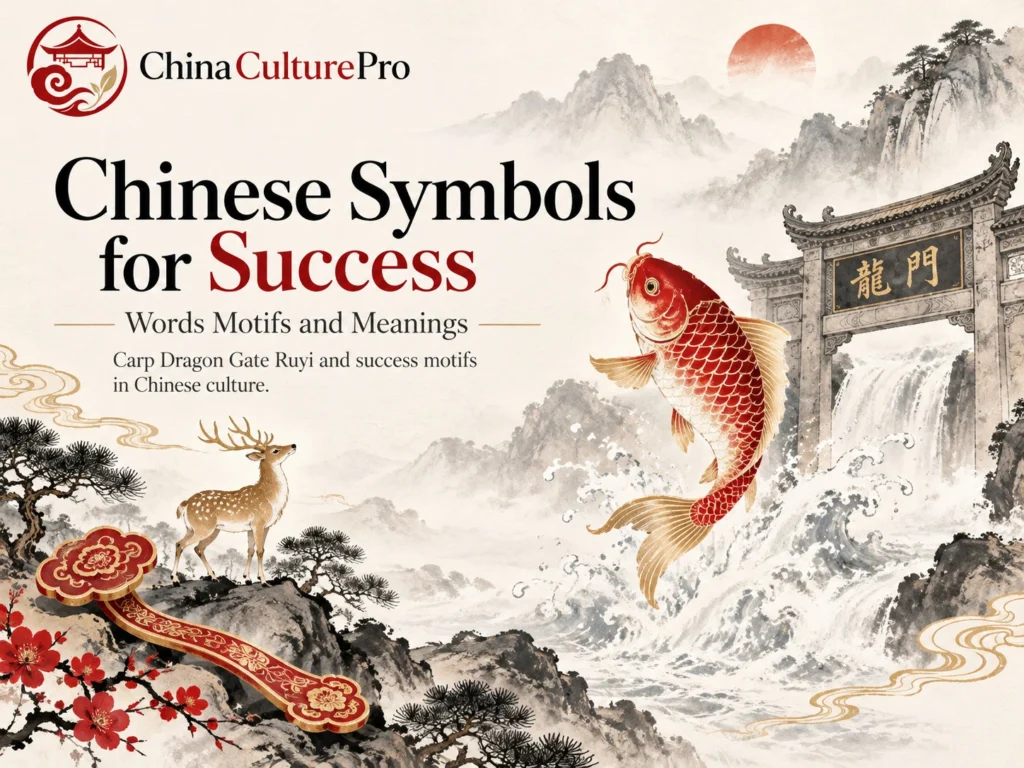

Quick Answer: What Are the Chinese Symbols for Success?
The Chinese word for success is Chenggong (成功, chénggōng), meaning achieving a goal. There is no single universal Chinese success emblem.[1]
- Direct wording: Calligraphy can express success, achievement or smooth progress without relying on a hidden pictorial meaning.
- Examination motifs: Carp leaping the Dragon Gate (鲤鱼跃龙门, lǐyú yuè lóngmén) represents transformation and overcoming a demanding threshold. Literary allusions and learning deities offer related examination wishes.
- Rank and promotion: Lu (禄/祿, lù), deer and composed animal motifs convey wishes connected with official status or advancement.
- General wish fulfillment: Ruyi (如意, rúyì) means “as you wish” and supports broader hopes for things to turn out well.[2]
These are traditional wishes and cultural symbols. They have no demonstrated ability to guarantee exam results, promotion or career success.
Choosing a Chinese success symbol starts with the occasion: passing an examination, earning a promotion, completing a project or pursuing a new ambition. The right wording or image depends on which achievement you want to celebrate or encourage.
Chinese Success Symbols at a Glance
These ten groups are an editorial selection, not an official “top ten” system. Use the recognition clues to identify a possible meaning, then check the title, inscription and surrounding imagery before deciding what a particular object conveys.
| Symbol or motif | Recognition clues | Success association | Interpretation limit |
|---|---|---|---|
| Chenggong | Two-character calligraphy or seal | Achieving a goal | Ordinary wording; no inherent religious meaning |
| Carp leaping the Dragon Gate | Leaping carp, waves or fish-dragon hybrid | Exams; major breakthrough | A plain carp need not invoke this legend |
| Plucking a gui branch (折桂, zhéguì); osmanthus (桂花, guìhuā) | Branch, blossoms, moon or scholar | Literary and examination honors | Seasonal flower imagery alone is inconclusive |
| Yilu lianke (一路连科, yī lù lián kē) | Egret with lotus | Success through successive examinations | Single elements need supporting context |
| Erjia chuanlu (二甲传胪, èr jiǎ chuán lú) | Two crabs with reeds | Palace-examination distinction | “Second class” does not mean second overall |
| Lu; deer (鹿, lù) | Character or deer image | Official salary and status | Deer also appear in longevity imagery |
| Mashang fenghou (马上封侯, mǎ shàng fēng hóu) | Monkey on horseback; sometimes bees | Swift elevation to noble rank | A horse alone does not establish this rebus |
| Guanshang jiaguan (官上加官, guān shàng jiā guān) | Rooster with cockscomb flowers | Further promotion | Composition or wording establishes the pun |
| Ruyi | Curved scepter with cloudlike head | Wishes fulfilled | Broader than exam admission or promotion |
| Wenchang Dijun (文昌帝君, Wénchāng Dìjūn); Kui Xing (魁星, Kuíxīng) | Scholar-official deity; dynamic brush-bearing figure | Learning and examination devotion | Distinct figures within related religious traditions |
How Is Success Written in Chinese?
Success is written with two characters: 成功. Its simplified and traditional forms are identical. It can describe succeeding in an undertaking or the successful result itself; it does not specify whether the goal concerns study, employment or another part of life.[1]
| Word and pronunciation | Core meaning | Suitable wording context |
|---|---|---|
| Chenggong (成功, chénggōng) | Achieving an intended goal.[1] | A completed project or general success wish |
| Chengjiu (成就, chéngjiù) | Achievement or accomplishment; also to bring something about.[3] | Recognition of work already accomplished |
| Shengli (胜利/勝利, shènglì) | Victory over an opponent in competition or conflict.[4] | A sporting or competitive victory |
| Shunli (顺利/順利, shùnlì) | Proceeding or finishing without obstruction.[5] | A project, application or undertaking going smoothly |
The distinction is practical when commissioning an inscription. Chengjiu emphasizes accomplishment; Shunli emphasizes how an undertaking proceeds. Shengli introduces the idea of defeating an opponent, so it is usually a less natural choice for an ordinary graduation or promotion message.
The individual characters Cheng (成, chéng) and Gong (功, gōng) have meanings associated with completion and accomplishment, but neither is the full everyday word for success.[19][20] A decorative single character needs its own intended meaning. For lettering and script choices, explore Chinese character symbols.
Why Does the Carp Leaping the Dragon Gate Symbolize Success?
The Dragon Gate legend tells of a carp overcoming a formidable passage and becoming a dragon. The transformation made it an apt metaphor for a candidate moving from obscurity to examination recognition and the prospect of official standing.[6]
The story is a legend, not a historical account of animals changing species. Its cultural force lies in the leap: an ordinary creature crosses an exceptional threshold. In a modern graduation gift, that can express perseverance and a hoped-for breakthrough without claiming that modern examinations reproduce the imperial system.
A documented example is the Seattle Art Museum’s Plaque with winged carp-dragon, a nephrite carving dated to the 13th–14th century, accession 33.1274. Its fish-dragon form is connected with examination success; the motif does not require a literal architectural gate in every representation.[6]
Look for transformation, an identifiable Dragon Gate composition, a title or other contextual evidence. A fish in an ordinary pond scene is insufficient by itself. Fish (鱼, yú) also sounds like surplus (余, yú), supporting a different wish for abundance.[2]
The wider carp and koi symbolism guide helps distinguish these readings. The question is which story the artwork activates, rather than which meaning can be assigned to the animal in isolation.
Symbols of Examination Success: Flowers, Rebuses and Deities
Traditional examination wishes draw on literary allusions, picture-based wordplay and religious devotion. Their historical setting is the imperial examination system (科举, kējǔ): successful results opened routes toward office, but degree attainment and appointment were not interchangeable events. Modern exam greetings borrow the imagery without reproducing those institutions.
Osmanthus and Plucking a Gui Branch
Plucking a gui branch is a literary expression for examination success. Changong zhe gui (蟾宫折桂, chángōng zhé guì), “plucking gui in the moon palace,” links that honor with the legendary tree on the moon.[7]
In art, a branch, moon or scholar reaching for blossoms can activate the allusion. An inscription may establish it even when the scene is abbreviated. Conversely, a seasonal flower study need not be an examination wish simply because it depicts osmanthus.
Translate the historical gui cautiously: a literary reference to a moon tree does not, by itself, establish a modern botanical identification. For a contemporary graduation design, osmanthus symbolism offers a recognizable connection with scholarly honor when the accompanying words make the intended wish clear.
Egrets, Lotus and Crabs: Examination Rebuses
Yilu lianke expresses a wish for success through successive examinations. Egret (鹭, lù) sounds like road or way (路, lù), while lotus (莲, lián) sounds like continuous or successive (连, lián). Lotus does not sound like the final word for examinations; the established composition conveys the full phrase.[8]
The Qing green-jade Lotus roots and egret, accession 故00099970, combines the bird with lotus roots, flowers, pods and leaves. It is a concrete example of this examination and official-career wish.[8] Compare the broader meanings of lotus imagery before treating any lotus as an exam symbol.
Erjia chuanlu combines two crabs with reeds. Their shells suggest Jia (甲, jiǎ), the examination classification; reed (芦, lú) supplies the sound of Lu (胪, lú). In Qing usage, Chuanlu (传胪, chuán lú) specifically named the first candidate in the second class of palace-examination results, not the runner-up overall.[9]
The Qing white-jade Double crabs, accession 故00103767, holds reed flowers and seed heads in its claws. A Daoguang-period painted snuff bottle, accession 新00043777, uses the same crab-and-reed theme.[9][10] These objects show why identifying the combination matters more than labeling every crab a success symbol.
Wenchang and Kui Xing: Deities Associated with Learning
Wenchang Dijun is associated with literature, learning and examination hopes. He is often represented as a robed scholar-official. Kui Xing is a distinct figure associated with examination distinction, commonly shown in a dynamic pose with a brush and raised leg. Their worship can overlap; they are not interchangeable identities.[11][12]
A wooden Kui Xing, accession 2004.028.1050, belongs to the National Museum of Taiwan History. Its brush, raised-leg posture and fishlike Ao (鳌, áo) support the identification; its date is recorded as unknown.[12]
Color schemes and surviving attributes vary, so a brush alone is insufficient identification. These are devotional figures with religious backgrounds. Choosing one for a gift involves understanding that background, beyond selecting an attractive image of a scholar.
Official Rank and Promotion: Lu, Deer and Visual Puns
Examination honors, an official salary and a noble title were different achievements. Their symbols may serve modern career congratulations, but a corporate promotion is a contemporary adaptation of the historical wish.
Lu and Deer: Official Salary and Status
Lu refers to official salary and the benefits associated with rank. Deer shares its Mandarin pronunciation, allowing the animal to stand for this aspiration through a visual pun.[2] The fuller Lu symbol guide explains its place among traditional blessings.
Context remains essential. Deer also belong to longevity and immortal imagery; a deer beside a crane or in an otherworldly landscape may support a different reading.[2] Look for accompanying wording, figures or a documented decorative program before calling it a promotion symbol.
For a modern gift, explain the intended career wish in the card. That makes a historically specific image understandable without presenting every deer as a universal emblem of professional success.
A Monkey on a Horse and a Rooster with Cockscomb
Mashang fenghou wishes for swift elevation to noble rank. Monkey (猴, hóu) sounds like marquis (侯, hóu), while Mashang (马上, mǎ shàng) means both “on horseback” and “immediately.” A monkey mounted on a horse therefore creates a wordplay-based wish for rapid advancement.[13]
The 17th-century nephrite Horse and monkey, accession 50.145.123, demonstrates this combination. Some variants add a bee (蜂, fēng), sounding like enfeoff or confer a title (封, fēng), but the documented horse-and-monkey example needs no bee.[8][13] This is a specific rebus within the wider field of horse symbolism.
Guanshang jiaguan conveys further promotion through a rooster and cockscomb flowers. The comb or crest (冠, guān) sounds like official (官, guān), making the repeated comb forms a wish for rising rank.[14]
The combination, inscription or known artistic context establishes that reading. An isolated rooster or flower should not automatically receive it. These promotion wishes also differ from the general hopes for material abundance covered in Chinese symbols for wealth.
Chinese Success Phrases for Exams, Careers and New Projects
For a card or inscription, an explicit phrase can communicate the occasion more clearly than a small decorative image. These four choices emphasize different kinds of progress.
| Phrase and pronunciation | Natural English sense | Best-fit occasion |
|---|---|---|
| Ma dao cheng gong (马到成功, mǎ dào chéng gōng) | May you achieve success swiftly.[15] | A launch, competition or important undertaking |
| Jin bang ti ming (金榜题名, jīn bǎng tí míng) | May your name appear among the successful candidates.[16] | Entrance exams or qualification results |
| Bu bu gao sheng (步步高升, bù bù gāo shēng) | May you keep rising in rank.[17] | Promotion and career advancement |
| Da zhan hong tu (大展宏图, dà zhǎn hóng tú) | May you realize your grand ambitions.[18] | Starting a career, business or substantial new endeavor |
These are best-fit uses, not rigid bans on other occasions. Ma dao cheng gong is a broad wish for swift success, distinct from the noble-rank horse-and-monkey rebus. Jin bang ti ming concerns acceptance or examination recognition; it does not require finishing first. Bu bu gao sheng emphasizes advancement in position, while Da zhan hong tu looks toward ambitions rather than a single result.
How to Read a Success Motif in Chinese Art
Qi Baishi’s Rooster and coxcomb, dated 1947, is a hanging scroll in ink and color on paper, accession 2008.188.1. Read its promotion meaning through four layers of evidence.[14]
- Visible facts: The painting combines a rooster with cockscomb flowers. Its upper-right title is Jiaguan (加官, jiā guān), “promotion,” rather than the full four-character expression.[14]
- Contextual evidence: The paired comb imagery activates the Guanshang jiaguan wordplay; the written title strengthens that interpretation.
- Reasonable reading: The work conveys a wish for further advancement in rank, which can inform a modern career congratulations design.
- What remains unknown: This symbolism alone does not identify an original recipient, a particular promotion celebration or any effect on someone’s career.
The creation date is 1947; the accession number is an identifier, not the painting’s date. This method also applies to other symbolism in Chinese art: inspect the evidence before assigning a wish to an individual flower or animal.
How to Choose a Chinese Success Symbol for a Gift or Design
- Define the occasion: Decide whether the message concerns an exam, promotion, completed achievement or new undertaking. Write the intended wish in ordinary language first.
- Select the form: Choose clear wording, an identifiable artistic motif or a devotional figure whose religious background suits the recipient.
- Check the meaning: Verify the phrase or the full image combination. Confirm the homophones and explain any historical rank terminology in the accompanying message.
- Review the finished design: Have a competent Chinese reader check the actual lettering, character forms and orientation. For engraving or tattoos, inspect the final artwork for mirrored text and incomplete motifs.
For a broad “may things go as you wish” message, Ruyi symbolism may fit better than an examination rebus. To compare other intentions, use Chinese symbols by meaning.
FAQs About Chinese Symbols for Success
What Is the Chinese Character for Success?
The standard word is 成功, pronounced chénggōng. It contains two characters and is written identically in simplified and traditional Chinese. Neither individual character is the complete everyday equivalent of “success.”
Why Does a Carp Symbolize Success in Chinese Culture?
The Dragon Gate legend links a carp’s transformation into a dragon with overcoming a demanding threshold. A recognizable transformation scene, title or context supports that meaning; an ordinary carp image does not automatically do so.
Which Chinese Symbols Are Associated with Examination Success?
Common examples include the Dragon Gate carp, plucking a gui branch, egret-and-lotus designs and paired crabs with reeds. Wenchang Dijun and Kui Xing represent related devotional traditions rather than guaranteed routes to better results.
Does Lu Mean the Same Thing as Success?
Lu concerns official salary and status, whereas Chenggong means achieving a goal more generally. Their meanings overlap in some career wishes, but Lu does not cover every form of personal achievement.
Can Chinese Success Symbols Be Used in Tattoos?
Yes, as personal artistic expressions. Check the complete wording, character shapes, orientation and motif context before committing. Religious figures also require attention to their devotional meaning; a tattoo cannot guarantee exam success or professional advancement.
Sources
[1] Ministry of Education, Taiwan. Chenggong 成功
[2] Asian Art Museum. Hidden Meanings in Chinese Decorative Motifs
[3] Ministry of Education, Taiwan. Chengjiu 成就
[4] Ministry of Education, Taiwan. Shengli 勝利
[5] Ministry of Education, Taiwan. Shunli 順利
[6] Seattle Art Museum. Plaque with winged carp-dragon (33.1274)
[7] Ministry of Education, Taiwan. Changong zhe gui 蟾宮折桂
[8] Palace Museum. Green-jade lotus roots and egret (故00099970)
[9] Palace Museum. White-jade double crabs (故00103767)
[10] Palace Museum. Snuff bottle with an Erjia chuanlu design (新00043777)
[11] Taiwan Historica. Wenchang examination devotion
[12] National Museum of Taiwan History. Wooden Kui Xing (2004.028.1050)
[13] The Metropolitan Museum of Art. Horse and monkey (50.145.123)
[14] The Metropolitan Museum of Art. Qi Baishi, Rooster and coxcomb (2008.188.1)
[15] Ministry of Education, Taiwan. Ma dao cheng gong 馬到成功
[16] Ministry of Education, Taiwan. Jin bang ti ming 金榜題名
[17] Ministry of Education, Taiwan. Bu bu gao sheng 步步高陞
[18] Ministry of Education, Taiwan. Da zhan hong tu 大展宏圖
[19] Ministry of Education, Taiwan. Cheng 成
[20] Ministry of Education, Taiwan. Gong 功