
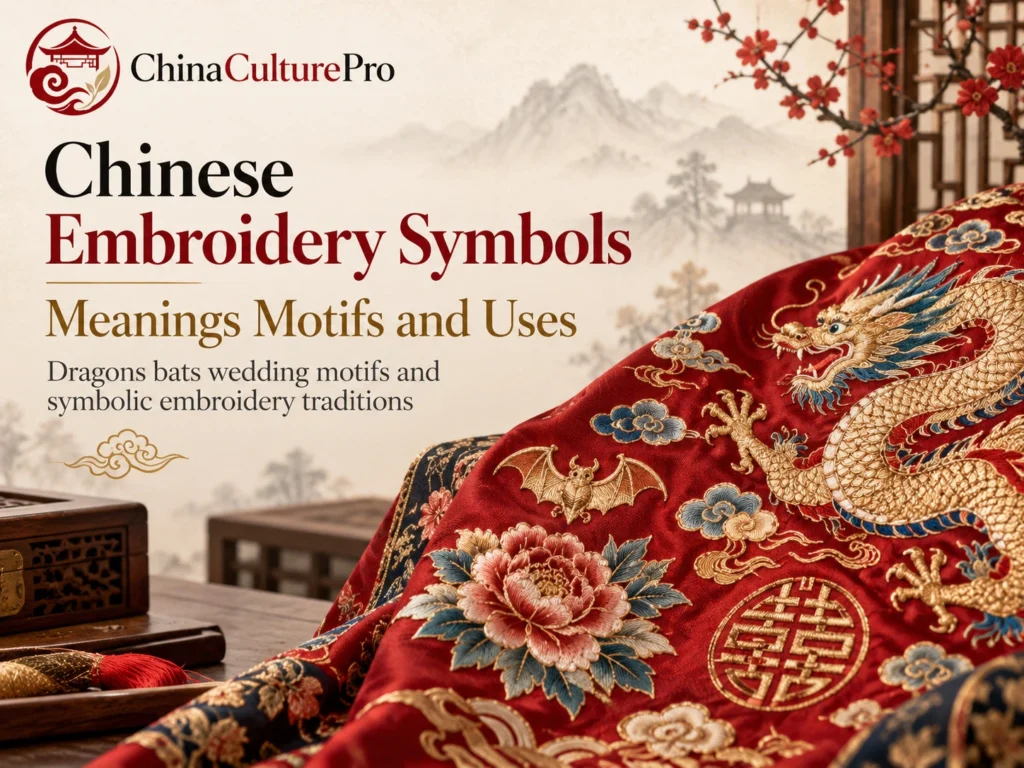

Quick Answer: What Do Chinese Embroidery Symbols Mean?
Chinese embroidery (刺绣, cìxiù) uses stitched images to express blessings, social rank, religious devotion, literary interests, and community identity. Some designs chiefly serve decoration. Their meaning depends on the object’s date, purpose, complete composition, and local tradition.
- Good wishes: Bats, peaches, and auspicious characters can convey blessings and longevity.
- Status: Prescribed animals on official dress identify rank.
- Religion: Sacred figures and emblem groups belong to particular devotional settings.
- Community: Locally meaningful designs can carry family hopes and cultural memory.
- Interpretation: Identify the textile before assigning meanings to its individual motifs.
These are cultural expressions and traditional beliefs, not evidence that embroidery can prevent harm or extend life.
A bird embroidered on a sleeve, official badge, or baby carrier can belong to three different systems of meaning. This guide helps you distinguish them through materials, imagery, and documented examples. The wider framework appears in our guide to Chinese patterns and motifs.
What Counts as Embroidery—and What Is Woven Instead?
Embroidery forms decoration by stitching threads into or onto an existing ground. The ground may be plain cloth or patterned fabric; its being woven does not make the decoration a mixed technique. Embroidery is the added needlework. [1]
Kesi (缂丝, kèsī) is tapestry weaving: colored weft threads build the design during weaving. Brocade (织锦, zhījǐn) also forms patterns on a loom, through a different woven construction. Neither should be classified as embroidery simply because its image resembles stitched work.
Genuine mixed decoration combines methods within the image. A Qianlong-period Guanyin hanging in the Palace Museum uses kesi for figures and clothing, embroidery for a scarf, and painted details. The added stitches are part of a larger woven picture. [2]
Check the catalogue’s medium field before interpreting craftsmanship. “Silk” names a material; “embroidery” and “tapestry” name how the design was made. A collection heading such as “textiles” may include all of them.
Common Chinese Embroidery Motifs at a Glance
Use these twelve groups as an identification index. Read each association with its condition; the same subject can appear in a natural scene, a blessing, or a prescribed insignia.
| Motif | Visual clue | Possible meaning | Context to check |
|---|---|---|---|
| Dragon (龙纹, lóngwén) | Long scaled body, claws, clouds | Authority or auspiciousness | Date and dress category matter; five claws do not identify an emperor. [3] |
| Phoenix (凤纹, fèngwén) | Elaborate tail and crest | Auspiciousness; court or marriage associations | Establish garment function before identifying a wearer. |
| Crane (鹤纹, hèwén) | Long neck, legs, pointed beak | Longevity; official rank | A birthday scene and official badge require different readings. |
| Bat (蝙蝠纹, biānfúwén) | Spread wings, compact body | Blessings through wordplay | Count the bats and inspect accompanying characters. [4] |
| Fish (鱼纹, yúwén) | Fins, scales, often water | Surplus through wordplay | A swimming fish can also be a naturalistic subject. [5] |
| Mandarin ducks (鸳鸯纹, yuānyāngwén) | Distinctive waterbirds, often paired | Partnership and marital harmony | Pairing and a suitable textile context support this reading. |
| Butterfly (蝴蝶纹, húdiéwén) | Paired wings, antennae | Love, seasonal beauty, or local beliefs | Marriage is one interpretation, not a universal code. [6] |
| Peony (牡丹纹, mǔdānwén) | Large layered blossom | Wealth, honor, distinction | “Wealth and honor” concerns social flourishing as well as money. [7] |
| Lotus (莲花纹, liánhuāwén) | Flower, broad leaves, seedpod | Buddhist purity or secular wishes | Companions and use distinguish devotion from other themes. |
| Peach / pomegranate (桃 / 石榴, táo / shíliu) | Pointed peach; crowned or opened pomegranate | Long life; descendants | Identify the fruit and theme; wishes are not predictions. [7][8] |
| Four Gentlemen (四君子, sì jūnzǐ) | Plum, orchid, bamboo, chrysanthemum | Cultivated character | A literary plant group rather than a generic luck emblem. [9] |
| Auspicious characters (吉祥文字, jíxiáng wénzì) | Decorative Chinese writing | Explicit wishes | Read the actual character; stylization may obscure it. |
The table names subjects, not stitch techniques. A dragon can be stitched in silk or outlined with metallic thread without becoming a different creature. Conversely, identical stitches can depict a court emblem or an ordinary flower. Keep those two kinds of identification separate.
For unclear animals, retain a broad identification until a record supports the species. A long-tailed bird is not automatically a phoenix, and every pale bird is not a crane. Missing leaves or a heavily stylized blossom can likewise make flower identification uncertain.
How Do Embroidered Images Acquire Meaning?
Homophones and Written Blessings
A visual rebus lets an image suggest a word through sound. The bat character 蝠, fú, sounds like Fu (福, fú), meaning blessings. Fish, 鱼, yú, sounds like 余, yú, meaning surplus. These associations help turn recognizable creatures into wishes. They do not prove that every depiction was intended as wordplay. [4][5]
Exact homophones differ from approximate associations, and both differ from symbolism based on a story. Checking the mechanism keeps a proposed reading testable: ask which word or narrative the image is meant to suggest.
Writing is more direct. Shou (寿, shòu) expresses longevity. Double Happiness (囍; 双喜, shuāngxǐ) combines two 喜 forms for marriage celebration; it is not the traditional-script form of 喜. On a wedding garment, the written wish can clarify otherwise ambiguous animal imagery. [10]
Natural Forms, Stories and Cultural Associations
Other meanings follow different paths. Pomegranate’s many seeds suggest descendants; peach imagery draws on immortality and longevity traditions. Their family-continuity and long-life associations need no identical-sounding word. [7][8]
Moral comparison offers another route: bamboo’s upright growth and hollow stem suggest integrity and humility. A stitched plant can therefore participate in literary culture rather than convey a prosperity wish. [9] Traditional descendant imagery reflects older family ideals; describing it does not impose a reproductive expectation on modern viewers.
How Do Embroidered Motifs Combine into Complete Wishes?
Five bats can represent the Five Blessings (五福, wǔfú), a named framework of life blessings. [4] Count the figures and check their arrangement before naming a combined wish.
| Named composition | Elements | Supported reading |
|---|---|---|
| Five Blessings Surrounding Longevity (五福捧寿, wǔfú pěngshòu) | Five bats around Shou or a longevity emblem | Blessings joined with long life; the surrounding arrangement matters. |
| Joy at the Eyebrows (喜上眉梢, xǐ shàng méishāo) | Magpie on plum branches | Joy expressed through the bird’s association and plum/eyebrow wordplay. |
| Mandarin Ducks Among Lotuses (鸳鸯戏莲, yuānyāng xì lián) | Paired ducks with lotus and water | Marital harmony in an appropriate wedding composition; further fertility meanings need evidence. |
Adding a central Shou joins the Five Blessings with longevity: an early eighteenth-century ceremonial robe at the Met, 43.119, uses this arrangement. [4] Magpie-plum and paired-waterbird interpretations are also documented on remounted embroidered sleeves. [6] Remounting can change apparent relationships, so inspect the original garment context when known. A panel assembled from two sleeves may visually join designs that once occupied separate arms. [6]
How Does the Embroidered Object Change the Meaning?
Court Robes and Rank Badges
A rank badge (补子, bǔzi) on Ming–Qing official dress uses prescribed creatures to identify office. Civil ranks generally use birds, military ranks animals. Badges belong on the front and back of the official surcoat; the rules must be matched to the period. [8]
The Met’s Qing silver-pheasant badge, 30.75.986, dates to the eighteenth–early nineteenth century. Its bird identifies the fifth civil rank. Here the species performs a formal status function, while the surrounding ornament and costly materials supply other visual layers. [11]
Dragon garments require the same attention to dress categories. Qing princes could wear five-clawed dragons on a mangpao (蟒袍, mǎngpáo), a category distinct from the imperial dragon robe. A Jiaqing-period child’s woven robe documents that exception. It establishes a dress distinction, not an embroidery technique. [3] The guide to symbolism in Chinese clothing explains how the whole outfit helps identify status.
Wedding Textiles and Children’s Accessories
Wedding textiles often combine paired creatures with written wishes. A Guangxu-period empress’s wedding jacket in the Palace Museum has dragon-phoenix and Double Happiness roundels on a dark blue ground. Its documented ceremonial use makes the marriage reading secure without requiring red cloth. [10]
Children’s accessories can connect practical care with family hopes. A decorated baby carrier supports a child while also displaying a maker’s labor and affection. Its community, original use, and surviving parts matter more than assigning every animal a protective power. [12]
Religious Hangings and Pictorial Embroidery
A devotional hanging is identified through sacred figures and documented use, not one lotus. The mixed-technique Guanyin image introduced above has a clearly Buddhist subject. By comparison, the Eight Auspicious Symbols (八吉祥, bā jíxiáng) occur on an eighteenth-century sutra cover at the Met, 2012.559—but that cover is kesi, not embroidery. Similar imagery crosses techniques. [2][13]
Pictorial embroidery can reproduce landscapes, flowers, poems, or stories. Silk can render painting-like outlines, shading, calligraphic inscriptions, and seals. [14] These features connect needlework to pictorial art: read the words and scene together before interpreting a hanging as devotional or auspicious.
Do Color, Gold Thread and Stitches Have Fixed Meanings?
No universal system makes a particular color, thread, or stitch mean one thing. They shape the image’s texture, brightness, and visual emphasis; symbolic interpretation depends on how the object used those qualities.
Red can strengthen a festive mood, but the dark blue imperial wedding jacket shows why color alone cannot identify an occasion. Its Double Happiness imagery and recorded use are stronger evidence. [10]
Couching (钉金绣, dìngjīnxiù) lays metallic thread on the surface and secures it with small stitches. On the silver-pheasant badge, this creates gleaming waves. The method explains how the shine was achieved; it does not supply a separate “gold energy” meaning. [11]
Flat stitches, knots, and changes in thread direction affect surface and shading. When comparing two versions of the same motif, ask what the needlework makes visible or emphasizes. Do not infer a different blessing solely because one version uses raised or reflective stitching.
Why Do Regional Styles and Community Traditions Matter?
The four famous regional traditions provide a useful geographic introduction:
- Su embroidery (苏绣, sūxiù): Associated with Jiangsu, especially Suzhou.
- Xiang embroidery (湘绣, xiāngxiù): Associated with Hunan.
- Yue embroidery (粤绣, yuèxiù): Associated with Guangdong.
- Shu embroidery (蜀绣, shǔxiù): Associated with Sichuan.
These names identify important craft traditions, not four separate symbol dictionaries or the full extent of Chinese embroidery. Regional labels alone do not establish what one flower means. [1]
Community traditions add another level. Among some Miao groups, embroidered carriers connect child care with family gifting; designs may refer to ancestral places or Butterfly Mother traditions. These interpretations require local evidence and cannot be transferred automatically to every carrier labelled “Miao.” [12]
A useful record identifies the community and locality, not just a province. Traditions can also borrow and change through contact. A design should not be treated as culturally isolated simply because a museum classifies it under one community name. For a contemporary adaptation, identify the particular textile that inspired it rather than claiming to represent an entire people.
Two Worked Examples: A Longevity Panel and a Miao Baby Carrier
A Dated Qing Panel with Cranes and an Embroidered Poem
The Met’s Panel with cranes over an immortal land, 1977.264.5, is Qianlong-period silk embroidery on silk satin, catalogued as dated 1777. Its Chinese subject is Adding Tallies to the Sea House (海屋添筹, hǎiwū tiānchóu). [15]
- Visible facts: Two cranes carry sticks above a landscape; a pavilion holds a vase containing more sticks. An embroidered poem occupies the right side.
- Evidence: The scene invokes a longevity legend involving tallies of immense age. The poem describes the immortal setting and bears the date 1777.
- Supported reading: Image and poem together make this a suitable birthday-gift subject, expressing long-life wishes.
- Limits: The subject does not identify a recipient or exact birthday. Niu Yizu supplied the calligraphic script used for the embroidery; this does not identify him as the stitcher.
The poem provides a second line of evidence: it narrows the reading from a general crane scene to an immortal landscape and long-life theme. Its dated text is more informative than assuming that two birds necessarily express partnership. [15]
A Miao Baby Carrier with Birds, Butterflies and Fruit
The Lanmama Museum’s Miao baby carrier, collection number 46, is dated to the Republic of China period. Its record is accessible through the University of Hong Kong’s Gifts from Lanmama digital exhibition. [16]
- Visible facts: Red embroidered squares contrast with a black ground. Flat stitching depicts birds, butterflies, flowers, and fruit, including pomegranate and lotus.
- Evidence: The object is a Guizhou Miao carrying textile. Its catalogue connects the nature imagery and labor of making with maternal love and hopes for a child.
- Supported reading: The carrier combines practical child care, skilled work, and family expression within a local tradition.
- Limits: Its butterflies should not automatically be assigned a wedding meaning or identified as Butterfly Mother without further object-specific evidence.
The catalogue identifies motifs individually, but it does not supply a full translation of every detail. That gap should remain visible: maternal hopes are supported, while a precise sentence assembled from each flower and insect would require additional evidence. [16]
How to Interpret Chinese Embroidery Without Overreading It
Use this sequence for a textile or design reference:
- Establish the object: Record its approximate date, locality, community, condition, and documented purpose. Note whether it survives intact or as a fragment.
- Identify the technique: Check whether the design is stitched, woven, painted, or mixed. Use the catalogue’s medium description rather than surface appearance alone.
- Map the composition: Inspect the main field, borders, inscriptions, and all available sides. Count repeated elements and note missing sections or remounting.
- Match the use: Decide whether rank, marriage, child care, devotion, literary expression, or decoration provides the strongest context.
- Check the interpretation: Compare an authoritative object record and relevant community knowledge. Separate observable facts from traditional associations and your own inference.
For a modern design, retain the source context and explain your adaptation. An incomplete photograph should lead to a provisional description rather than a completed blessing invented from expectation.
Common Misreadings of Chinese Embroidery Symbols
- Every embroidery seeks luck: Designs also identify office, depict stories, or celebrate craft.
- Every motif has one translation: An object’s function and local tradition change the reading.
- A dragon proves an imperial owner: Claws alone cannot establish the wearer.
- Paired birds or butterflies always mean marriage: Species, companions, and community evidence matter.
- Red and gold prove royal status: Materials and colors also occur outside court contexts.
- Kesi is another stitch: Its image is woven; embroidery adds needlework to a ground.
Avoid replacing an unsupported claim with its opposite. An uncertain interpretation is not evidence that a design has no meaning.
FAQs About Chinese Embroidery Symbols
Does a Dragon in Chinese Embroidery Always Mean the Emperor?
No. Establish the period, garment category, and dress rules. Even five-clawed dragons could appear on Qing princes’ robes. A dragon image alone cannot identify an emperor or prove imperial ownership.
What Do Bats and Peaches Mean in Chinese Embroidery?
In auspicious compositions, bats suggest blessings and peaches longevity. Five bats add the Five Blessings theme. The more specific “surrounding longevity” design also requires their relationship to a central longevity emblem.
Do Paired Birds or Butterflies Always Mean Marriage?
No. Partnership is a familiar reading in some textiles, but other designs concern natural beauty, stories, or community beliefs. Identify the species and object’s context before interpreting the pair.
Is Chinese Embroidery Always Made with Silk?
No. Embroidery can use different grounds and threads, including cotton alongside silk and metallic elements. Museum records of Miao carriers document cotton-and-silk examples. [12]
Can Chinese Embroidery Motifs Be Used in Modern Designs?
Yes. Check the source and intended meaning, preserve important relationships, and acknowledge the adaptation. Religious and community-specific imagery needs particular care; a modern design need not inherit every historical association.
Sources
[1] ChinaCulture.org. Chinese Embroidery
[2] Palace Museum. 缂丝加绣观音像轴
[3] Palace Museum. 杏黄色缂丝彩云蝠八宝金龙纹小男夹蟒袍
[4] The Metropolitan Museum of Art. Woman’s ceremonial robe
[5] Hong Kong Palace Museum. Reinventing Traditional Patterns
[6] Auckland Museum. The language of Chinese embroidery
[7] SFO Museum, with the Asian Art Museum of San Francisco. Hidden Meanings — Gallery
[8] Cornell University Library. Symbolic Motifs
[9] Ashmolean Museum. The Four Gentlemen
[10] Palace Museum. 石青色绸绣八团龙凤双喜棉褂
[11] The Metropolitan Museum of Art. Rank Badge with Silver Pheasant
[12] Bowers Museum. Baby Back Cribs: Embroidered Carriers of the Miao
[13] The Metropolitan Museum of Art. Sutra Cover with Eight Buddhist Treasures
[14] The Metropolitan Museum of Art. Painting with Threads
[15] The Metropolitan Museum of Art. Panel with cranes over an immortal land
[16] Lanmama Museum Collection / University of Hong Kong Libraries. 苗族背带 The Miao Baby Carrying Belt