
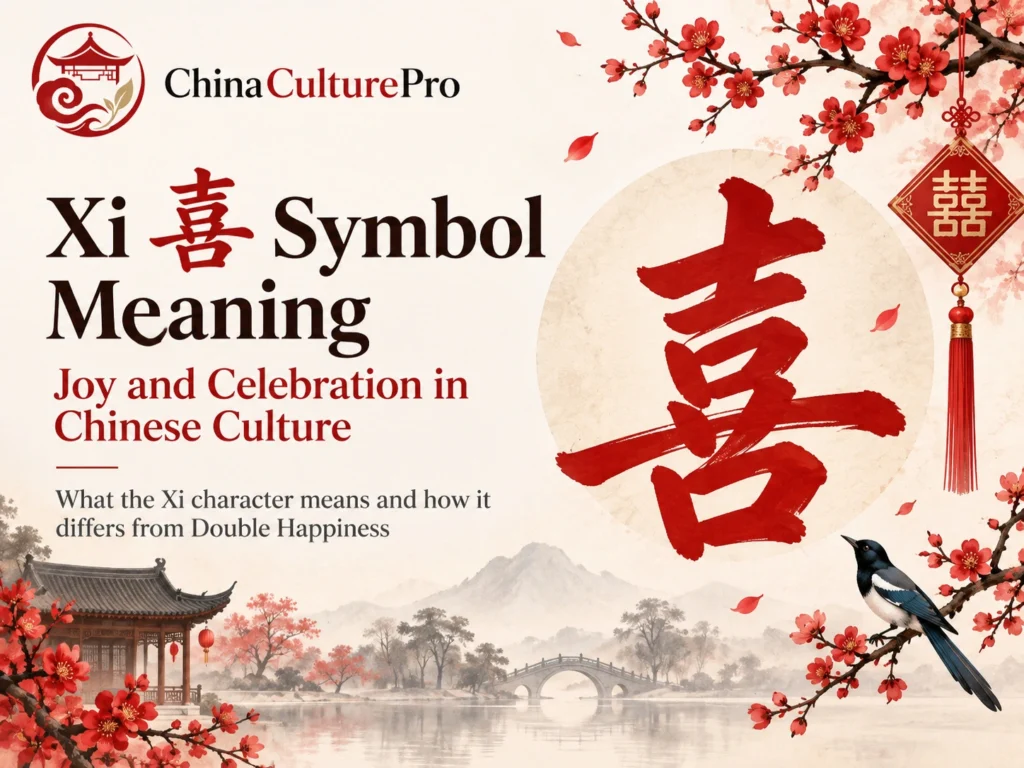

Quick Answer: What Does the Xi Symbol Mean?
Xi (喜, xǐ) is the Chinese character for joy, gladness, and events worthy of celebration. Displayed alone in calligraphy, festive decoration, or decorative art, it becomes a visible emblem of joy and celebration.[1]
- Pronunciation: Xǐ, with the third tone.
- Core meanings: Joy, a happy occasion, and a festive atmosphere.
- Common settings: Calligraphy, gifts, ceramics, textiles, festival decorations, and wedding objects.
- Character form: 喜 has the same standard form in simplified and traditional Chinese.
- Important distinction: 喜 is a general character; Double Happiness (囍, shuāngxǐ) is a wedding-focused ligature.
The character expresses a cultural wish. It does not guarantee luck, attract romance, or cause a happy event.
Chinese decorative art often turns ordinary words into visual emblems. 喜 remains part of normal written Chinese, yet it can stand alone on an object to communicate celebration. This distinction is useful when reading the broader system of Chinese symbols and meanings. Context controls the translation: on a wedding object it may refer to marital joy, while in ordinary language it can describe pleasure, preference, good news, or another occasion for congratulations.
A standalone display is therefore still readable language, not a separate magical mark. Inside a sentence, the same form may perform an ordinary grammatical job rather than act as a blessing or decoration.
What Does Xi Mean in Chinese?
The central idea of 喜 is positive emotion connected with something welcome or worth celebrating. Dictionaries record it as a verb for feeling pleased, a noun for a happy or auspicious event, and an adjective in expressions connected with happiness or marriage.[1]
| Term | Best English direction | Main distinction |
|---|---|---|
| 喜 (xǐ) | joy; celebration; happy occasion | Gladness or something worth celebrating |
| 福 (fú) | blessing; good fortune | Broader wellbeing and favorable circumstances |
| 乐/樂 (lè) | pleasure; joy; music | Enjoyment; can also mean music |
| 幸福 (xìngfú) | happiness; wellbeing | A more complete or lasting state of life |
| 吉 (jí) | auspicious; favorable | Favorable significance without necessary emotion |
No single English word works everywhere. “Joy” is usually the cleanest gloss for the emotion; “celebration” or “happy occasion” is better on festive objects. “Happiness” may sound more lasting and psychological than 喜 itself.
喜 also has ordinary grammatical uses. In 喜欢 (xǐhuan), it contributes to the verb “to like.” 有喜 (yǒuxǐ) is a traditional euphemism for pregnancy. Neither is the default message of a standalone decorative 喜.
How Is the Character Xi Formed and Written?
喜 is a standard twelve-stroke Chinese character, not a pictorial charm invented for celebrations. The traditional analysis recorded in the Shuowen tradition describes it as “from 壴 and from 口” (从壴,从口). This identifies the received graphic components; it should not be expanded into a certain historical scene without stronger evidence.[2]
The standard character is written 喜 in both simplified and traditional Chinese. Seal, clerical, regular, running, or cursive script can change its appearance but not its basic meaning. A stylized version should remain recognizable.
Because the two modern writing systems share this form, choosing between “simplified 喜” and “traditional 喜” is unnecessary. The real design choice is usually the typeface or calligraphic script, not a different standard character.
For tattoos, logos, and jewelry, script is a design choice rather than a scale of authenticity. An archaic-looking or difficult-to-read form is not automatically more auspicious.
What Is the Difference Between 喜 and 囍?
The Double Happiness ligature joins two 喜 forms side by side. It is strongly associated with weddings and marital harmony. 喜 is a normal Chinese character with a much wider range of uses.
| Form | Type | Main message | Typical contexts | Key limit |
|---|---|---|---|---|
| 喜 | Standard character and decorative emblem | Joy, celebration, or a happy event | Ordinary writing, festivals, gifts, calligraphy, weddings | Not limited to marriage |
| 囍 | Decorative Double Happiness ligature | Marital joy and harmony | Invitations, wedding rooms, gifts, ceramics, wedding decorations | Usually not used as an ordinary sentence character |
A Qing-dynasty porcelain vase from the Daoguang period combines 囍 with bats and peaches; its description identifies the character as an allusion to marital harmony.[3] The object shows how Double Happiness works inside a larger auspicious design, but it does not make every 喜 character a wedding symbol.
The two forms are not simplified and traditional versions of one character, nor are they interchangeable font styles. Replacing one with the other changes the scope from general joy to a specifically marriage-centered convention.
Where and How Is the Xi Symbol Used?
喜 becomes a decorative emblem when enlarged, centered, written as calligraphy, repeated as a pattern, or placed on an object connected with celebration. The occasion, color, neighboring motifs, and object type determine the most likely reading.
Celebrations and Family Milestones
Weddings are the clearest setting for both 喜 and 囍, but 喜 also appears in broader festive language and congratulatory design. A new birth, family celebration, move, opening, or another welcome milestone may be described as a 喜事 (xǐshì), a happy event. This does not mean every occasion has a fixed custom of displaying a standalone 喜.
Red is the most familiar festive presentation because the color has its own celebratory associations. It is a visual pairing, not part of the character’s dictionary meaning. Black-ink calligraphy, gold lettering, and other palettes can carry the same word. See red in Chinese culture for the color’s separate role.
There is no nationwide rule governing the number, direction, color, or placement of a general 喜 decoration.
Art, Gifts and Permanent Designs
On ceramics, textiles, paintings, cards, jewelry, red envelopes, and modern branding, 喜 can make joy or celebration the central message. Historical objects should be read with their surrounding imagery.
A repeated 喜 pattern may work as word-based ornament, while bats, peaches, flowers, or other nearby motifs contribute separate wishes. The whole composition matters more than the character in isolation.
For a permanent or public design, use four checks:
- Verify the form: Confirm that it is 喜 rather than 囍, a mirrored form, or an invented pseudo-character.
- Match the context: Use 喜 for broad joy; consider 囍 for a specifically wedding-centered message.
- Check the script: Ask a fluent reader or calligrapher to review highly cursive or seal-script forms.
- Describe modern choices honestly: A new stylization can be culturally informed without being presented as an ancient fixed design.
How Does Xi Appear in Magpie and Rebus Imagery?
The Chinese word for magpie (喜鹊, xǐquè) begins with 喜, helping the bird carry associations with joyful news. In decorative art, it can therefore express joy without displaying the written character.
A classic rebus is “joy reaches the brows” (喜上眉梢, xǐ shàng méi shāo). A magpie supplies joy, while a flowering plum evokes the sound of “brow”: 梅 (méi, plum) and 眉 (méi, eyebrow) are homophones. A Qing woodblock print pairing magpies with prunus is catalogued with both joyful and marital readings.[4]
The image is not a universal code. A naturalistic bird-and-flower painting may simply portray wildlife, and paired magpies do not automatically mean marriage. Position, title, occasion, and companion motifs must support the rebus. See magpie symbolism in Chinese culture for the broader range of readings.
When the plum branch, perched bird, and an auspicious title appear together, the rebus is much more secure than when a magpie appears alone in a landscape.
Common Misreadings of the Xi Symbol
| Common claim | More accurate interpretation |
|---|---|
| 喜 is only a wedding symbol | It is a general character for joy and happy occasions. |
| 喜 and 囍 are alternate spellings | 喜 is a standard character; 囍 is a doubled wedding ligature. |
| 喜 always means happiness or good luck | “Joy,” “celebration,” or “happy occasion” is often more precise. |
| 喜 directly means love | Love is not its literal core meaning, though it appears in wedding settings. |
| 喜 must be red | Red is a conventional presentation, not part of the word’s meaning. |
| Traditional 喜 is more authentic than simplified 喜 | The standard character is the same in both systems. |
| Any magpie picture means joy | The reading depends on composition, title, and companion motifs. |
| Displaying 喜 causes good fortune | It expresses a wish; it does not guarantee an outcome. |
FAQs About the Xi Symbol
Does Xi Mean Happiness, Joy or Good Luck?
“Joy” is usually the closest short translation. On a festive object, “celebration” or “happy occasion” may be better. “Happiness” is broader and more lasting, while “good luck” describes fortune rather than the character’s central emotion.
Is 喜 the Same as 囍?
No. 喜 is a standard character used for joy and many kinds of celebration. 囍 joins two 喜 forms into Double Happiness, a decorative ligature used mainly for weddings and marital harmony.
Is 喜 the Same in Simplified and Traditional Chinese?
Yes. The standard form is 喜 in both systems. Typefaces and calligraphic scripts may look different, but they do not create separate simplified and traditional characters.
Can Xi Be Used Outside Weddings?
Yes. 喜 can describe joy, good news, festivals, and events worthy of congratulations. Whether the standalone character suits a decoration depends on the object and occasion; 囍 has a much narrower wedding focus.
Sources
[1] Taiwan Ministry of Education. 喜 — Revised Mandarin Chinese Dictionary
[2] Taiwan Ministry of Education. 喜 — Dictionary of Chinese Character Variants
[3] The Metropolitan Museum of Art. Vase decorated with bats and peaches amid scrolling floral vines and “double happiness” character
[4] The British Museum. Magpies and Prunus (喜上眉梢)