
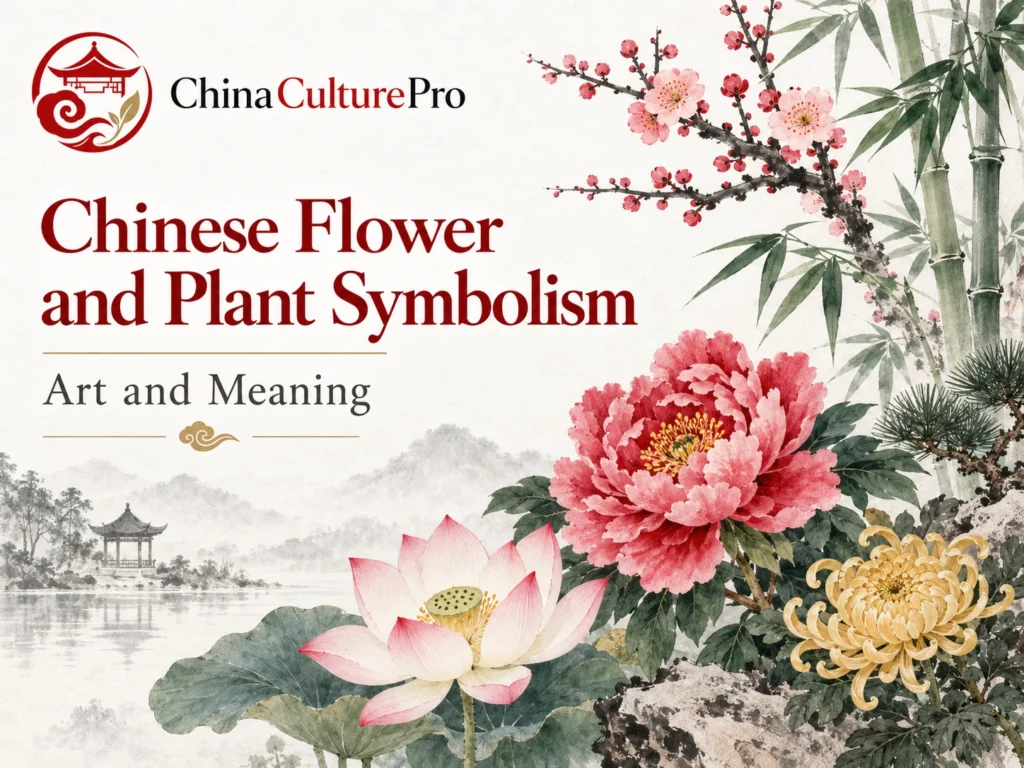

Quick Answer: What Do Flowers and Plants Symbolize in Chinese Culture?
Chinese flowers and plants can express seasonal change, moral character, religious ideals, social status, family wishes, or simply delight in nature. There is no universal plant dictionary, and one species may belong to several systems at once.
- Plum, orchid, bamboo, chrysanthemum, and pine often support the noble-person ideal, 君子 (jūnzǐ, noble person), in literati art.
- Peach blossom, willow, osmanthus, chrysanthemum, and plum can mark seasons, festivals, parting, return, or renewal.
- The lotus can convey Buddhist purity or the ethical uprightness praised in Song literature.
- Pomegranate, persimmon, Buddha’s hand citron, and lotus-fish designs can form auspicious wishes through shape or pictorial wordplay.
- Peony can suggest courtly splendor, rank, and prosperity in appropriate decorative settings.
These are interpretive starting points, not automatic definitions. A painting made for scholarly self-expression, a Buddhist sculpture, a wedding textile, and a porcelain birthday gift use different visual languages. Their positive meanings are cultural metaphors and traditional wishes, not mechanisms for wealth, fertility, longevity, romance, or luck.
The same plant can carry sharply different meanings in Chinese art. A lotus beneath a Buddhist figure can evoke purity and spiritual transcendence, while lotus and fish on a late imperial dish may form a rebus for continuous surplus. One image belongs to religious iconography; the other to secular auspicious decoration. Neither meaning comes from the plant alone.
That contrast is the central rule of Chinese flower and plant symbolism: context comes first. Date, medium, inscription, accompanying motifs, and intended use determine what an image can reasonably mean. This guide explains the system and helps you move from a visual clue to a defensible interpretation without reducing every flower to a one-word label.
How Chinese Flower and Plant Symbolism Works
Chinese plant meanings are produced by several overlapping mechanisms. The first task is to identify which one controls the object in front of you.
| Meaning mechanism | How it works | Typical example | Interpretive limit |
|---|---|---|---|
| Natural observation | Growth habit, season, fragrance, resilience, or evergreen foliage becomes a metaphor | Plum flowering in cold weather suggests endurance | A natural trait does not create a fortune-telling rule |
| Classical text or allusion | A poem, essay, historical figure, or story fixes a literary association | Tao Yuanming links chrysanthemum with reclusion | The allusion needs textual or visual context |
| Moral analogy | Scholars compare plant qualities with cultivated character | Bamboo’s straight joints suggest integrity | Common in literati art, not every bamboo object |
| Religious iconography | Doctrine and ritual define the plant’s role | A Buddhist lotus supports purity and transcendence | Religious meaning is not a secular wealth wish |
| Rebus or pictorial wordplay | Sound, near-sound, number, and image combine into a phrase | Lotus 莲 (lián) evokes 连 (lián), “continuous,” beside fish 鱼 (yú), echoing 余 (yú), “surplus” | The complete combination matters; one element cannot carry the whole phrase |
| Court or festival use | Occasion, patron, and function narrow the image | A peony on courtly decorative art can signal rank and splendor | Occasion-specific meaning is not universal |
Pictorial wordplay became especially productive in later decorative art. The Metropolitan Museum of Art’s study of rebus painting shows how recognizable images could function like words, sometimes through sound and sometimes through established association.[1] Yet wordplay is only one layer. A naturalistic painting may deliberately avoid it, while a single object can combine a rebus with seasonal or moral references.
How Plant Symbolism Changed Across Chinese History
Early Texts, Ritual Use, and Seasonal Observation
Early Chinese texts use plants in many ways: as offerings and materials, as signs of the seasons, and as images that begin a poem or frame a human relationship. The peaches in the Book of Songs can help shape a marriage scene; willow may accompany departure; fragrant plants can distinguish refinement from corruption. These are contextual poetic uses, not evidence for a complete early “flower language.”
Early ritual and archaeological objects also require restraint. A leaf, seed, or blossom may identify a material, season, place, or decorative preference without standing for later ideas such as wealth, longevity, or many sons. If an excavated object lacks an inscription or a secure motif tradition, “plant decoration” may be the most accurate conclusion.
Literati Painting and Moral Character
By the Song and Yuan periods, bird-and-flower painting, 花鸟画 (huāniǎohuà), ranged from close observation to highly personal ink expression. Scholars increasingly treated selected plants as companions, ethical models, or vehicles for self-portraiture. A bent pine could register endurance; orchid growing away from court could suggest unadvertised worth; bamboo could visualize restraint, flexibility, and principled conduct.
The lotus gained an influential ethical reading in Zhou Dunyi’s “On the Love of the Lotus.” Zhou calls chrysanthemum the recluse among flowers, peony the flower of wealth and rank, and lotus the gentleman among flowers—not the recluse. The comparison praises a person who can emerge from a compromised world without becoming morally stained.[4] This literary scheme should not be imposed on every lotus, peony, or chrysanthemum image, but it became an important resource for educated viewers.
Ming-Qing Auspicious and Decorative Art
Ming and Qing decoration expanded the use of rebuses and compound auspicious images across porcelain, lacquer, jade, textiles, furniture, and popular prints. Plants that already carried seasonal or moral associations could acquire additional wishes for blessing, longevity, descendants, examination success, or domestic abundance.
This did not erase older meanings. Literati ink painting, religious art, naturalistic studies, court commissions, and popular decoration continued side by side. The result is a layered system rather than a linear replacement: a Qing chrysanthemum might evoke Tao Yuanming in a scholar’s painting, autumn on a seasonal album leaf, or healthy aging on a birthday object. Medium and use decide which reading leads.
Major Chinese Flower Symbols at a Glance
This is a navigation guide rather than a substitute for the individual plant histories. The companion page on Chinese flower symbols will compare flowers in greater species-level detail.
| Flower | Contextual associations | Main source of meaning | Do not assume |
|---|---|---|---|
| Lotus, 莲花 (liánhuā) | Buddhist purity and transcendence; upright character in Zhou Dunyi; continuous surplus in a lotus-fish rebus | Religion, literature, wordplay | Every lotus means money, fertility, or Buddhism. Smithsonian’s lotus record specifically locates purity and spiritual transcendence in Buddhist tradition.[2] |
| Peony, 牡丹 (mǔdān) | Courtly splendor, wealth and rank, flourishing prosperity | Tang court taste and later decorative culture | A peony guarantees personal riches. A Smithsonian record notes its Tang court prestige and titles such as “king of flowers.”[3] |
| Plum blossom, 梅花 (méihuā) | Courage in adversity, renewal, purity of character; one member of two scholar groupings | Winter flowering, literati ethics | Every plum is a New Year good-luck sign. Museum interpretation also connects plum with hope, transience, scholarhood, and reclusion.[5] |
| Orchid, 兰 (lán) | Unassuming fragrance, refinement, loyal or cultivated character | Classical poetry and literati moral analogy | A universal romance or wealth symbol |
| Chrysanthemum, 菊 (jú) | Autumn, reclusion, resilience, and in some later festive art, wishes for healthy aging | Seasonal life, Tao Yuanming, later decoration | Every white chrysanthemum is funerary, or every chrysanthemum means longevity |
| Osmanthus, 桂花 (guìhuā) | Autumn fragrance, Mid-Autumn settings, distinction or examination success in specific allusions | Season, 桂 (guì) / 贵 (guì) homophony, literary allusion | All osmanthus promises promotion or wealth |
| Narcissus, 水仙 (shuǐxiān) | Winter refinement and regional Lunar New Year freshness, especially in southeastern traditions | Flowering season and local festival use | A single national New Year meaning or strong supernatural luck |
| Magnolia, 玉兰 (yùlán) | Spring beauty, purity, and courtly elegance; part of larger compound rebuses | Form, season, garden and court taste | Magnolia alone means “a hall full of gold and jade”; that phrase normally depends on a fuller composition |
The table shows why one-label summaries fail. Even the best-known plants change role across religion, poetry, painting, and decoration. For example, a Smithsonian painting of peonies supports rank and status, while Zhou Dunyi uses the same flower critically as an emblem of worldly display.[3][4] Both readings are historical; the object tells you which is relevant.
Trees, Bamboo, Fruits, and Other Plant Symbols
Chinese plant symbolism extends well beyond flowers. Stems, evergreen trees, fruit, seeds, and fragrant citrus often carry meanings that blossoms cannot.
| Plant | Contextual associations | How the meaning forms | Important boundary |
|---|---|---|---|
| Bamboo, 竹 (zhú) | Integrity, resilience, restraint, humility, cultivated friendship | Straight growth, flexible stem, hollow center, segmented joints | Its main literati role is ethical, not fortune-bringing |
| Pine, 松 (sōng) | Endurance, constancy, longevity wishes, reclusion | Evergreen habit plus literary and birthday contexts | A landscape pine need not be a birthday symbol; pine beside chrysanthemum can invoke Tao Yuanming and reclusion.[6] |
| Willow, 柳 (liǔ) | Spring, parting, lingering attachment, return | Seasonal growth, gift customs, poetry, and near-sound association with 留 (liú), “to stay” | Not a general love or good-luck charm |
| Peach, 桃 (táo) | Blossom: spring and romance; fruit: longevity wishes; wood: protection in particular traditions | Different plant parts and separate textual or ritual systems | “Peach means longevity” is incomplete unless the fruit or relevant immortal context appears |
| Pomegranate, 石榴 (shíliu) | Numerous descendants and family continuity in later auspicious art | Many seeds, with seed 子 (zǐ) also meaning child or son in a rebus | A cultural family wish, not a promise of fertility. The Met documents this seed/son visual pun.[10] |
| Persimmon, 柿子 (shìzi) | Smooth affairs in specific rebus compositions | 柿 (shì) echoes 事 (shì), “matter” | The conventional “may everything go as you wish” design usually needs two persimmons for 事事 plus a ruyi; one persimmon is insufficient |
| Buddha’s hand citron, 佛手 (fóshǒu) | Blessing and longevity wishes in Qing hardstone and decorative art | Near-sound association between fóshǒu and fúshòu, “blessing and longevity” | It is not literally a Buddha’s hand relic, and the sounds are similar rather than identical. The Met identifies the rebus in hardstone carving.[10] |
These examples also show that “meaning” may depend on the plant part. Peach blossom, peach fruit, and peach wood do not form one interchangeable symbol. The same applies to bamboo shoots versus mature bamboo, or pomegranate blossom versus an opened fruit full of seeds. Precise identification prevents a generic label from swallowing the scene.
Four Gentlemen and Three Friends of Winter
Two groupings dominate introductions to Chinese plant art, but they are not alternate names for the same tradition.
The Four Gentlemen
The Four Gentlemen, 四君子 (sì jūnzǐ), are plum, orchid, bamboo, and chrysanthemum. Each can represent cultivated character: plum withstands cold, orchid suggests quiet fragrance and unadvertised worth, bamboo combines uprightness with flexibility, and chrysanthemum recalls autumnal independence and reclusion. The Ashmolean Museum presents these four as plants associated with qualities valued in a gentleman.[7]
Their connection with four seasons is useful but should not become a rigid code. Individual works may focus on brush technique, the artist’s biography, political frustration, friendship, or the pleasure of ink. The conventional grouping crystallized through long literati practice and later painting instruction; the plants’ separate textual histories are older than the label. See the dedicated Four Gentlemen guide for that development.
The Three Friends of Winter
The Three Friends of Winter, 岁寒三友 (suìhán sānyǒu), are pine, bamboo, and plum. They remain green or flower through the cold season, so together they can express perseverance, constancy, and fellowship under pressure. A sixteenth- to early-seventeenth-century dish in the Metropolitan Museum of Art uses the trio as an established decorative theme.[8]
This grouping is winter-centered, not a four-season personality map. Pine replaces orchid and chrysanthemum, while bamboo and plum overlap with the Four Gentlemen. In a scholar’s gift, the trio may honor steadfast friends; in decorative art, it may broaden into endurance and renewal. It is not automatically a promise of wealth or long life. The Three Friends of Winter guide treats its textual and visual history separately.
| Grouping | Members | Leading theme | Typical interpretive setting |
|---|---|---|---|
| Four Gentlemen | Plum, orchid, bamboo, chrysanthemum | Cultivated character across complementary plant types | Literati painting, calligraphic brushwork, scholarly self-expression |
| Three Friends of Winter | Pine, bamboo, plum | Perseverance and constancy in adversity | Winter imagery, gifts between scholars, later decorative art |
How Plant Combinations Change Meaning in Chinese Art
In many decorative objects, the combination—not the individual plant—is the smallest reliable unit of meaning.
| Combination | Visual or verbal mechanism | Contextual reading | Limit |
|---|---|---|---|
| Lotus + fish | 莲 (lián) suggests 连 (lián), continuous; 鱼 (yú) sounds like 余 (yú), surplus | Continuous or year-after-year surplus in later secular art | A Buddhist lotus or natural pond scene need not carry this rebus |
| Plum + magpie | Magpie supplies 喜 (xǐ), joy; 梅 (méi) sounds like 眉 (méi), brow; placement high on a branch completes the image | “Joy reaches the eyebrows” in appropriate decorative compositions | Not every plum-and-bird painting forms the phrase. The British Museum documents the established reading.[9] |
| Pine + crane | Evergreen endurance and the crane’s longevity associations reinforce each other | Birthday and longevity wishes in later art | A natural landscape with one element may have no birthday function. Smithsonian records a paired crane-and-pine longevity wish.[11] |
| Peach + bat | Peach fruit contributes longevity; 蝠 (fú), bat, echoes 福 (fú), blessing | Blessing and longevity in late imperial decorative art | Peach blossom without fruit may lead toward spring or romance instead |
| Two persimmons + ruyi | Two 柿 (shì) evoke 事事 (shìshì), “every matter”; ruyi supplies 如意, “as wished” | 事事如意, “may everything go as you wish” | One persimmon or a lone ruyi does not spell the full visual phrase |
A rebus is not an equation that applies wherever the components appear. Position, repetition, title, medium, and occasion can determine whether the wordplay is active. Conversely, one composition can layer meanings: a pine-and-crane birthday image may also display an artist’s admiration for endurance. The disciplined reading is to name the leading meaning, then note plausible secondary layers.
What Chinese Flower and Plant Symbols Do Not Automatically Mean
| Common claim | More accurate interpretation |
|---|---|
| Every plant has one permanent meaning | Meanings change with era, medium, text, combination, and use |
| All Chinese flower art is auspicious | Natural studies, religious images, and literati paintings may have no secular luck message |
| Color and number create a universal code | Certain rites and compositions use them, but no single code governs all Chinese plant art |
| Literati painting and folk decoration use the same language | Scholar painting often develops moral or personal allusion; later decoration frequently favors rebuses and occasion-specific wishes |
| Chinese meanings equal Japanese hanakotoba | The systems developed in different languages and social contexts; shared plants do not guarantee shared interpretations |
| Peony is China’s officially designated national flower | China has no universally settled official national-flower designation; peony’s cultural prestige is not the same as legal status |
| A plant image changes luck, fertility, health, or relationships | Traditional motifs communicate values and wishes; they do not produce supernatural outcomes |
Modern “flower language” lists are useful only when labeled as modern convention. They cannot date an antique, identify a ritual object, or override a museum catalogue. Likewise, a contemporary designer may give a lotus a personal meaning, but that new use should not be presented as the only ancient Chinese interpretation.
How to Interpret or Use Chinese Plant Symbols Correctly
Use a six-step process when viewing a painting, porcelain vessel, embroidery, architectural carving, tattoo, or logo.
- Identify the plant as precisely as the image allows. Separate flower, fruit, branch, leaf, and wood; note when stylization makes the species uncertain.
- Establish date and place. An early ritual object, Song literati painting, Qing porcelain dish, and modern poster do not share one symbolic grammar.
- Identify the medium and original function. Ask whether the work was devotional, scholarly, funerary, courtly, seasonal, matrimonial, celebratory, or simply decorative.
- Read the whole composition. Count repeated elements and inspect animals, objects, figures, inscriptions, and placement before translating a rebus.
- Test the proposed meaning against the correct cultural mechanism: natural observation, literary allusion, moral analogy, religion, pictorial wordplay, or occasion.
- Separate documented historical meaning from modern creative use. Personal symbolism is legitimate when it is described as personal.
For museum viewing, prioritize the institution’s title, date, provenance, inscription, and curatorial explanation. For Chinese porcelain patterns or Chinese embroidery symbols, function and production context may be as important as species. For a Chinese-inspired tattoo or brand mark, choose one historical layer deliberately and describe any adaptation honestly. This method is also the foundation of broader Chinese symbolism in art and helps connect plant motifs to the wider system of Chinese symbols and meanings.
FAQs About Chinese Flower and Plant Symbolism
What Is the Most Auspicious Flower in Chinese Culture?
There is no universal “most auspicious” flower. Peony is prominent in courtly and prosperity imagery, lotus spans Buddhist purity and several secular rebuses, and plum blossom can signal endurance or renewal. The best answer depends on the object and occasion. Ranking them by generic luck erases the different religious, literary, courtly, and popular systems that gave each flower meaning.
Which Chinese Flowers and Plants Symbolize Longevity?
Peach fruit, pine, chrysanthemum, and certain combinations such as pine with crane can convey longevity wishes in birthday or late imperial decorative contexts. They do not all mean the same thing: pine emphasizes endurance, peach draws on immortal and birthday traditions, and chrysanthemum may suggest autumn, vigor, or reclusion. These are cultural metaphors and celebratory wishes, not ways to extend life.
What Is the Difference Between the Four Gentlemen and the Three Friends of Winter?
The Four Gentlemen are plum, orchid, bamboo, and chrysanthemum, a grouping centered on cultivated character and literati expression. The Three Friends of Winter are pine, bamboo, and plum, a winter grouping centered on perseverance and constancy. Bamboo and plum appear in both, but the membership, organizing logic, and leading themes are different.
Do Flower Colors and Numbers Have Fixed Meanings in China?
No universal color-and-number code governs Chinese plant art. A color or count can matter in a particular ritual, rebus, local custom, or documented composition, but it cannot be transferred automatically to another era or medium. Identify the object, date, use, and accompanying motifs before treating color or number as meaningful.
Are Chinese Flower Meanings the Same as Japanese Hanakotoba?
No. Chinese plant symbolism and Japanese hanakotoba developed in distinct languages, literary traditions, ritual settings, and modern popular cultures. Some plants and broad seasonal associations overlap, but their wordplay and conventional uses may differ. A Japanese flower meaning should not be used to interpret a Chinese painting or object without specific historical evidence.
Sources
[1] The Metropolitan Museum of Art. Image as Word: A Study of Rebus Play in Song Painting
[2] Smithsonian National Museum of Asian Art. Lotus
[3] Smithsonian National Museum of Asian Art. Peonies
[4] Internet Encyclopedia of Philosophy. Zhou Dunyi
[5] Smithsonian National Museum of Asian Art. Plum
[6] Smithsonian National Museum of Asian Art. Chrysanthemums and Pine
[7] Ashmolean Museum. The Four Gentlemen
[8] The Metropolitan Museum of Art. Dish with the Three Friends of Winter
[9] The British Museum. Print with Magpies and Plum Blossom
[10] The Metropolitan Museum of Art. Chinese Hardstone Carvings
[11] Smithsonian National Museum of Asian Art. Cranes and Pines