
Quick Answer: What Does the Magpie Symbolize in Chinese Culture?
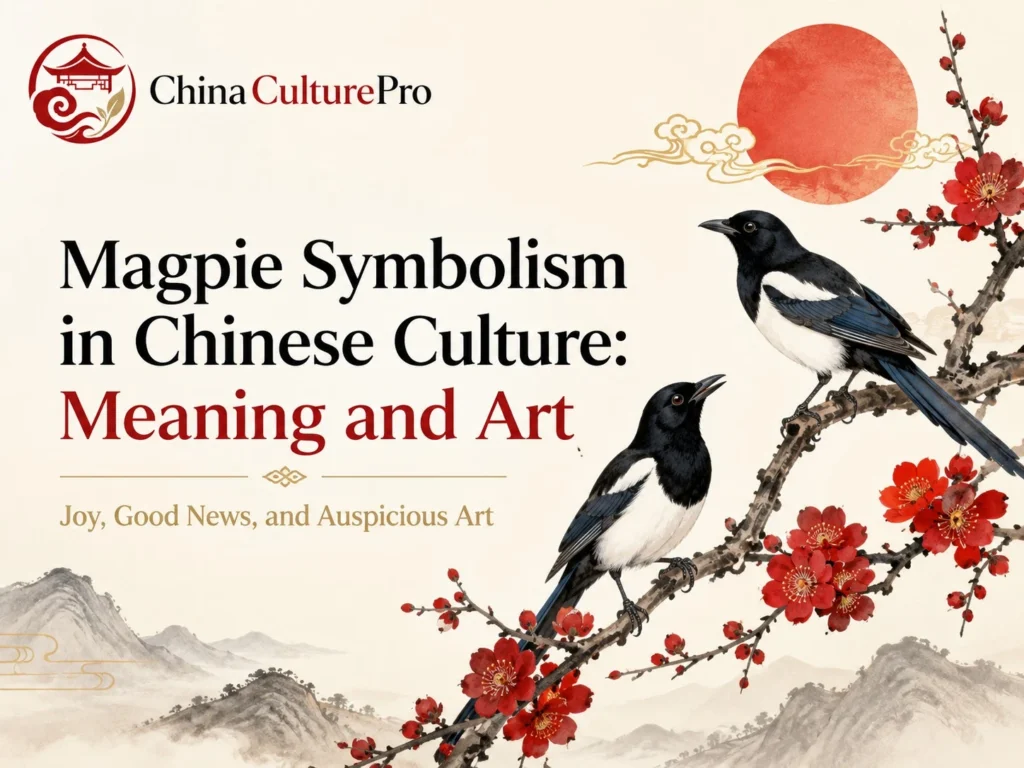
In Chinese culture, the magpie most often suggests joy, welcome news, or a happy occasion. It does not have one permanent meaning in every painting or object.
- Joy and good news: The bird’s Chinese name, 喜鹊/喜鵲 (xǐquè), contains 喜 (xǐ), meaning joy or happiness. Traditional lore also treats its call as an announcement of good news.
- Double happiness: Two magpies can intensify the idea of joy, especially on celebratory or wedding objects. A pair alone does not make every picture a marriage symbol.
- Reunion and love: In the Qixi story, a flock of magpies forms a bridge for Niulang and Zhinü, making the birds symbols of reunion in that specific narrative.
- Nature and seasonal life: In bird-and-flower painting, magpies may simply be alert, noisy birds interacting with a landscape or other animals.
Wealth, supernatural protection, and lifelong romantic fidelity are not default magpie meanings. These associations are cultural expressions, not promises of real-world luck.
The same magpie can perform very different cultural jobs. On a late-imperial box, birds among flowering plum branches can turn into a wish for happiness. In Cui Bo’s 1061 painting Magpies and Hare, two calling birds confront a hare in a windswept landscape; the work captures animal behavior and a charged moment in nature rather than functioning as a simple wedding emblem.[2]
That difference is the key to reading magpies in Chinese art. A date, inscription, companion plant, number of birds, object type, and narrative setting can matter more than the species alone. The broader guides to Chinese animal symbolism and Chinese symbols and meanings apply the same context-first method across other animals, characters, plants, and objects.
Why Did Magpies Become Symbols of Joy and Good News?
Three related mechanisms turned the magpie into a joyful image. The first is the bird’s name. 喜鹊/喜鵲 (xǐquè) begins with 喜, the character for joy, happiness, or a happy event. This is more precise than saying that the whole word “magpie” merely sounds like “happiness”: the favorable character is visibly part of the name.
The second mechanism is omen lore. A Qing court bird album preserves an explanation that when a happy event is approaching, a magpie calls; the same text therefore calls it a “numinous magpie” that signals joy. The album also describes the bird’s long tail, dark upper body, pale underside, and nesting behavior, placing natural observation and traditional interpretation side by side.[1] The omen belongs to historical belief, not verified prediction.
The third mechanism is artistic translation. Painters and craftspeople combined the name and the idea of announcing good news with other images, producing rebuses—visual puns that turn words into pictures. A magpie could supply “joy,” while a plum branch, a second bird, or a narrative scene completed a more specific message. This mechanism is one example of how symbols of happiness work through language and composition rather than through an animal’s supposed power.
How Magpie Symbolism Changed Across Chinese History
Early Omens, Poetry, and Natural Observation
Early references to magpies did not form one standardized decorative code. Texts could discuss nests, calls, seasonal behavior, omens, or human relationships through the bird. The Book of Poetry, for example, opens “Que Chao” with a magpie’s nest occupied by a dove and uses that image in a marriage poem.[8] It does not present a universal dictionary definition for every later magpie picture.
This distinction matters because verbal traditions and visual formulas develop at different speeds. The belief that a call might announce joy could exist before artists regularly paired magpies with plum blossoms or other motifs. A later rebus should not automatically be projected onto an earlier poem, excavated object, or naturalistic painting.
From Song Bird-and-Flower Painting to Ming–Qing Auspicious Art
Song bird-and-flower painting made close observation a major artistic subject. In Magpies and Hare, signed and dated 1061, two grey magpies call and react to a hare below. The composition records territorial behavior and the animals’ immediate responses with unusual precision.[2] The title Double Happiness supports an auspicious wordplay, but it does not by itself prove that the painting was commissioned as a wedding gift or that natural observation was secondary.
By the later imperial period, magpies were also firmly embedded in Chinese symbolism in art. An early seventeenth-century carved-lacquer box uses flowering plum and a pair of magpies, while an eighteenth-century porcelain dish combines two magpies, plum, and bamboo into a stated rebus of double happiness.[3][4] Such images moved easily across porcelain patterns, lacquer, furniture, and Chinese embroidery. The mature auspicious system did not erase painting’s naturalistic, poetic, or seasonal uses.
Common Magpie Motifs and Their Meanings in Chinese Art
Companion images act like visual grammar: they narrow the broad idea of joy into a more specific phrase or occasion.
| Motif | How the image works | Possible reading | Typical context | Interpretation limit |
|---|---|---|---|---|
| One magpie in a landscape | The bird appears without a completed rebus | Natural observation, an alert bird, or a broad association with good news | Bird-and-flower painting, album leaf | Context decides whether any auspicious reading is intended |
| Two magpies | A second bird doubles the visual idea of joy | Double happiness or shared celebration | Wedding objects, congratulatory decoration, ceramics | In an uninscribed nature scene, the pair may simply show animal interaction |
| Magpie and flowering plum | The bird supplies 喜, while plum 梅 (méi) can evoke eyebrow 眉 (méi) | 喜上眉梢, “joy reaches the brows” | Lacquer, prints, textiles, porcelain | Position, title, occasion, and other motifs should support the rebus |
| Magpies, plum, and bamboo | Several motifs form one compound visual message | A couple delighting in double happiness, or layered seasonal and moral associations | Export porcelain and decorative art | Bamboo’s separate meanings do not make every version of the composition identical.[4] |
| Magpies forming a bridge | A flock becomes a path across the Milky Way | Qixi reunion, longing, and the meeting of Niulang and Zhinü | Festival prints, narrative painting, modern illustration | Ordinary groups of magpies are not automatically a Magpie Bridge |
The table provides starting points, not automatic translations. A museum title, inscription, wedding use, or other narrative clue can confirm one reading; without such evidence, “can suggest” is more accurate than “always means.” For comparison, mandarin ducks are more directly associated with paired married life in later Chinese art, while magpies usually begin with the wider idea of joy or good news.
Magpie and Plum Blossom: “Joy Reaches the Brows”
The plum-and-magpie design is a layered visual pun. The magpie contributes 喜 (xǐ), “joy.” A bird on or among the flowering tips creates the pictured phrase 喜上梅梢—joy upon the plum tips. Because 梅 (méi, plum) and 眉 (méi, eyebrow) are homophones in Mandarin, the scene evokes 喜上眉梢 (xǐ shàng méi shāo), an idiom for happiness becoming visible in a person’s expression. Museum records explicitly identify plum and magpie imagery with “happiness up to your eyebrows.”[5]
The exact geometry should not be treated as a rigid switch. A bird need not occupy one mathematically defined point on the highest twig before the rebus becomes possible. The complete composition, object use, title, and inscription matter. Plum also has its own history of seasonal renewal and endurance, explained in the guide to plum blossom meaning; those meanings may coexist with, rather than disappear inside, the wordplay.
Magpies, Qixi, and the Bridge of Reunion
In the Qixi narrative, the cowherd Niulang and the weaver girl Zhinü are separated by the Milky Way. Once a year, magpies gather and form a bridge so the two can meet. Within that story, the birds serve as agents of reunion, carrying ideas of longing, separation, and a meeting made possible after waiting.[6]
This is why a Magpie Bridge can belong among Chinese symbols for love or appear in Chinese wedding symbolism. The meaning depends on the narrative. A lone bird on a branch, two birds in a winter landscape, and a flock spanning the sky do not perform the same cultural job.
Qixi should also not be reduced to an ancient version of modern Valentine’s Day. The festival has included star lore, demonstrations and prayers concerning women’s skills, and changing regional customs alongside the lovers’ story. This page uses Qixi only to explain the magpie’s role in reunion imagery, not to define the entire festival.
Ordinary Magpie, Auspicious Magpie, Qixi Magpie, and Korean Tiger-and-Magpie: What Is the Difference?
Similar birds can belong to different artistic systems. The system should be identified before a familiar meaning is assigned.
| Image type | Cultural system | Primary job | Recognition clues | Do not assume |
|---|---|---|---|---|
| Ordinary or naturalistic magpie | Chinese bird-and-flower art | Observe nature, season, posture, or animal interaction | Landscape setting, lifelike behavior, no complete rebus | Every bird announces luck |
| Auspicious magpie motif | Chinese decorative art | Express joy, good news, or a compound congratulatory wish | Plum, paired birds, inscriptions, ceremonial object | Every pairing means marriage or wealth |
| Qixi Magpie Bridge | Chinese festival narrative | Reunite Niulang and Zhinü across the Milky Way | A flock forming a bridge, the two lovers, stars or celestial setting | Any two magpies are Qixi lovers |
| Tiger-and-magpie painting | Korean Joseon folk painting | New Year imagery, humor, protective wishes, authority, or social commentary depending on the work | A tiger below a pine with one or more calling magpies | The mature Korean hojakdo reading applies unchanged to Chinese art |
Tiger-and-magpie imagery has a cross-border history: a recent Korean museum exhibition traces its visual roots to Yuan China while identifying the later humorous tiger-and-magpie composition as a major subject of Korean Joseon folk painting.[7] That development is better understood as localization than as one universal East Asian code. Readers comparing it with Chinese tiger symbolism should keep each object’s country, date, format, and inscription in view.
What Does the Magpie Mean in Chinese Idioms and Language?
Language preserves more than one kind of magpie image. These expressions should be read in their own literary or conversational setting, not used as labels for every artwork.
| Expression | Literal image or source | Meaning in use | Tone and boundary |
|---|---|---|---|
| 喜上眉梢 (xǐ shàng méi shāo) | Joy reaches the eyebrows | Delight is visible in someone’s face | Positive; related to the plum-magpie rebus but also used without an image |
| 鹊桥相会 (quèqiáo xiānghuì) | Meeting on the Magpie Bridge | Lovers or separated people reunite | Romantic or celebratory; tied to Qixi language |
| 声名鹊起 (shēngmíng quèqǐ) | A magpie-like rising of reputation | Someone quickly rises to fame | Positive; it does not make a pictured magpie a success charm |
| 鸠占鹊巢 (jiū zhàn què cháo) | A dove occupies a magpie’s nest | Someone takes another person’s place, property, or achievement | Negative modern idiom; the source poem “Que Chao” itself is a wedding poem, not a story of theft.[8] |
| 灵鹊报喜 (língquè bàoxǐ) | A numinous magpie announces joy | A traditional expression of welcome news | Folk and literary language, not a testable prediction |
The contrast is useful: a culturally auspicious bird can still appear in a critical idiom. Words, stories, and visual motifs share material, but they do not force one another into a single definition.
How to Interpret or Use a Chinese Magpie Symbol Correctly
Use this sequence when examining museum objects, antiques, wedding designs, logos, or contemporary art:
- Identify the bird: Look for the long tail, contrasting dark and pale plumage, posture, and surrounding species. Stylization can blur the difference between a magpie, crow, myna, or another long-tailed bird.
- Date the image and identify the carrier: A Song hanging scroll, late-Ming lacquer box, Qing textile, festival print, and modern logo do not follow the same conventions.
- Read the whole composition: Count the birds, but also inspect plum, bamboo, tiger, celestial figures, inscriptions, and the object’s intended occasion. These elements determine whether the image is observation, rebus, or narrative.
- Locate the cultural system: Separate Chinese auspicious decoration, Qixi imagery, Korean folk painting, European counting lore, and modern commercial symbolism.
- Describe evidence before interpretation: A title, dedication, museum record, dated catalogue, or visible narrative can support a precise reading. Without it, present plausible meanings as possibilities.
Modern creators may adapt magpies to express joy, reunion, or hoped-for good news. The design should be labeled as a modern interpretation when it combines traditions or assigns a personal meaning. Neither an image nor its placement can guarantee luck, attract a partner, protect a home, or change a person’s future.
FAQs About Magpie Symbolism in Chinese Culture
Is a Single Magpie Unlucky in Chinese Culture?
No general Chinese rule makes one magpie a sign of sorrow or bad luck. That idea is familiar from British and Irish counting rhymes, not from a universal Chinese number code. In Chinese art, one magpie may be a natural subject or may broadly evoke welcome news. The object’s period, inscription, setting, and purpose still decide whether any symbolic reading is intended.[3]
Do the Number and Direction of Magpies Have Fixed Meanings?
No. Two magpies can support a “double happiness” reading in a suitable celebratory composition, but Chinese art has no single cross-dynastic chart that assigns fixed fortunes to every number or flight direction. Claims that three, eight, or nine magpies always predict specific events are usually modern commercial rules. Use the dated object, inscription, companion motifs, and documented tradition instead.
What Does a Chinese Magpie Tattoo Mean?
A modern magpie tattoo can express joy, anticipated good news, reunion, or a personal memory. Plum blossoms may add the “joy reaches the brows” rebus, while a celestial bridge can invoke Qixi. A tiger may introduce Korean hojakdo rather than a standard Chinese pairing. The guide to Chinese tattoo symbols and meanings explains why cultural source and personal intent should both be stated. There is no ancient universal magpie-tattoo code, and the tattoo has no supernatural effect.
Sources
[1] National Palace Museum, Taipei. Bird Album I: Northern Magpie
[2] National Palace Museum, Taipei. Cui Bo, Magpies and Hare
[3] The Metropolitan Museum of Art. Box with Plum Blossoms and Birds
[4] The Metropolitan Museum of Art. Dish with Flowers and Birds
[5] The British Museum. Print with Magpies and Plum Blossom
[6] University of Alberta Museums. The Magpie Bridge: Two Cultural Perspectives
[7] Leeum Museum of Art. Tigers and Magpies
[8] Chinese Text Project. Book of Poetry: Que Chao