
Quick Answer: Who Are the Nine Sons of the Dragon?
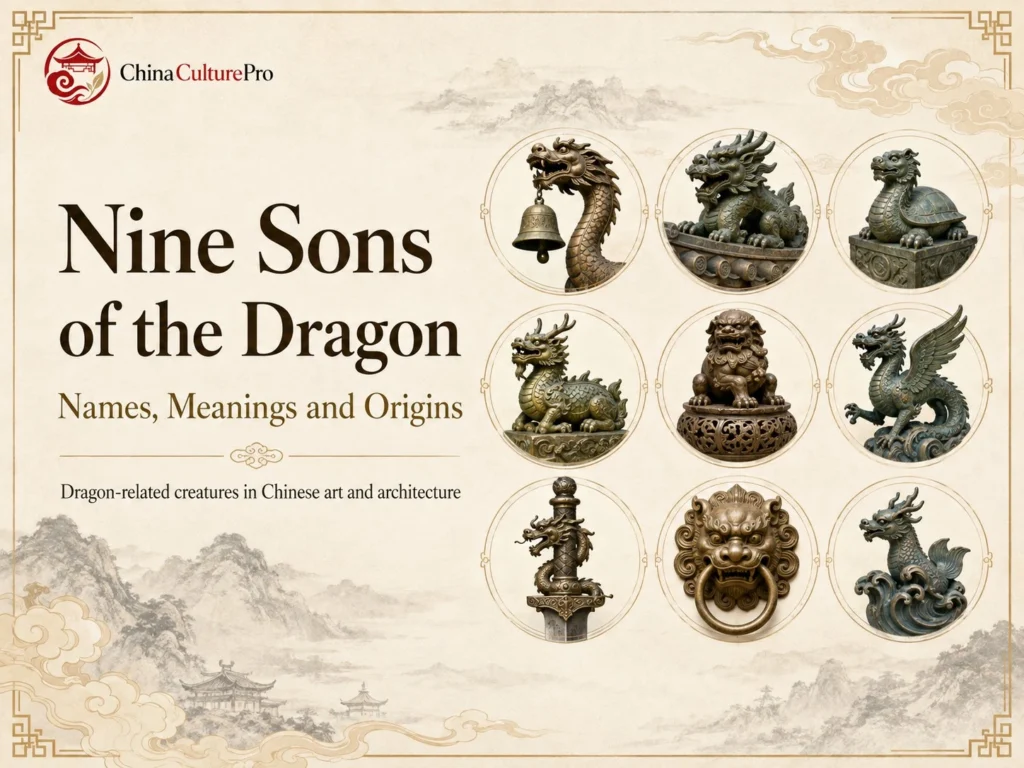
The Nine Sons of the Dragon, or Lóng Shēng Jiǔ Zǐ (龙生九子), are dragon-related creatures whose different preferences were matched to particular objects and architectural settings. There is no single canonical list. This guide uses the widely circulated list associated with the Ming writer Li Dongyang as its navigation baseline, then compares it with Yang Shen’s alternative version.[1][2][3]
- The list is not universal: Ming sources record different names and functions.
- Nine is not necessarily a head count: In this tradition, it can suggest abundance or a complete set rather than a documented family of exactly nine siblings.
- Each creature “likes” something different: Music, loud sounds, danger, litigation, weight, writing, or swallowing helps explain its assigned object.
- Material setting matters more than fantasy biography: The strongest identification clues are the instrument, weapon, roof, gate, bell, stele, or ritual object on which the beast appears.
The nine commonly listed today are Qiuniu, Yazi, Chaofeng, Pulao, Suanni, Baxia, Bi’an, Bixi, and Chiwen. They form one branch of the broader system explained in Chinese symbols and their meanings.
The Nine Sons of the Dragon are not a fixed ancient family tree or nine miniature dragons with matching bodies. The named system took shape in Ming-dynasty writing by linking dragon-related beasts to musical instruments, weapons, roof fittings, bells, steles, gates, and other objects.
This makes the tradition especially useful for reading Chinese material culture. A bell knob identified as Pulao, a beast at a roof corner associated with Chaofeng, and a load-bearing creature beneath a stele do more than illustrate stories: their supposed preferences explain why each image belongs on a particular object. The result is a functional branch of the wider system of Chinese mythical creatures.[1][4]
What Does “Nine Sons of the Dragon” Mean?
The guiding phrase is lóng shēng jiǔ zǐ, bù chéng lóng, gè yǒu suǒ hào—“the dragon produced nine sons; none became a dragon, and each had its own preference.” The saying is important because it describes difference within a shared category. These creatures belong to the dragon’s symbolic family, but they do not all look like the long, scaled Chinese dragon.
Three parts of the expression need qualification:
- Nine: The Palace Museum’s English guide notes that nine can mean “a whole lot,” which helps explain why multiple nine-member lists circulated. It should not be treated as proof of one biological family with a settled birth order.[1]
- Sons: “Sons” is the conventional English translation of zǐ (子). Here it works as a classificatory label for dragon offspring or dragon-kind derivatives. The surviving accounts do not supply one mother, a complete genealogy, or connected childhood stories.
- Each had its own preference: A creature’s stated taste explains an ornament’s location. One that liked music appeared on an instrument; one that liked loud cries appeared on a bell; one that liked bearing weight appeared under a stele.
The best-known named lists survive in Ming sources. A later critical account says Li Dongyang obtained the information from other officials, recorded it for an imperial question, and did not know its ultimate source.[2] That makes “later systematized tradition” more accurate than “unchanged mythology from remote antiquity.”
The Nine Sons at a Glance
The table follows the sequence used by the Palace Museum’s English guide and the list attributed to Li Dongyang. It is a practical reference, not a proven birth order. Some written forms and object associations vary in later transmission, especially Baxia and Bixi.[1][2]
| Name | Chinese and pinyin | Recorded preference | Traditional placement | Recognition clue | Interpretation limit |
|---|---|---|---|---|---|
| Qiuniu | 囚牛, Qiúniú | Likes music | Head or end of a huqin and other stringed instruments | A small dragon-like head integrated into an instrument | Musical refinement and artistic talent are later interpretations, not part of the short Ming record. |
| Yazi | 睚眦, Yázì | Likes killing or martial action | Sword hilt, knife handle, guard, or “dragon-swallowing” weapon fitting | A fierce animal or dragon head from which a blade seems to emerge | Its placement supports a martial association; it does not establish a universal protective power or a complete personality profile. |
| Chaofeng | 嘲风, Cháofēng | Likes danger or precarious heights | Palace or temple roof corners | A beast standing high on a corner or sloping ridge | It should not be used as the name for every roof-ridge figurine. Official roof processions contain several different creatures. |
| Pulao | 蒲牢, Púláo | Likes to cry or roar | Knob or suspension feature on a large bell | A compact dragon-like beast attached to the top of a bell | The story about Pulao fearing a whale explains the whale-shaped striker in later accounts; it is not zoological history. |
| Suanni | 狻猊, Suānní | Likes sitting | Buddhist throne or lion-shaped seat ornament | A seated lion-like beast in a Buddhist setting | Li’s list emphasizes sitting and a Buddhist seat. Incense smoke is more explicit in Yang Shen’s description of Jinni and in later blended traditions. |
| Baxia | 霸上 or modern 霸下, Bàxià | Likes bearing heavy loads | Beast-shaped base beneath a stone stele | A sturdy animal supporting a heavy inscription monument | Modern retellings often merge Baxia with the turtle-like Bixi. The names cannot be separated by one rule across every source and period. |
| Bi’an | 狴犴, Bì’àn | Likes litigation | Prison gate or official judicial setting | A stern lion- or tiger-like head at an entrance | Justice and integrity are later positive summaries of its judicial placement, not proof that the image itself enforces justice. |
| Bixi | 屓屭 or 赑屃, Bìxì | Likes writing or literary inscriptions in the Li-associated list | Dragon ornament beside or around a stone inscription | A dragon form connected to written text rather than necessarily carrying the monument | Yang Shen instead uses Bixi for the turtle-like stele bearer. Spelling and function must be checked against the version being used. |
| Chiwen | 蚩吻, later often 螭吻, Chīwěn | Likes swallowing | Large beast head at the end of a main roof ridge | An open-mouthed dragon or sea-beast form appearing to swallow the ridge | Its water and fire-prevention associations belong to architectural symbolism. They should not be presented as a guaranteed supernatural effect. |
These entries are best read as compact links between image, preference, and carrier. The table does not prove that every older lion, turtle, beast mask, or roof ornament was originally designed as one of the dragon’s sons.
Where the Tradition Comes From and Why the Lists Differ
The creatures and decorative forms did not all suddenly appear in the Ming dynasty. Bells, roof beasts, lion forms, turtle-shaped stele supports, and dragon ornaments have longer and partly independent histories. What became clearer in Ming writing was the act of gathering selected forms into a named set of nine dragon offspring.
A Ming blue-and-white plate in the National Museum of China provides a useful visual parallel. Five sea creatures decorate the inner wall and nine appear outside; the museum interprets the design as an allusion to “the dragon giving birth to nine sons.”[4] The plate supports the importance of the theme in Ming visual culture, but it does not identify its creatures as the same nine names in either literary list.
Li Dongyang’s Huailutang Ji List
The list associated with Li Dongyang names Qiuniu, Yazi, Chaofeng, Pulao, Suanni, Bashang, Bi’an, Bixi, and Chiwen. Its unusual strength is not a connected story but a neat series of correspondences: music and the huqin, killing and weapons, danger and roof corners, loud cries and bells, sitting and Buddhist seats, weight and stele bases, litigation and prison gates, writing and inscriptions, swallowing and roof ridges.[2]
Li’s authority should not be overstated. A later textual discussion reports that he did not initially know all the names, consulted Luo Qi and Liu Ji, and could not identify the older source behind the information. That caution matters: the list is an influential Ming formulation, not an official catalog proven to have governed every earlier workshop.
Yang Shen’s Alternative List
Yang Shen records the same introductory saying but supplies a different set. His list contains Bixi (赑屃), Chiwen (螭吻), Pulao (蒲牢), Bi’an (狴犴), Taotie (饕餮), Gongfu (蚣𧏡, a rare form with varying transcriptions), Yazi (睚眦), Jinni (金猊), and Jiaotu (椒图).[3]
| Relationship to Li-associated list | Members and functions in Yang Shen’s version |
|---|---|
| Shared names | Pulao roars and appears on a bell knob; Bi’an has force and stands at a prison gate; Yazi likes killing and appears on a weapon fitting. |
| Shared or related names with changed details | Bixi is turtle-shaped, likes bearing weight, and supports a stele; Chiwen likes looking outward and appears as a roof beast. |
| Version-specific members | Taotie likes food and appears on a vessel lid; Gongfu likes water and appears at a bridge pier; Jinni resembles a lion, likes smoke, and appears on an incense burner; Jiaotu resembles a shellfish, likes closure, and appears on a door fitting. |
Yang says he recorded the account from memory after hearing about the response to the imperial question. Even within this compact tradition, name forms are difficult: the rare characters used for Gongfu have been transcribed and romanized in several ways.
What the Disagreement Tells Us
The disagreement is not a defect that must be repaired by creating a hybrid “correct” list. It shows how names, craft objects, visual forms, and explanatory stories moved together unevenly. Some creatures were already known in other contexts; some functions could migrate between names; and later editors regularized rare characters differently.
For readers, the safest conclusion is simple: identify the source version before interpreting an object. The Palace Museum/Li sequence is a useful modern navigation standard, while Yang Shen preserves an equally important alternative history. Neither should be projected backward onto every earlier artifact.
Where the Nine Sons Appear in Chinese Art and Architecture
The most reliable way to understand the dragon sons is to group them by what their images do on material objects. Placement often carries more identifying value than color, claws, or a modern illustrated character sheet.
Music and Bells
Qiuniu belongs to the visual world of stringed instruments. Its dragon-like head turns the end of a huqin or related instrument into a creature associated with musical attention. Pulao belongs to bells. Its reputation for roaring makes a bell knob an apt place for the creature, while the whale-striker story provides an imaginative explanation for a louder sound.[1]
The ornament does not produce the acoustic force by magic. It joins the instrument’s real function to a memorable visual metaphor: the musician gives Qiuniu music, and the struck bell makes Pulao cry.
Weapons and Justice
Yazi’s fierce face appears on weapon fittings because the Ming account describes it as liking killing. The image strengthens a sword or knife’s martial character without turning every beast-headed weapon fitting into a securely identified Yazi.
Bi’an belongs to judicial space rather than the battlefield. Its placement at prison or government entrances led to later associations with judgment and integrity. It is also useful to distinguish Bi’an from Xiezhi, a separate one-horned creature whose cultural identity is much more directly centered on discerning right and wrong.
Roofs and High Places
Chaofeng is associated with exposed heights and roof corners, while Chiwen belongs at the ends of a main roof ridge. They are not interchangeable. A roof-corner procession is also not simply a display of the Nine Sons: the Palace Museum’s own list of ridge figurines includes a dragon, phoenix, lion, Xiezhi, Suanni, and several other creatures, and the number used varies with a building’s rank.[5]
Large dragon-shaped ridge-end components had practical as well as decorative jobs. A surviving Ming glazed dragon ridge fitting was made to stabilize and seal the meeting point of roof surfaces while completing the roof visually.[6] Symbolic fire prevention and real construction function should therefore be explained as separate layers.
Steles, Inscriptions, and Incense Settings
Stele imagery exposes the largest naming problem. The Li-associated account gives load-bearing work to Bashang/Baxia and literary ornament to Bixi. Yang Shen calls the turtle-shaped stele bearer Bixi. Modern museum and popular descriptions may therefore use Baxia or Bixi for a dragon-headed turtle carrying a monument. The object is easier to recognize than the name is to standardize.
Incense imagery produces a similar overlap. Li connects Suanni with sitting on a Buddhist seat. Yang connects the lion-like Jinni with smoke and an incense burner. Later visual culture often blends the seated lion, Buddhist setting, and incense smoke. This does not make Suanni identical to ordinary Chinese guardian lions, which form their own architectural guardian tradition.
Do the Nine Sons Have Fixed Symbolic Meanings?
The Nine Sons do not have one timeless dictionary of personality traits. Their meanings are easier to evaluate in three layers:
| Interpretation layer | What it contains | How to use it |
|---|---|---|
| Recorded preference | Likes music, cries loudly, bears weight, favors litigation, or likes swallowing | Treat this as the core textual clue, while naming the Ming version being followed. |
| Material association | Instrument, bell, weapon, prison gate, roof ridge, stele, incense burner, or door fitting | Use the object and placement to explain why the creature belongs there. |
| Later or modern symbolism | Artistic sensitivity, courage, justice, endurance, protection, or other design messages | Label these as interpretations rather than the original definition or a real-world effect. |
A motif may express a wish for stability, authority, safety, or cultural continuity. That is different from claiming that a Baxia image physically makes a monument last forever, that Bi’an guarantees justice, or that a Chiwen ornament prevents fire. The tradition supplies symbolic language, not verifiable causal power.
Common Misidentifications and Name Confusions
| Common confusion | More accurate interpretation |
|---|---|
| Bixi and Baxia are always two clearly separated creatures | The Li-associated list separates a load-bearing Bashang/Baxia from a literary Bixi, but Yang Shen calls the turtle-shaped stele bearer Bixi. Check the source, spelling, and object rather than enforcing one universal rule. |
| Chiwen, Chaofeng, and every roof beast are the same | Chiwen belongs to the end of a main ridge, while Chaofeng is associated with dangerous heights or roof corners. Formal ridge-beast processions contain many other creatures and follow architectural rank rules. |
| Suanni is simply another name for a guardian lion | Suanni is a dragon-related lion form in the Nine Sons tradition. Guardian lions have a broader and separate history as paired architectural protectors. |
| The Nine Sons are children of the Dragon Kings | The Dragon Kings are water deities in religious and mythic narratives. The Nine Sons list classifies ornamental creatures and does not supply one Dragon King parent. |
| Taotie is always one of the Nine Sons | Taotie appears in Yang Shen’s version but not the Li-associated navigation list. The original meaning of Shang and Zhou taotie motifs remains debated; Yang’s later food-loving beast must not be used to decode every ancient bronze mask. |
| Bi’an and Xiezhi are interchangeable justice beasts | Bi’an is tied to litigation and prison gates in the Nine Sons tradition. Xiezhi is an independent one-horned emblem of legal discernment. |
Rare characters make the problem harder. Bixi appears as 赑屃 in simplified Chinese and 贔屭 in traditional Chinese, while older texts preserve additional graphic variants. Chiwen may appear as 蚩吻, 螭吻, 鸱吻, or in related roof terminology. These spellings can reflect textual transmission and architectural vocabulary, not nine newly discovered creatures.
How to Identify One of the Nine Sons in Art
- Start with the carrier: Decide whether the image belongs to an instrument, bell, weapon, gate, roof, stele, Buddhist seat, incense burner, bridge, or door.
- Check the exact position: A beast under a stele performs a different job from a dragon winding around its inscription. A main-ridge end differs from a corner-ridge figurine.
- Study the full composition: Look for a blade emerging from a mouth, a creature forming a bell knob, a turtle-like body bearing weight, or a shell-like face holding a door ring.
- Establish the date: An older beast motif may predate its later classification as a dragon son. Do not label it from shape alone.
- Identify the textual version: A stele bearer called Bixi may fit Yang Shen, while Baxia fits many modern retellings of the Li sequence. Taotie and Jiaotu point toward the alternative list.
- Use the catalog label as evidence, not decoration: Museum records, archaeological reports, inscriptions, and architectural documentation are stronger than modern character art or sales descriptions.
Color and claw count are weak tests. There is no cross-period rule requiring each son to have one color, number of horns, body type, or fixed facial expression.
How to Use the Nine Sons in Modern Design
- Choose a version: Use the Palace Museum/Li sequence for broad recognition, or name Yang Shen’s version when using Jiaotu, Gongfu, Jinni, or Taotie as members.
- Match creature and context: Qiuniu fits music; Pulao suits sound; Chiwen suits a roof theme; Jiaotu suits closure or a doorway. The historical object relationship gives the design coherence.
- Verify characters and pinyin: Rare characters and variant spellings deserve checking before engraving, tattooing, or registering a logo.
- Keep sensitive settings in mind: Bi’an’s prison association and Yazi’s weapon context may not suit a wedding, children’s product, or peaceful hospitality brand.
- Label new invention honestly: A winged, elemental, color-coded team of nine can be strong fantasy design, but its powers and hierarchy are modern creations.
- Avoid efficacy claims: Present endurance, justice, protection, or musical refinement as cultural messages—not promises of luck, wealth, safety, or legal success.
For a permanent tattoo, architectural installation, or commercial identity, review both the image and its accompanying Chinese text with a qualified cultural and language specialist.
Final Takeaway
The Nine Sons of the Dragon are best understood as a flexible Ming-era explanatory system for images placed on objects and buildings. Their lists differ because names, motifs, and craft functions were never governed by one universal genealogy. Read the carrier, location, date, and textual version before assigning a name or meaning.
FAQs About the Nine Sons of the Dragon
How Do You Pronounce Longsheng Jiuzi?
Lóng shēng jiǔ zǐ is the standard Mandarin pinyin for 龙生九子. The tones are second, first, third, and third. An English approximation cannot reproduce those tones accurately, so pinyin with tone marks is preferable in educational or formal writing.
Are the Nine Sons of the Dragon Gods?
The Nine Sons are primarily legendary creatures and explanations for decorative forms, not one organized group of gods. The major Ming lists do not give them a shared temple system, priesthood, or standard worship ritual. A particular creature may gain broader religious or folk associations in another setting, but that does not make the entire list a pantheon.
Do All Nine Sons Appear Together in Traditional Art?
No. A single object normally uses the creature suited to its purpose: Pulao on a bell, Yazi on a weapon, or a load-bearing beast under a stele. Complete nine-member ensembles exist in later art and modern design, but an artifact does not need all nine figures to use this symbolic language.
Are the Nine Sons Always Male?
The conventional phrase uses zǐ, commonly translated as “sons,” but the Ming lists do not provide biological descriptions that establish a fixed sex for every creature. Modern illustrations should not infer gender from color, horn count, size, or position in the list.
Do the Nine Sons Have the Same Names Across East Asia?
No universal East Asian list exists. Dragon-related beasts, roof ornaments, stele turtles, and Chinese texts traveled across the region, but names, functions, artistic forms, and religious associations were localized. A Japanese, Korean, or Vietnamese image should be interpreted through its own date and cultural setting.
Is the Nine-Dragon Wall About the Nine Sons?
No. The Nine-Dragon Wall in the Forbidden City displays nine dragons in cloud-and-water settings; its official description does not identify them as the Nine Sons.[7] A group of nine dragons is not automatically a coded list of Qiuniu through Chiwen.
Sources
[1] The Palace Museum Youth. Nine Son of the Dragon
[2] Hu Shizhen. Shuo Lü, Volume 30
[3] Yang Shen. Sheng’an Ji, Volume 81
[4] National Museum of China. Blue-and-White Plate with Winged Dragons amid Sea Waves
[5] The Palace Museum Youth. The Mysterious Beasts on the Roof Ridges
[6] The Palace Museum. Glazed Dragon-Shaped Roof-Ridge Component
[7] The Palace Museum. Nine-Dragon Wall