

Quick Answer: What Was the Guangwu Restoration?
The Guangwu Restoration (光武中兴, Guāngwǔ Zhōngxīng) was the reestablishment of Han imperial rule under Liu Xiu (刘秀, Liú Xiù), known as Emperor Guangwu. He took the throne in 25 CE and established the Eastern Han (东汉, Dōng Hàn), also called Later Han. His armies defeated the last major rival to control of the former Han heartland in 36 CE. [1][2][3][4]
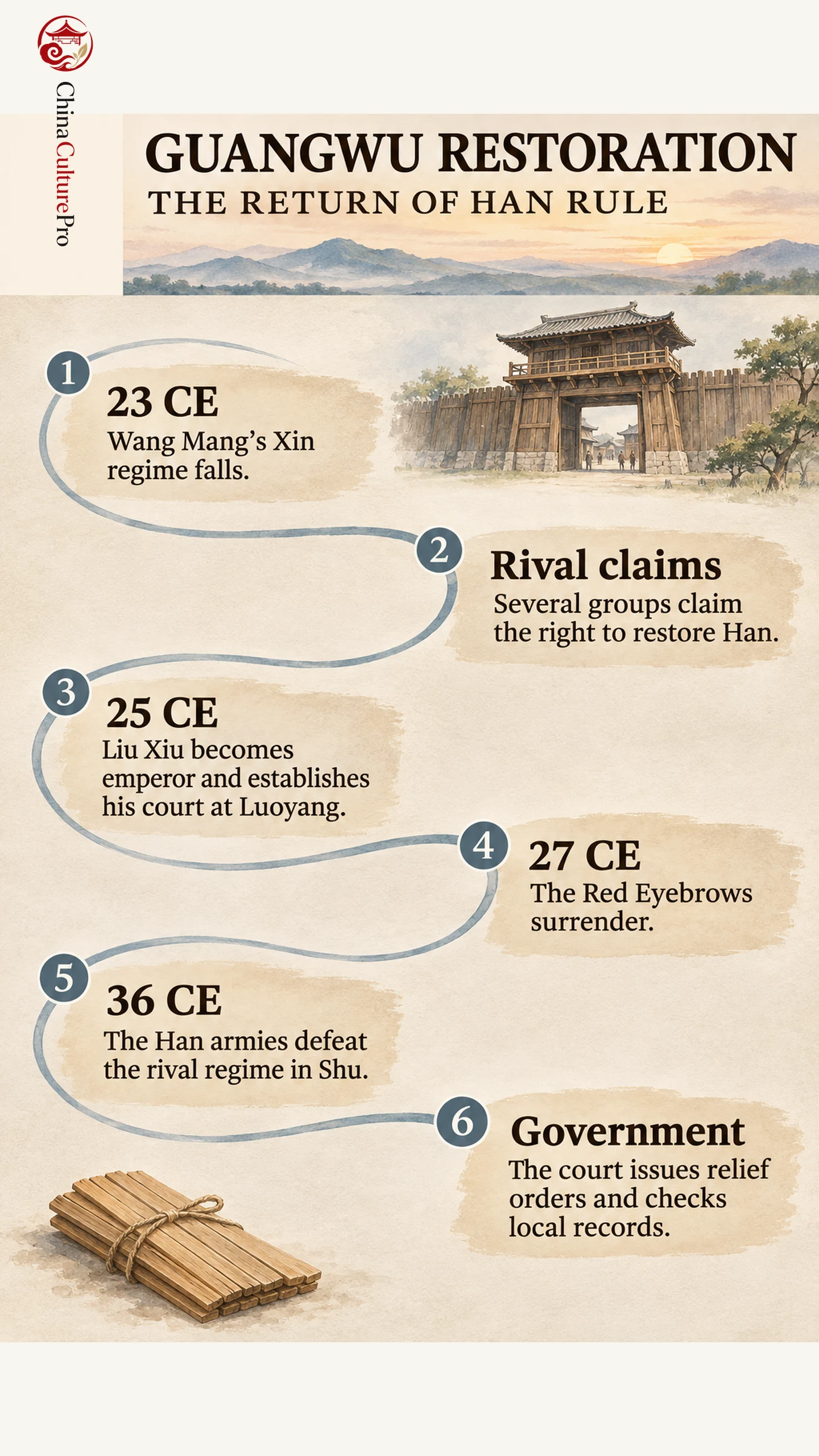
- 23 CE: The preceding regime fell and rival forces competed for power.
- 25 CE: Liu Xiu became emperor and made his capital in the east.
- 36 CE: His forces took control of Shu in the southwest. [1][2][3][4]
Restoring the Han title and reunifying the former imperial core took place at different points. [1][2][4]
Several groups could claim to speak for Han after the collapse of imperial rule in 23 CE. Liu Xiu’s success came from turning one claim into a government with a capital, a network of commanders and the ability to govern places that had not yet submitted.
How Wang Mang’s Fall Opened Several Claims to Power
The rule of Wang Mang (王莽, Wáng Mǎng) interrupted the Han line when he established Xin (新, Xīn) in 9 CE. By 23, uprisings and military defeats were destroying his government. Liu Xiu and his brother Liu Yan joined rebels claiming to restore Han. The Book of the Later Han credits Liu Xiu with an important role in their victory at Kunyang (昆阳, Kūnyáng) in 23. [1][3]
Wang Mang’s death left several armies competing for the old imperial territories. Another member of the Liu family, Liu Xuan, ruled as the Gengshi Emperor (更始帝, Gēngshǐ Dì). His forces occupied the former capital region. The Red Eyebrows (赤眉, Chìméi), a different insurgent coalition, later put forward their own Han claimant, Liu Penzi. Several armies could fight under the name of Han while serving different leaders. [1][3]
How Liu Xiu Built a Court at Luoyang
Liu Xiu built support north of the Yellow River. He recruited commanders and took on local rivals, including Wang Lang, who presented himself as a member of the Han ruling house. Liu Xiu’s victory over Wang Lang gave him a stronger northern base. Control of troops and territory north of the Yellow River gave him a base independent of Gengshi’s court. [1][3]
Liu Xiu took the imperial title in 25 and adopted the Jianwu reign name. Later that year his forces secured Luoyang (洛阳, Luòyáng) after its defender Zhu Wei surrendered. Liu Xiu established his capital there. The Book of the Later Han presents his accession as a restoration of rightful rule. Its account also records appointments for military followers and a siege before he entered the new capital. [1][3][4]
Why Reunification Took Until 36 CE
The Red Eyebrows took Chang’an, the former western capital, in 25. Their forces struggled to find provisions. They eventually left and surrendered to Liu Xiu in 27. Their defeat removed one claimant. Other commanders still held territories in the northwest and southwest. [1][3]
In the northwest, the regime of Wei Ao resisted Liu Xiu’s armies. The northwest had to be brought under Han control while an independent regime still held Shu. The strongest southwestern rival was Gongsun Shu (公孙述, Gōngsūn Shù), who ruled from the region of modern Sichuan. His armies were defeated in 36. Fan Ye’s annals record Gongsun Shu’s death from wounds and killings after Guangwu’s forces took Chengdu. [2][3][4]
Consolidation also involved bringing regional commanders into the new court. Dou Rong, who controlled a northwestern corridor, recognized Guangwu and later joined operations against Wei Ao. The combination of negotiated allegiance and military action reduced the number of rivals the new court had to fight. [2][3]
How the Restored Han Rebuilt Government
Continuity with the Han dynasty rested on more than the Liu surname. The court used existing units such as commanderies and kingdoms to administer territories. It also needed officials who could collect revenue and distribute relief. Guangwu’s annals record an order directing local governments with grain to supply vulnerable residents after floods, drought and crop damage. The edict identifies the people the court intended to help. The annals give no accounting of how much grain reached them. [2][4][5]
Reliable local information was another problem. Guangwu ordered officials to check cultivated land and household figures. Patricia Ebrey notes that false land reports came from powerful districts, including the capital area and Guangwu’s home region of Nanyang. Rebuilding tax registers depended on officials who often worked among the same interests they were supposed to report. [2][3][5][6]
FAQs About the Guangwu Restoration
Why is the restored dynasty called Eastern Han?
Liu Xiu established his capital at Luoyang, east of the former Western Han capital at Chang’an. Eastern Han and Later Han name the same dynasty. [1][4]
Did the Han restoration happen in 25 or 36 CE?
The dynasty conventionally begins with Liu Xiu’s accession in 25 CE. His armies defeated the last major rival to control of the former Han heartland in 36 CE. [1][2][4]
Did Liu Xiu overthrow Wang Mang and immediately become emperor?
No. Wang Mang’s regime fell in 23. Other forces and claimants remained in power, and Liu Xiu did not take the imperial title until 25. [1][3][4]
Sources
[1] Fan Ye, with commentary by Li Xian and others. Book of the Later Han, Volume 1A: Annals of Emperor Guangwu
[2] Fan Ye, with commentary by Li Xian and others. Book of the Later Han, Volume 1B: Annals of Emperor Guangwu
[3] Hans Bielenstein. Wang Mang, the Restoration of the Han Dynasty, and Later Han
[4] David R. Knechtges. From the Eastern Han Through the Western Jin (AD 25–317)
[5] Hans Bielenstein. The Institutions of Later Han
[6] Patricia Ebrey. The Economic and Social History of Later Han