


Quick Answer: Who Are China’s Uzbek Communities?
The Uzbek people(乌孜别克族,Wūzībiékèzú) are an officially recognized ethnic group in China, with communities dispersed across Xinjiang. Many families have urban histories in places such as Yining and Kashgar, while others have lived in pastoral areas. Their culture brings together Central Asian connections, regional language contact, Islamic traditions and knowledge passed through households and occupations. The local setting helps explain which language, food or custom a particular account describes. [1]
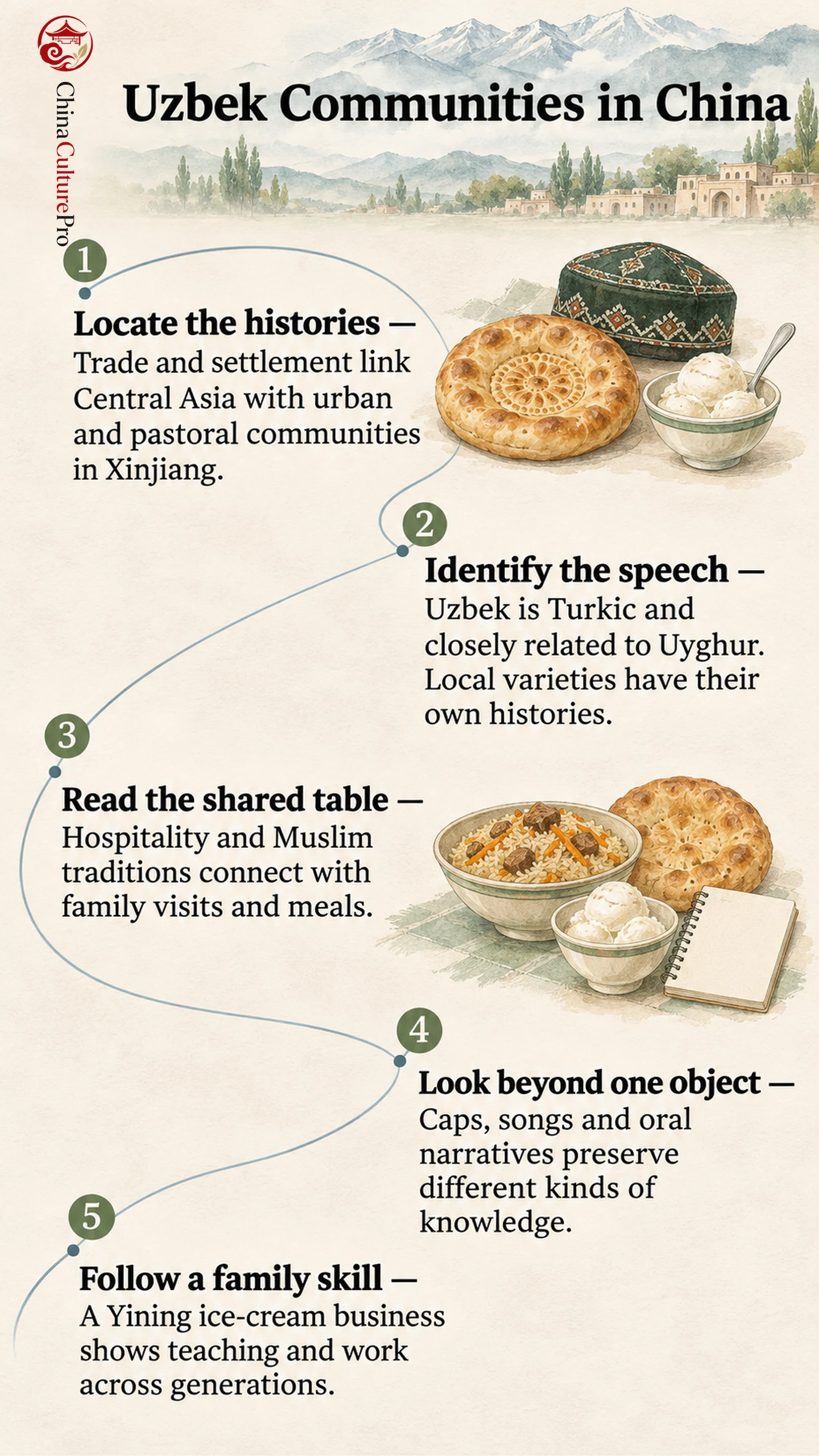
A family recipe can become a business, a skill taught to apprentices and a way of remembering earlier generations. The relationship between home and work offers a way into Uzbek culture in China. It places food and craft alongside the histories of trade, language and settlement behind them.
Trade, Settlement and Different Local Settings
Historical accounts connect Uzbek settlement in Xinjiang with movement from Central Asia. Merchants traveled between commercial centers, carried goods and formed relationships along the routes. Over time, settlement also included farmers, artisans and educated people. These patterns continued through different periods rather than arising from a single migration event. [2]
Older sources sometimes identify people by places such as Andijan, Kokand or Bukhara. Those names reflect the commercial and regional networks through which people were known. An older place-based label can therefore be relevant to a family’s history even when a later account uses Uzbek as its principal category. [2]
Present community settings include towns and cities in Ili, Kashgar, Urumqi and Tacheng. Danangou Uzbek Township in Mulei provides a contrasting pastoral setting. The difference gives practical meaning to the idea of regional variation. Urban shopkeeping and work with livestock can sustain different daily routines while remaining part of the same broader community history. [1]
Uzbek Speech in a Multilingual Region
The Uzbek language(乌孜别克语,Wūzībiékèyǔ) is Turkic and closely related to Uyghur. Varieties used in China have developed through their own patterns of contact and differ in some respects from the standard language of Uzbekistan. A modern description of standard Uzbek can help with comparison, but its recordings and sound system need to be identified by their own scope. [3]
| Language Contexts in Uzbek Communities | Local connection | What to distinguish |
|---|---|---|
| Uzbek heritage varieties in Xinjiang | Family speech and historical regional development | The local variety and the standard used in Uzbekistan |
| Uyghur | Communication in communities with close Uyghur contact | A frequently used language and a person’s ethnic identity |
| Kazakh | Contact in pastoral areas | The household and social setting in which it is used |
Regional descriptions record Uyghur use in southern communities and Kazakh use in pastoral settings. The similarity between local Uzbek and Uyghur can also complicate efforts to measure language shift. Simply asking whether someone is Uzbek does not establish the language they use at home. [1][3]
This is a useful point of comparison with neighboring Uyghur communities. Linguistic closeness and long contact help explain shared practices, while family identification and local histories deserve attention in their own right.
Hospitality, Faith and the Shared Table
Uzbek is among China’s predominantly Muslim ethnic groups. Religious affiliation has an important place in the community’s history and can shape occasions for family visits, shared meals and observance. Belief and practice still need to be understood through particular people and settings when discussing Islam in China. [4]
Traditional food accounts describe baked flatbread, milk tea, meat dishes and rice pilaf served to guests. Fruits and dried fruits also have a place at the table. These foods connect Uzbek households with a wider Central Asian and Xinjiang culinary setting. A dish shared with neighbors can be meaningful within a family without being exclusive to one ethnic group. [5]
The way a meal is offered matters alongside the dish. Accounts emphasize greeting guests and showing consideration to older people. These are social relationships expressed through visits and meals, whose details can change with the household, generation and occasion. A family’s explanation of who prepares or serves a dish gives it a more precise setting.
Dress, Music and Oral Literature
The doppa(朵帕,duǒpà), an embroidered cap, is one recognizable item in descriptions of traditional Uzbek dress. Caps come in different shapes, fabrics and patterns, and they belong to a broader regional tradition of decorated headwear. A particular cap is best understood through its maker, wearer and use. Formal garments and everyday clothing also change over time. [5]
Songs and instrumental performance add another medium for cultural expression. Documented traditions include solo singing with plucked-string instruments and hand drums. Oral literature includes stories, proverbs and longer narratives, with the heroic epic Alpamysh among the works associated with Uzbek tradition. The language and performance setting help identify how a version has been passed on. [5]
A cap, a song and a narrative preserve different kinds of skill. Stitching leaves a material result, while a singer or storyteller works through sound, memory and a relationship with listeners. Comparing these forms helps explain what a photograph, recording or written text can preserve, and what still depends on teaching between people.
A Family Skill at Work in Yining
A 2019 profile follows an Uzbek family’s hand-made ice-cream business in Yining’s Kazanqi area. The shop began with the proprietor’s grandfather. After graduating in 1998, the third-generation owner returned home to continue the work and later welcomed apprentices from other parts of China. The dated account gives a specific example of family knowledge moving into a wider setting. [6]
The story also places the business within a multilingual urban neighborhood. Family members and employees serve customers, while demonstrations and online videos make the craft visible to new learners. Serving customers and teaching apprentices give the inherited skill new settings. [6]
This example can be read alongside older accounts of commerce and handicrafts. It follows one family’s choices, which is enough to show how a tradition can enter education, employment and daily encounters. Keeping the family and the date attached to the story gives it more explanatory value than treating one occupation as a rule for an entire community.
FAQs About Uzbek Communities in China
Are Uzbek and Uyghur the same language?
They are distinct, closely related Turkic languages. Local contact can make their relationship especially close in Xinjiang.
Do all ethnic Uzbeks in China speak Uzbek at home?
No. Language use varies, and Uyghur or Kazakh can be important in particular communities and households.
Are China’s Uzbeks the same as citizens of Uzbekistan?
Ethnic identity and citizenship describe different things. Uzbek communities in China have their own histories of settlement and life in the country.
Sources
[1] National Ethnic Affairs Commission. Overview of China’s Uzbek Communities
[2] National Ethnic Affairs Commission. Uzbek Community History
[3] Shinji Ido. Uzbek, Journal of the International Phonetic Association
[4] Pew Research Center. Islam in China
[5] National Ethnic Affairs Commission. Uzbek Customs, Food and Arts
[6] National Ethnic Affairs Commission. A Yining Family’s Hand-Made Ice-Cream Tradition