
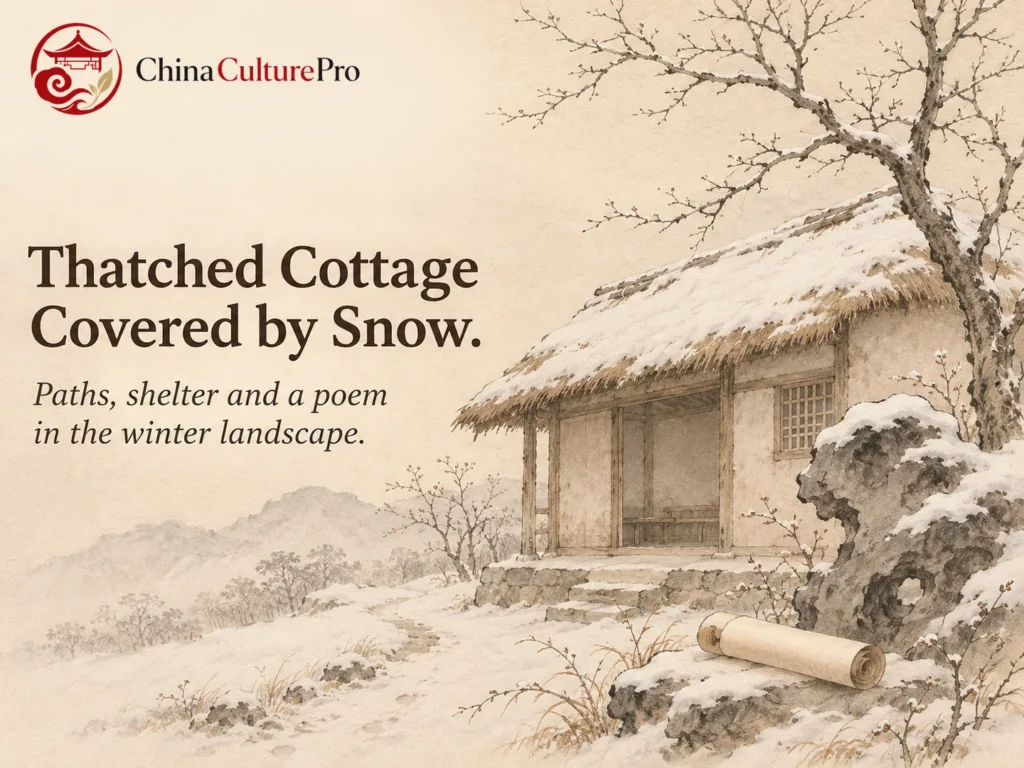

Quick Answer: What Is Thatched Cottage Covered by Snow?
Thatched Cottage Covered by Snow(柴门掩雪图,Cháimén yǎnxuě tú)is a snow landscape catalogued under Tang Yin(唐寅,Táng Yín)in the National Museum of China. Its attribution has prompted differing assessments.[1]
- Format: A vertical paper hanging scroll.
- Scene: Small buildings and a traveller beneath towering, snow-covered rocks.
- Reading focus: The routes through the landscape and the poem at the upper right.
The painting’s title evokes shelter, but the full composition includes movement and activity outside the cottage.

An umbrella-bearing traveller appears near the lower-left edge, dwarfed by the cliffs ahead. Buildings occupy different heights, and water descends between the rocks. This Chinese landscape-painting guide follows those small points of activity before turning to the snow’s pale surfaces and the written poem.
Identifying the National Museum Painting
The museum records a Ming hanging scroll in colour on paper. Its 2016 exhibition entry gives 84.0 × 48.7 cm.[1] A 2026 Macao Museum of Art presentation of the National Museum’s painting gives 84 × 43.7 cm.[2] These published widths differ; the accompanying images show the same composition.
For identification, compare the traveller low at the left, the buildings beside falling water, the bamboo-screened houses lower right and the inscription above. Those features are more useful than assuming that every repeated English title carries consistent measurements.
The vertical format gathers several changes of height into one view. The scroll-formats guide explains how a hanging composition differs from the successive sections of a handscroll. Here, the eye can move between the lower road and the high cliffs while retaining the whole arrangement.
A Traveller, Houses and a Mountain Stream
Start with the small figure carrying an umbrella. The canopy makes a light, rounded shape above the body; the neighbouring bank has a darker, broken surface. A pale stretch of ground opens ahead, directing attention toward the houses farther right.
The group of low roofs sits near a cluster of fine, dark stems and leaves. Its regular eaves and upright walls stand out against that growth. A projecting pole adds another thin line near the buildings, while a small boat lies at the lower-right waterside.
Now look higher and left. Another building occupies a ledge beside water dropping through a narrow cleft. Its horizontal roof and supporting structure give a brief interruption to the repeated downward lines of the falls. The water then disappears into the broader arrangement of rock and open space below.
Additional roof shapes appear farther among the trees. They make the setting more extensive than a single isolated hut. The picture offers several places of shelter within a landscape that remains much larger than any of them.
Follow the visible segments of paths and streams, then return to the complete composition to compare the scale of the person, roofs and tallest ridge.
How Pale Snow Defines the Rocks
Snow is legible through contrasts. Broad, pale surfaces lie above and beside darker bands of rock. A ridge can be followed along its light upper edge, then downward through short, irregular marks that distinguish the exposed face below.
Compare the rounded central rock with the taller forms behind it. The nearer face has repeated horizontal accents and darker passages. Higher up, long pale edges rise more continuously, interrupted by small clusters of vegetation. Those different marks prevent every snowy surface from appearing equally flat.
Trees provide another measure of contrast. Dark stems and compact foliage sit against the lighter mountain, while some branches project beyond the edge of a ridge. Their dark silhouettes mark the edges of the broader snow-covered masses.
The upper-right field is quieter. Its relatively even tone leaves room for the inscription beside the mountain. A reproduction makes these relationships visible, but does not by itself establish the painting’s complete pigment composition or every step of its making.
The Poem: Shelter, Reading and Warmth
The four-line inscription begins with a brushwood gate closed amid abundant snow. It moves toward the warmth and aroma of wine heated at the hearth, then presents a poet’s secure place through a book and burning incense. The poem is signed Tang Yin.[1]
Those words add sensations the image cannot literally deliver. The grey, pale landscape suggests outdoor cold; the verse brings reading, warmth and fragrance into the experience of viewing. A cottage becomes associated with a way of spending the snowy interval.
That association need not assign every line to a specific visible object. The book and incense belong to the poem’s account of shelter, while the traveller and buildings keep the painted setting open to other activities. Reading both together produces a fuller scene than treating the title as a description of one roof alone.
The painting-inscriptions guide offers a next step for considering how written words alter a landscape’s meaning. The verse supplies an inviting interior experience without establishing that the painting records Tang’s own house or a literal self-portrait.
Attribution and Earlier Landscape Models
The National Museum’s entry records differing opinions during a 1984 appraisal. It also discusses a possible Song-period model behind the composition, while leaving the precise relationships between surviving versions unresolved.[1]
The combination of a snowy landscape, watermill and roadside lodging belongs to that discussion. It concerns inherited pictorial arrangements, rather than proving that this paper scroll is itself a Song painting.[1]
Keep that distinction alongside the visual reading. The scene can be studied closely while the catalogued artist’s name retains the qualifications attached to its attribution.
FAQs About Thatched Cottage Covered by Snow
Is the cottage the only building in the picture?
No. Several roofs appear at different heights within the landscape.
Is this painting on silk?
It is recorded as a paper scroll.[1]
Is the attribution to Tang Yin undisputed?
No. The museum records differing expert assessments.[1]
Sources
[1] National Museum of China. Chaimen Yanxue Tu: Catalogue Entry in Eastern Painting, 2016
[2] Macao Museum of Art. Reading Tang Yin’s Snow Landscape, Painting Caption in a 2026 National Museum Exhibition