
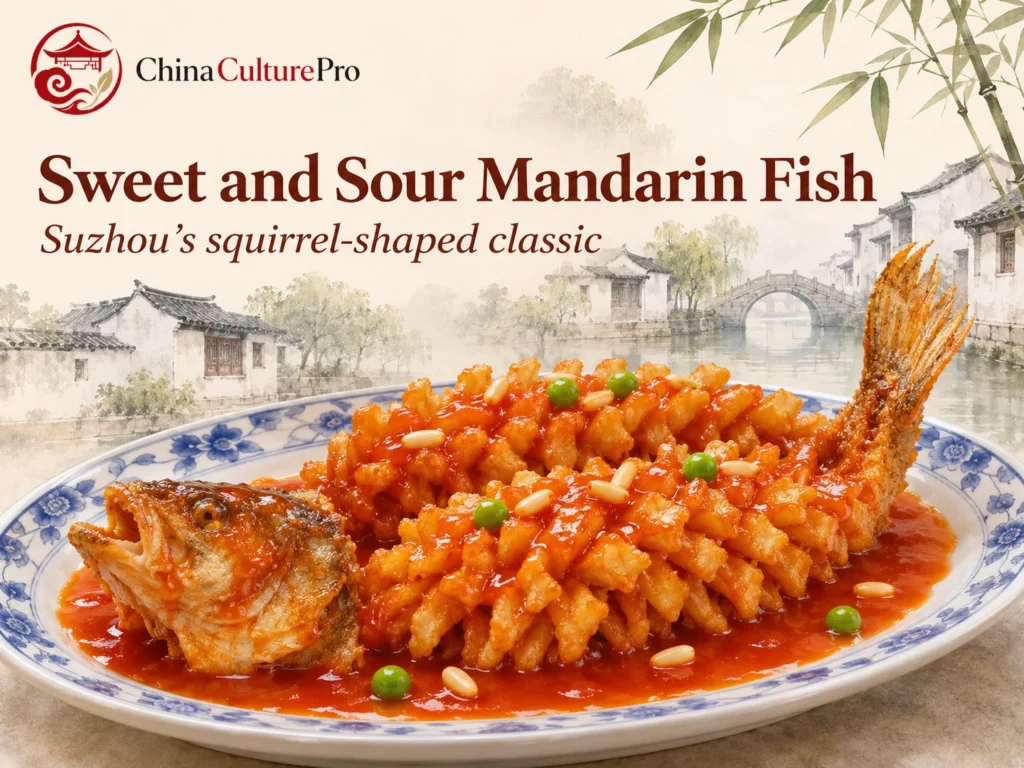

Quick Answer: What Is Sweet and Sour Mandarin Fish?
Suzhou’s squirrel-shaped mandarin fish (松鼠鳜鱼, sōngshǔ guìyú) is deboned, crosshatched, starch-coated and fried so the flesh opens outward, then covered with sweet-and-sour sauce.[2][3]
- “Squirrel” describes the presentation, rather than an ingredient.[3]
- Mandarin fish (鳜鱼, guìyú) is the traditional named fish; other species appear in adaptations.[2][4]
- The skin holds the scored flesh together; cutting through it breaks the structure.[4][5]
This is a skilled whole-fish preparation. A simpler fillet version can preserve the flavour and scoring without reproducing the full display.

Prepare the serving platter and sauce before frying. A large, fragile piece of cooked fish is much easier to move when its destination and lifting tools are already beside the stove.
Suzhou Identity and the Qianlong Legend
The dish belongs to Suzhou cuisine (苏帮菜, sūbāngcài), within the regional setting of Jiangsu cuisine (苏菜, sūcài). Its raised head, arched tail and opened flesh make it an elaborate banquet centrepiece.[2][3]
A familiar story links it to Emperor Qianlong visiting Songhelou in Suzhou: a cook transformed a carp into a squirrel-like dish that pleased the emperor. Both official accounts present this as a story or legend. It does not establish a securely documented inventor, date or original recipe. The distinction between history and legend matters here.[2][3]
The defining feature is the cut-and-fry presentation. A sweet-and-sour fish fillet without that scoring may taste related, but it does not reproduce the same structure.
Fish, Cutting and Sauce Variations
Deboning and scoring are separate jobs: remove the backbone and ribs first, then make intersecting cuts through the flesh while keeping the skin intact. Starch must reach between the opened cuts, rather than sitting only on the surface.[4][5]
Sauce and garnish choices differ:
- Peas and pine nuts: Cooked peas and pine nuts finish some versions.[10]
- Fruit-rich sauce: Another recipe adds pineapple, preserved fruit and goji berries to its sweet-and-sour finish.[5]
- Honey and jelly: A separate chef’s striped-bass recipe uses honey and strawberry jelly in a ketchup-based sauce.[4]
These examples are individual recipes, not fixed rules separating every city or restaurant.
Ingredients for a Whole-Bass Home Version
- Fish coating: 1 whole bass or branzino, 680–900 g, scaled and gutted, scored at ½-inch intervals; ¼ tsp salt; ⅛ tsp white pepper; 2 tsp clear rice wine (米酒, mǐjiǔ); ¼ tsp sesame oil; 1 egg yolk; ⅔ cup cornstarch.[1]
- Vinegar mixture: 3 tbsp sugar; ½ cup hot water; 1½ tsp cornstarch; 6 tbsp white vinegar; 3 tbsp pineapple juice; ¾ tsp salt; ⅛ tsp white pepper.[1]
- Tomato mixture: 1 tbsp ketchup; 2½ tbsp tomato paste; 1½ tbsp hot water.[1]
- Oil and finishing: 6 cups canola oil, with 2½ tbsp allocated to the sauce; 2 tbsp minced onion; 1 tbsp each pine nuts and frozen peas.[1]
Choose a stable, deep vessel that fits the fish and leaves the oil no more than half full. Use dry, long utensils; keep bulk oil in its pot until cool enough to transfer safely.[8]
How to Shape, Fry and Sauce the Fish
Maintain 350°F/175°C oil throughout this home method.[1]
- Mix two bowls. Dissolve sugar in its hot water; mix the vinegar bowl. Mix the tomato bowl separately.[1]
- Shape and dry. Reserve the head; remove backbone and ribs, keeping fillets joined at the tail. Crosshatch deeply without cutting through skin; pat thoroughly dry.[5]
- Coat the grooves. Mix coating seasonings and yolk; coat fish and head. Dust thoroughly with starch; shake off excess.[1]
- Fry the fish. Lower the shaped body carefully using two long tongs, with skin inward. Fry body and head separately. For this egg-coated version, cook the thickest flesh of both to a conservative 160°F/71°C; timing alone is insufficient.[5][7][8]
- Prepare the finish. Fry pine nuts 30 seconds; drain. Heat peas. In a clean pan with allocated oil, cook onion 30 seconds, then tomato mixture 30 seconds.[1]
- Sauce and plate. Restir vinegar mixture; add to the tomato mixture and simmer until spoon-coating but pourable. Spoon over fish; add peas and pine nuts; serve.[1]
Keep hands away from hot oil and support the cooked fish with a broad lifter. Keep raw fish at 40°F/4°C or colder and use within 2 days, or freeze.[6][8]
FAQs About Sweet and Sour Mandarin Fish
Why did the scored flesh fail to open?
Cuts that are too shallow, cuts that break the skin, or starch that does not reach the grooves can compromise the intended shape. Separate the scored sections gently while coating them.[4][5]
Can I use separate fillets?
Skin-on fillets can be scored and fried separately. They simplify the presentation, without the joined-tail display.[1]
Is the finished fish completely boneless?
Do not assume so. Removing the backbone and ribs reduces bones, but inspect for remaining pin bones; the head, fins and tail still contain hard parts. Help diners identify the edible flesh.
How should I store and reheat leftovers?
Separate usable flesh into shallow portions and refrigerate within 2 hours, or 1 hour above 90°F/32°C. Keep at 40°F/4°C or colder for 3–4 days; reheat to 165°F/74°C. The scored crust will soften after saucing and storage.[9]
Sources
[1] Bill Leung. Squirrel Fish in Sweet and Sour Sauce
[2] Suzhou Municipal Government. Squirrel-Shaped Mandarin Fish
[3] Ministry of Culture and Tourism of China. Suzhou Squirrel Fish
[4] John Zhang. The Squirrel-Shaped Mandarin Fish
[5] Import Goods, recipe contributor. Traditional Banquet Dish: Squirrel-Shaped Mandarin Fish
[6] U.S. Food and Drug Administration. Selecting and Serving Fresh and Frozen Seafood Safely
[7] U.S. Food and Drug Administration. What You Need to Know About Egg Safety
[8] Iowa State University. Deep Fat Frying
[9] U.S. Department of Agriculture. How Do I Handle Leftovers Safely?
[10] Sun Hanlong, as demonstrated to Tianmu News. A Chef Demonstrates Traditional Squirrel-Shaped Mandarin Fish