
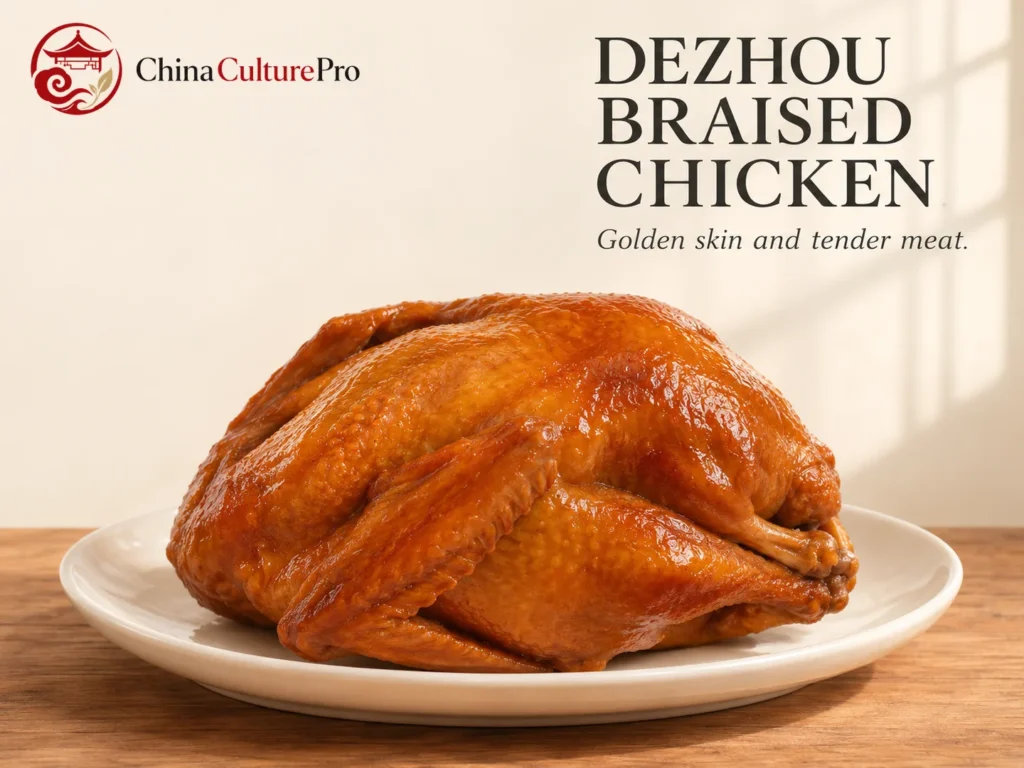

Quick Answer: What Is Dezhou Braised Chicken?
Dezhou paji (德州扒鸡, dé zhōu pá jī) is a Shandong whole-chicken dish known for golden-red skin, aromatic seasoning and meat tender enough to pull easily from the bones. Its home is Dezhou, not the provincial capital Jinan.[1]
- The bird is shaped and colored before its final cooking.
- Frying develops the surface color; stock-braising produces the tender finish.[4]
- It is normally presented as a complete bird, even though the cooked meat separates readily.[1]
“Fall-off-the-bone” describes tenderness, not a guarantee that every bone has been removed.
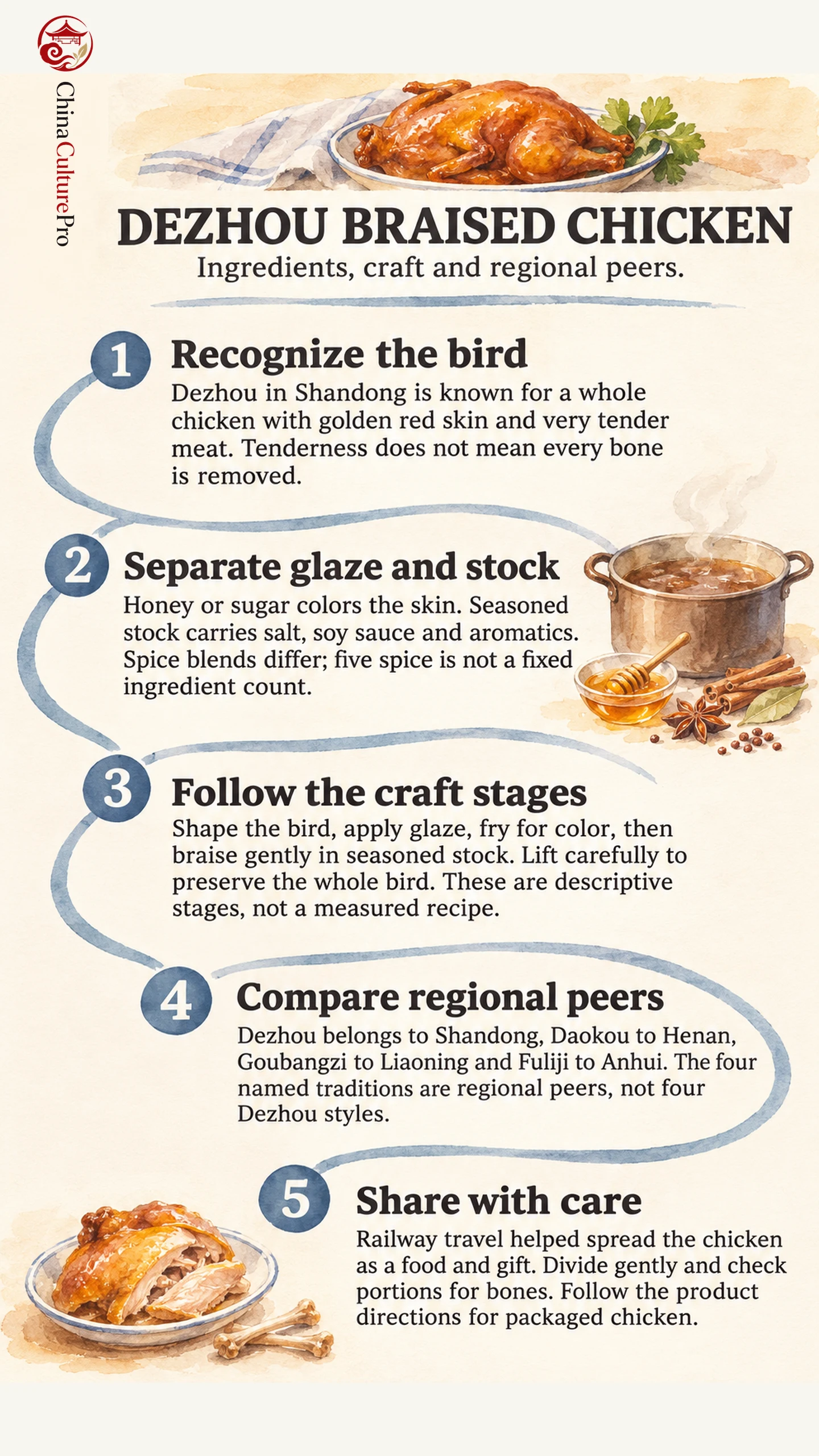
This Shandong food rewards looking beyond its glossy exterior. The final texture comes from wet cooking after frying, so a golden skin should not make you expect the crunch of freshly fried chicken.
Golden Skin and Meat That Pulls from the Bone
The finished bird has golden-red skin over soft, aromatic meat that separates readily from the bones.[1]
The traditional craft entered China’s national intangible cultural heritage list in 2014.[1]
A successful whole-bird presentation therefore involves two goals: tender meat and a bird that can still be lifted and displayed intact. Handling at the end matters as much as the attractive color.
Whole Chicken, Glaze and Spiced Stock
A whole chicken is arranged compactly with its legs tucked in. Honey-water coating and earlier malt-sugar coloring are both documented surface treatments.[2]
The braising liquid is a seasoned stock, often referred to as an old or master stock. An archived local preparation includes salt, soy sauce and aromatics such as cardamom, cloves and nutmeg.[3]
Sichuan pepper, cinnamon, star anise and fennel also appear in documented spice mixtures; a ready-made five-spice powder is not the defining requirement.[2]
How Dezhou Braised Chicken Is Made
The traditional workflow joins a short coloring stage to longer stock cooking. These are descriptive craft stages, not a measured home recipe.[4]
- Shape the bird: arrange the prepared whole chicken into its compact presentation.
- Apply the coloring: coat the surface with the preparation’s honey or sugar glaze.
- Fry for color: fry the glazed bird until the surface takes on its characteristic golden-red appearance.
- Braise until tender: cook in seasoned stock, moving from stronger heat to gentle cooking, then lift carefully to keep the whole bird intact.[2][4]
Dezhou and Three Regional Chicken Traditions
Dezhou is commonly grouped with three other regional chicken specialties as China’s “Four Famous Chickens.” The grouping compares foods from different provinces:[5]
| Dish | Home region | Name or method distinction |
|---|---|---|
| Dezhou paji | Dezhou, Shandong | The whole bird is fried for color, then stock-braised until very tender. |
| Daokou shaoji (道口烧鸡, dào kǒu shāo jī) | Daokou, Henan | A separate regional shaoji chicken tradition. |
| Goubangzi xunji (沟帮子熏鸡, gōu bāng zǐ xūn jī) | Goubangzi, Liaoning | A regional smoked-chicken tradition. |
| Fuliji shaoji (符离集烧鸡, fú lí jí shāo jī) | Fuliji, Anhui | Another regional shaoji chicken tradition. |
These names are not four versions made within Dezhou, and the familiar grouping is not a reason to rank one as the universally best chicken.
A Railway Food and a Shared Dish
Railway travel helped carry Dezhou chicken’s reputation beyond its home city. Passengers buying whole birds at Dezhou became part of its food story, and the chicken also traveled as a gift for family and friends.[4]
At the table, divide the bird gently and check each portion for bones. The soft meat is suited to sharing without carving it like a firm roast. A piece of skin and some meat together give a clearer first taste of the dish than judging it only by its glaze.
If buying a packaged product, use its own serving and storage directions rather than assuming every fresh-counter and sealed version is handled the same way.
FAQs About Dezhou Braised Chicken
What does pa mean in paji?
Pa (扒, pá) here refers to the gentle braising or covered cooking that develops tenderness. Frying is an earlier stage, not the complete cooking method.[2]
Is the chicken already boneless?
No. The traditional presentation is a whole bird; easy separation describes tenderness. Check each portion for bones.[1]
Does five-spice mean only five spices?
No. A documented blend has 16 seasonings, and formulas differ. “Five-spice” is not a universal ingredient count.[1][2]
Sources
[1] China Intangible Cultural Heritage Digital Museum. Dezhou Braised Chicken Traditional Craft
[2] Dezhou University, Yellow River and Grand Canal Culture Research Institute. Dezhou Braised Chicken
[3] Dezhou Regional Gazetteer, Archived Text. Dezhou Chicken Production and Ingredients
[4] China News Service, via the Ministry of Commerce Museum. Dezhou Chicken and Railway Food Culture
[5] Didao Fengwu, via The Paper. A Map of Regional Chicken Foods in China