

Quick Answer: What Is Snow-Cabbage Yellow Croaker?
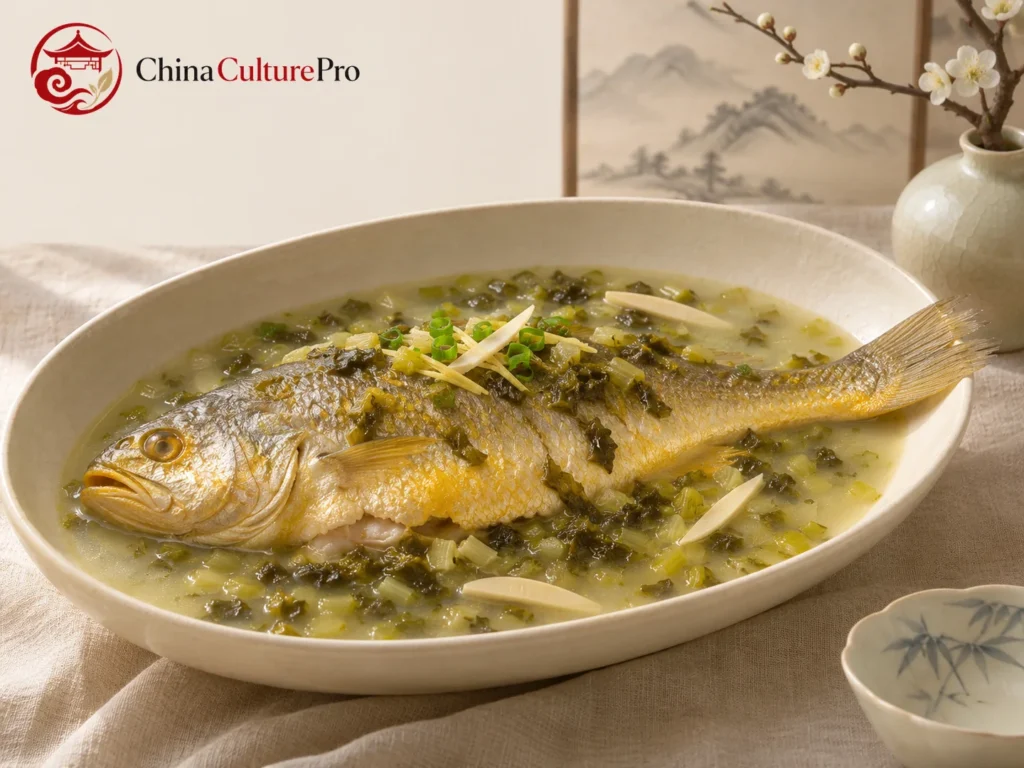
Snow-cabbage yellow croaker (雪菜大汤黄鱼, xuěcài dàtāng huángyú) pairs yellow croaker with preserved mustard greens in a generous soup, especially associated with Ningbo.[1]
- Fish: Yellow croaker supplies tender flesh and seafood flavor.
- Greens: Salt-preserved mustard adds savory depth.
- Broth: Fish and soup are served together.
- Additions: Bamboo shoots, ginger and other seasonings vary.
“Snow cabbage” does not mean fresh cabbage leaves, and the dish is not defined by a spicy red broth.[2][3]
This Chinese fish dish brings coastal seafood and preserved vegetables together. Understanding the greens makes its distinctive savory flavor much easier to recognize.
Snow Cabbage Means Preserved Mustard Greens
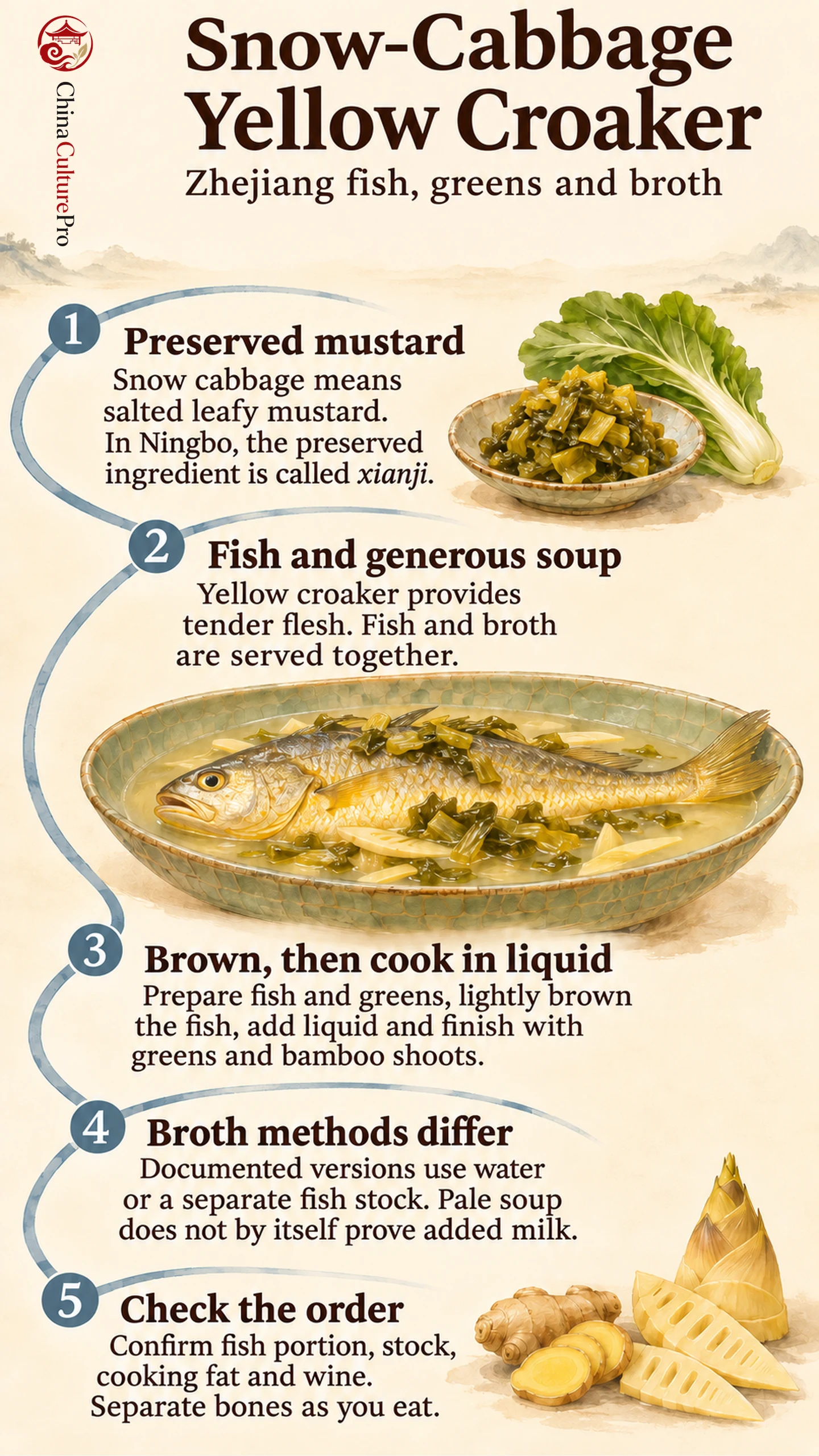
Here, xuecai (雪菜, xuěcài) refers to the preserved mustard greens used with the fish. Ningbo’s local kitchen vocabulary also calls the salted product xianji (咸齑, xiánjī). The starting vegetable is a leafy mustard; it is not a head of napa cabbage.[2]
Salting and preservation change its flavor and texture before it reaches the fish pan. Chopped stems and leaves can contribute small savory bites throughout the broth. This belongs to the wider world of Chinese preserved vegetables, rather than simply adding fresh greens at the end.
Local accounts place preserved mustard in everyday household eating as well as restaurant cooking. Its cultural significance extends beyond this one dish: Ningbo has a museum devoted to the vegetable and its preparation. That background explains the familiar pantry ingredient without requiring a story about a single inventor.[2]
The Fish, Broth and Supporting Ingredients
Yellow croaker is the seafood component. A documented Zhoushan preparation uses a whole fish and describes tender flesh in slightly pale broth. Whole-fish presentation preserves the recognizable form, but also means diners must separate bones.[3]
| Component | Main contribution | Useful distinction |
|---|---|---|
| Yellow croaker | Tender fish and seafood flavor | Confirm the fish form and portion. |
| Preserved mustard greens | Salty, savory vegetable character | Different from fresh cabbage or a complete sauce. |
| Bamboo shoots | A contrasting vegetable bite | Common in documented versions, not a guarantee on every menu. |
| Ginger, scallion and rice wine | Aromatic seasoning | Ask about additions that matter to your diet. |
The name’s soup emphasis matters: the fish is eaten with its cooking liquid, not merely coated in a reduced glaze. A deep serving bowl makes room for both the fish and broth.[1][3]
How the Soup-Style Dish Is Cooked
A Ningbo chef’s demonstration shows the following sequence, with frying and soup cooking serving different functions:[5]
- Prepare the cleaned fish, chopped preserved greens and bamboo shoots.
- Warm ginger and scallion in cooking fat, then lightly brown the fish.
- Add rice wine and the liquid used for the soup.
- Cook the fish in the liquid, then add the greens and bamboo shoots.
- Finish the seasoning and serve the fish with its broth.
The initial browning does not make the finished dish a crisp fried-fish plate. Its final setting is soup, and the greens season that liquid as well as accompanying the flesh. A pale, milky-looking broth is documented in preparations made with water or fish stock; the appearance alone does not prove that milk was added.[4][5]
Ningbo and Zhoushan: Documented Approaches
Ningbo’s culinary heritage record describes fresh croaker combined with finely cut preserved greens, winter bamboo shoots and aromatics. An individual restaurant craft account uses a separate pale fish stock after browning the croaker, followed by greens and bamboo. These examples share the central pairing while handling the broth differently.[1][4]
A Zhoushan technical text from 2012 records another soup-style preparation, using water after the initial frying and including lard among the cooking fats. It documents one local approach; it should not be turned into a rule for every kitchen in Zhejiang.[3]
The dish fits within coastal Zhejiang food culture. Readers also planning a visit can use the Ningbo travel guide for broader city context.
Ordering and Eating Snow-Cabbage Yellow Croaker
Confirm whether the order is a whole fish with soup or another presentation using the same ingredient pairing. Ask about the portion, bamboo shoots and the stock. If avoiding pork, ask specifically about lard: choosing fish does not settle the cooking fat.
Rice wine and compound seasonings also deserve checking when relevant. Fish is an obvious ingredient, while other restrictions depend on the kitchen. Do not judge the full recipe from a photograph or from the color of the broth.
At the table, take fish carefully, separate bones and spoon broth into your own bowl. The preserved greens are part of the dish and may be eaten with the fish. Ask about rice separately rather than assuming the fish arrives as a complete individual set.
FAQs About Snow-Cabbage Yellow Croaker
Does Snow Cabbage Mean Fresh Cabbage?
No. The ingredient here is preserved leafy mustard, known locally in Ningbo as xianji. Its salted character is central to the pairing.
Why Can the Broth Look Milky?
Published preparations produce pale broth with fish, cooking fat and water or fish stock. Milk is not required by those versions; check the actual ingredients if dairy matters.[3][4]
Is This the Same as Spicy Pickled-Fish Soup?
No. The dish described here centers on yellow croaker and Ningbo-style preserved greens. Similar English translations do not guarantee the same fish, seasoning or cooking method.
Sources
[1] Ningbo Intangible Cultural Heritage. 状元楼宁波菜烹饪技艺
[2] Ningbo Archives. 小小一株菜开出一家博物馆
[3] Zhoushan Municipal Cooking Specification. DB3309/T 38—2012: 雪菜大汤黄鱼
[4] Dongfuyuan / Ministry of Commerce Digital Museum. 东福园
[5] Liu Ting, Wu Yidan and Li Jingping / Yongpai. 雪菜大黄鱼 宁波人挥之不去的乡愁