

Quick Answer: Who Was Sun Simiao?
Sun Simiao (孙思邈, Sūn Sīmiǎo) was an early Tang physician and compiler. Two major medical collections are attributed to him, the Beiji Qianjin Yaofang (备急千金要方, Bèijí Qiānjīn Yàofāng) and Qianjin Yifang (千金翼方, Qiānjīn Yìfāng).[1][3][4]
- Life: The dynastic biography places his death in 682. His birth year is debated.
- Books: The first collection organized existing medical knowledge. The second extended it.
- Ethics: The essay on the excellence and sincerity of the Great Physician (大医精诚, Dàyī Jīngchéng) connects learning with care for patients.
Read the collections as historical records of medical knowledge and professional conduct.
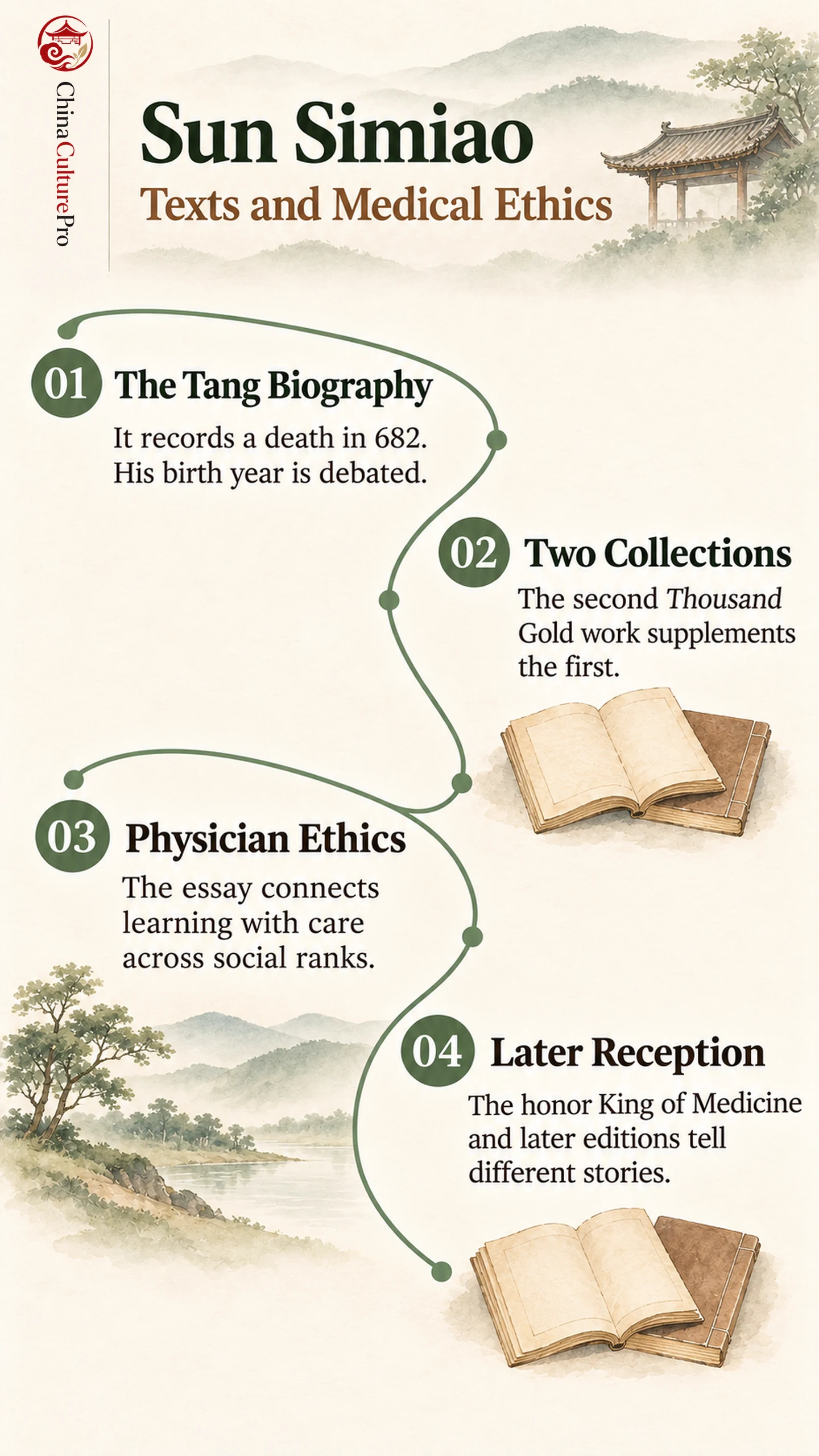
Sun Simiao’s legacy can be read in a dynastic biography, a physician’s essay and printed editions of a large collection. Each kind of record answers a different question. Together they show why his name matters in the history of Chinese medicine.
What the Tang Biography Can Establish
The Old Book of Tang identifies Sun as a native of Huayuan in the Jingzhao region, in present-day Shaanxi. It describes a man versed in several intellectual traditions and repeatedly invited to court. According to the biography, he declined official posts, although he remained in contact with rulers and court figures. That combination places his work within the Tang Dynasty without making a court appointment central to his identity.[1]
The biography dates his death to the first year of Yongchun, corresponding to 682. It also transmits conflicting impressions of his age. The conventional birth year is 581, but modern writers have questioned how early anecdotes and reported ages fit that year. A date of birth inferred from such details has a different evidentiary basis from the recorded year of death.[1][3][5]
The Two Thousand Gold Collections
The title of the first collection expresses the value of a prescription in the language of a thousand pieces of gold. Its traditional compilation date is around 652. The work assembles earlier writings and covers many kinds of practice, including discussions of children’s and women’s health, diagnosis and the character of a physician. The arrangement gives readers a way to see what the compiler chose to group together, including professional conduct and technical practice.[3][4]
The Qianjin Yifang is a separate supplementary work. It brings in additional material, some of it on the substances used in medicine and their preparation. The pairing matters for readers of Chinese medicine history. An English title containing “Thousand Gold” can refer to the first book, the supplement, or the two works considered together.[3]
A catalogue also describes a particular edition. The Library of Congress record is for an edition in ninety-three juan, or textual divisions. The dynastic biography describes the collection as a work in thirty juan. The two numbers refer to different arrangements of the work. Before using the number to judge which text is longer, check whether the catalogue describes the original work’s arrangement or the divisions of the copy it holds.[1][4]
What the Great Physician Essay Asks of a Doctor
The opening juan of the first collection contains the essay often translated as “On the Excellence and Sincerity of the Great Physician.” Its concern is both intellectual and ethical. The physician must cultivate judgment and maintain attention to the patient even when money, social rank, familiarity or personal discomfort might encourage a different response.[2][3]
The essay asks the reader to imagine a physician’s responsibility from the patient’s side. It asks the physician to regard a stranger’s suffering with the concern one would feel for a person close to them. That duty extends across differences of wealth and standing. The essay also warns against seeking reputation or gain through the encounter. Those claims explain why a discussion of moral conduct belongs at the start of a collection that also deals with highly technical material.[2][3]
Modern writers sometimes compare the essay with the Hippocratic Oath. The comparison can orient readers to medical ethics, while the form remains different. This is an account of how a great physician should act, set within a Chinese medical collection. Reading it in that setting shows how competence and humane attention reinforce one another.[2][3]
The King of Medicine and the Printed Record
Later communities honored Sun Simiao as the King of Medicine (药王, Yàowáng). That title belongs to the history of his veneration. A printed edition, by contrast, can show how his work was divided, copied or presented to later readers. The title records an honor, while the book records transmission.[3][4]
For a first reading, begin with the ethics essay and then open a library record for the collection. Notice the difference between the original work’s attributed date and the date of the edition on the screen. Historical prescriptions show how past practitioners wrote about health and illness. A discussion of modern evidence for traditional Chinese medicine requires its own sources.
FAQs About Sun Simiao
Why is Sun Simiao called the King of Medicine?
King of Medicine is a later honor associated with his reputation as a physician and the continuing reception of his works. The title belongs to cultural and religious veneration.
Did he write a Chinese Hippocratic Oath?
It is a modern analogy. The Chinese text is an essay about the skill and conduct expected of a physician. It appears near the start of the first Thousand Gold collection.
Can the Thousand Gold books be used as medical instructions today?
Their value here is historical. Assessing safety and effectiveness requires modern evidence. The collections describe historical practice and do not provide individual care.
Sources
[1] Old Book of Tang, chapter 191. Biography of Sun Simiao
[2] Sun Simiao, Beiji Qianjin Yaofang, juan 1. On the Excellence and Sincerity of the Great Physician
[3] Stanford Encyclopedia of Philosophy. Chinese Philosophy and Chinese Medicine, section 3.3
[4] Library of Congress. Sunzhenren bei ji qian jin yao fang: jiu shi san juan
[5] Zhen-Min Song, Chinese Journal of Medical History. Latest evidence about longevity of Sun Simiao