


Quick Answer: What Is Suan La Fen?
Suan la fen(酸辣粉,suān là fěn)is a sour-and-spicy starch-noodle dish associated with Sichuan and Chongqing. A familiar bowl combines slippery glass noodles, strongly seasoned broth and contrasting crunchy toppings.[1]
- The strands: Sweet potato starch noodles are characteristic, with a translucent, springy texture when cooked.
- The flavor: Vinegar, chili and Sichuan pepper bring different sensations.
- The finish: Pickled vegetables, crunchy beans or nuts and fresh herbs can complete the bowl.
The name describes a flavor and noodle preparation, not a guarantee about every ingredient. Meat-free-looking bowls and packaged versions still require a check of their stock, sauces and toppings.
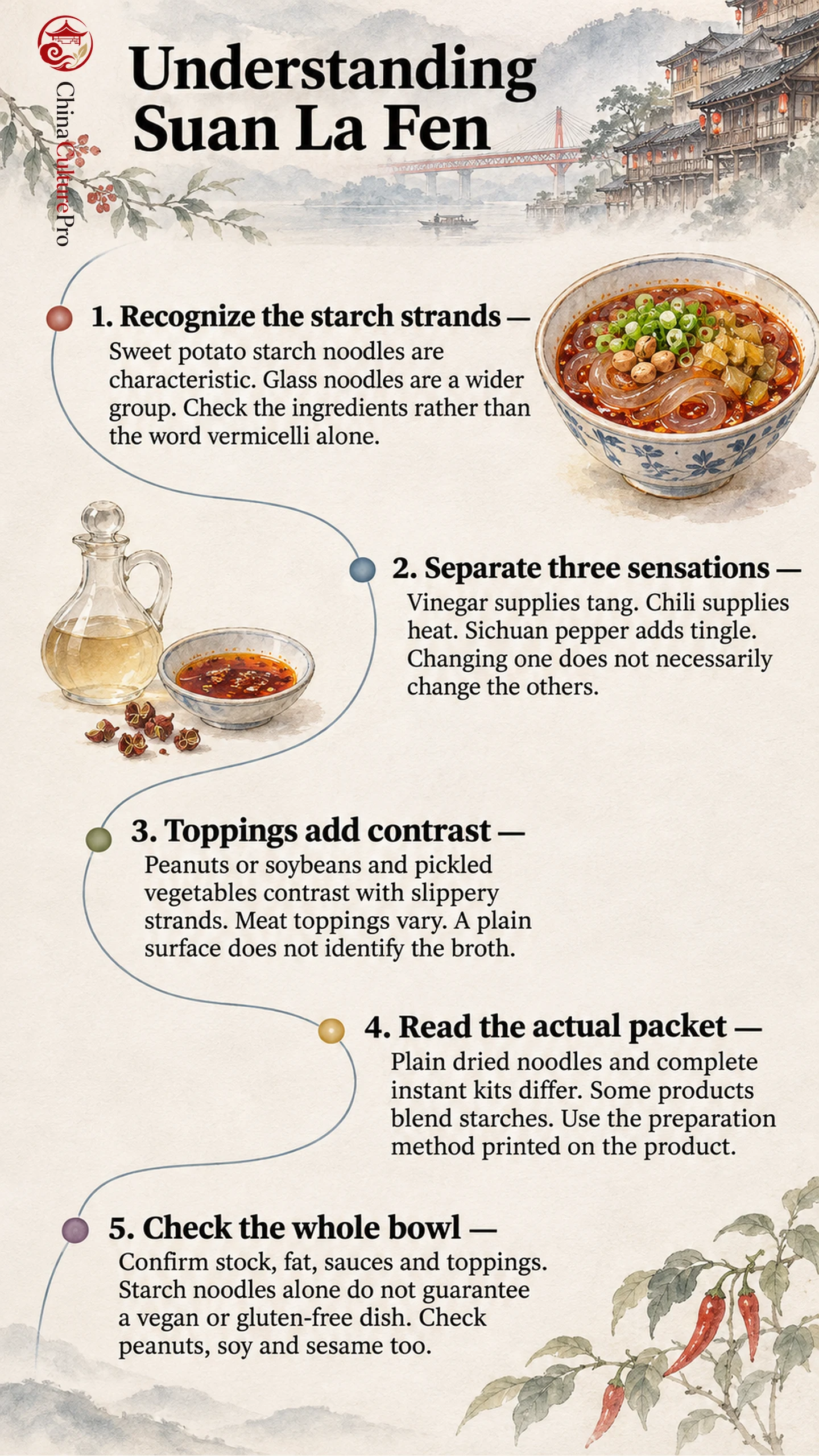
Translucent strands coil beneath red oil, with chopped pickles and crunchy toppings breaking up the surface. A mouthful can be tangy, spicy and tingling, but the noodles themselves supply a different pleasure: a slippery, yielding chew. Within the Chinese noodle family, its starch base and contrasting toppings make a distinctive combination.
Starch Noodles, Not Rice or Wheat Noodles
Sweet potato starch is central to many familiar versions. Chongqing’s own local food mapping describes regional sweet potato starch noodles and their use in sour-and-spicy bowls, hot pot and other dishes.[2] The material helps explain why these strands look and feel different from opaque wheat noodles.
“Glass noodles” describes a wider group of translucent starch noodles, not one universal ingredient. Rice noodles are another category, and the word “vermicelli” on an English packet can refer to different products. Read the ingredient list rather than relying on that English shape name to identify the starch.
In the finished bowl, the strands are pliable and springy, with a different bite from the crisp toppings. Product thickness and processing differ, so one fixed soaking or cooking instruction cannot cover every noodle sold for this dish.
Sourness, Chili Heat and Sichuan Pepper
The characteristic sensations have separate sources. In a cook’s published preparation, black rice vinegar supplies the tang, chili oil supplies heat, and ground Sichuan pepper adds a tingling quality. Garlic and soy sauce contribute aromatic and savory notes.[3] The guide to Chinese chili oil explains that condiment as a separate ingredient.
Sourness is not another name for chili heat, and the pepper’s tingle is a third sensation. A bowl can emphasize one more than another. Asking only for “less spicy” may leave the vinegar level and Sichuan pepper unchanged; specify which part you want adjusted.
The liquid base can be vegetable or chicken stock, or a differently seasoned base depending on the kitchen.[3] A red surface does not reveal the stock beneath it. Likewise, a pale-looking version is not proof that it contains no chili or animal ingredients. Check the base as well as the visible oil.
Crunchy Toppings and Street-Food Bowls
Crunch gives the soft strands a counterpoint. Peanuts or fried soybeans, pickled vegetables, scallions and cilantro are familiar finishing choices. A Sichuan cook’s account also describes street-food versions with minced pork, braised beef or intestines, while presenting a simpler bowl without those meat toppings.[4]
That range matters when ordering. The starch noodles and sour-and-spicy seasoning identify the familiar dish together; a meat topping adds another layer. A picture with one topping does not establish what every shop serves, and a plain order may still contain an animal-based broth.
The dish fits the individual-bowl setting of Chinese street food and the wider flavor landscape of Sichuan cuisine. Ask about the available topping and seasoning choices before the bowl is assembled. Mixing the strands through the liquid distributes the seasoning, while leaving crunchy additions on top preserves their contrast at first bite.
Packaged Suan La Fen and Product Instructions
A complete instant kit and a packet of plain dried starch noodles are different purchases. The kit contains seasoning components; plain noodles still need a separately prepared soup or dressing. Their appearance does not determine whether they require soaking, boiling or cup preparation.
One manufacturer’s hot-and-sour cup lists both sweet potato and potato starch in its noodles and gives a boiling-water cup method. Its sauces also list wheat-containing ingredients.[5] This illustrates why neither “all sweet potato” nor “the whole cup is gluten-free” follows automatically from the dish name.
Use the directions on the actual product. A cup designed for steeping does not establish that any dried starch noodle can be prepared the same way. Read the noodle and seasoning components together, including any separately enclosed garnishes. Product recipes can change, and the package in hand is more specific than a general online dish description.
Vegetarian, Gluten and Allergen Checks
For vegetarian or vegan ordering, confirm the stock, cooking fat, seasoning pastes and toppings. Removing meat from the surface leaves any animal-derived ingredients in the soup. A plant-based version needs those components checked together; see the broader guide to Chinese vegetarian food.
Pure sweet potato starch does not contain wheat gluten, but the assembled dish may introduce wheat through soy sauce or other seasoning. A specific packaged vinegar or sauce may contain gluten-bearing grains, so inspect its ingredients rather than assuming every product in that category is identical.
Peanuts, soy and sesame are further checks, alongside any additional meat, egg or seafood garnish. The FDA identifies wheat, peanuts, soy and sesame among major food allergens and emphasizes ingredient-label information.[6] Picking off visible nuts does not address ingredients already mixed into the bowl or contact through shared tools. Ask the kitchen about preparation as well as the topping list.
FAQs About Suan La Fen
Is suan la fen made with rice noodles?
The characteristic strands are starch noodles, commonly sweet potato-based. Rice noodles are a different material, even when an English menu calls both “vermicelli.”
Is suan la fen gluten-free?
Not automatically. Check the complete seasoning, broth and preparation environment as well as the noodles.
Can suan la fen be vegetarian or vegan?
Yes, with a suitable plant-based soup and seasonings. Removing a meat topping alone does not establish that.
Can every packet be prepared with boiling water?
No. Follow the actual product directions; plain dried noodles and instant cup kits have different preparation requirements.
Sources
[1] Judy, The Woks of Life. Chongqing Hot and Sour Glass Noodle Soup
[2] Chongqing Planning and Natural Resources Bureau. Chongqing Food Map: Regional Starch Noodles
[3] Wei Guo. Suan La Fen: An Authored Hot-and-Sour Noodle Preparation
[4] Elaine. Hot and Sour Noodles: Toppings and a Simpler Home Version
[5] Yihai US Food. Hot and Sour Vermicelli Cup: Ingredients and Preparation
[6] U.S. Food and Drug Administration. Food Allergies: What You Need to Know