
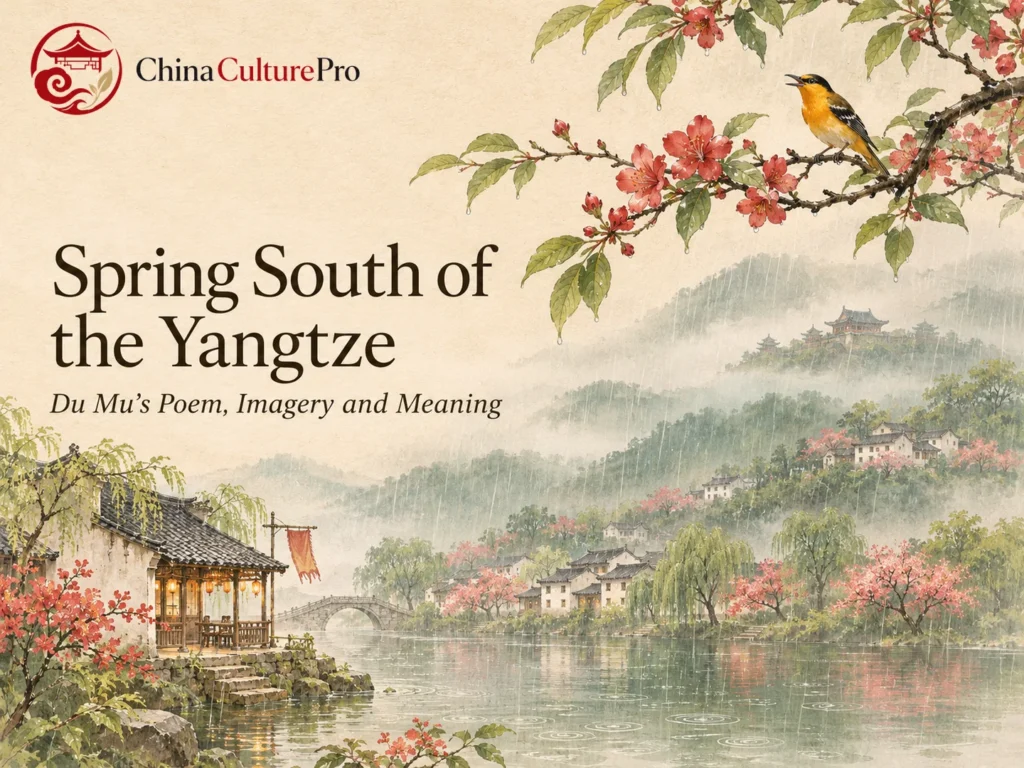

Quick Answer: What Is Spring South of the Yangtze?
Spring South of the Yangtze(江南春,jiāngnán chūn)is a poem by Du Mu(杜牧,dù mù; 803–852), a Tang poet.[3][4]
- Setting: Jiangnan(江南,jiāngnán), here the region south of the lower Yangtze.[3]
- Form: A seven-character jueju(绝句,juéjù), or quatrain: four lines of seven Chinese characters.[1][3]
- Movement: Birdsong and vivid colour lead toward old temple buildings in misty rain.[1]
It presents a regional panorama; its large numbers should not be read as a measured viewpoint or an exact temple census.[2]

Twenty-eight Chinese characters hold a wide scene: birds, blossom, villages, taverns and temples. The reading below follows its images before considering the historical reference in its closing pair.
The Poem: Chinese, Pinyin and an English Rendering
The text below uses simplified characters. This English rendering follows the Chinese images without attempting to reproduce its rhyme. The third line names the Southern Dynasties(南朝,náncháo).[1]
| Chinese | Pinyin | English rendering |
|---|---|---|
| 千里莺啼绿映红, | qiān lǐ yīng tí lǜ yìng hóng | A thousand li of oriole song, green leaves bright against red blossom;[1] |
| 水村山郭酒旗风。 | shuǐ cūn shān guō jiǔ qí fēng | Waterside hamlets, hill-walled towns: tavern banners catch the wind.[1] |
| 南朝四百八十寺, | nán cháo sì bǎi bā shí sì | The Southern Dynasties’ temples—four hundred and eighty;[1] |
| 多少楼台烟雨中。 | duō shǎo lóu tái yān yǔ zhōng | How many towers and terraces lie veiled in mist and rain?[1] |
How the Four Lines Build a Landscape
Oriole calls meet green and red: the opening joins hearing and vision. “A thousand li” opens a regional panorama.[1][2]
The second line gathers human settlements into the landscape. Tavern flags advertise wine shops; their movement makes the wind visible.[1][2]
The last pair shifts attention toward temple architecture. Earlier colours remain in the reader’s memory, but rain now softens outlines and distance. On this reading, the poem gains depth by changing visibility rather than describing every building in detail.[1]
The Southern Dynasties and the Temple Reference
The Southern Dynasties (420–589) preceded Du Mu’s Tang lifetime. These four regimes—Song, Qi, Liang and Chen—had their capital at Jiankang, today’s Nanjing. Earlier Buddhist temple building thus gives the scene historical depth. “Four hundred and eighty” emphasizes abundance, rather than supplying a verified inventory.[2]
Scenery, History and Possible Meanings
Read as scenery, the poem celebrates a region through concentrated sound, colour, settlement and weather. Read historically, the older temples introduce time into the view: buildings endure beyond the regimes associated with them. That can suggest reflection on change, but this is an interpretation, not a statement the poem explains outright.[1]
Nor do these four lines alone establish an attack on Buddhism. Scholar Liu Yongxiang, discussing another Du Mu temple poem, points to his repeated attraction to Jiangnan rain imagery, including this poem. Its visual pleasure deserves attention alongside any historical interpretation.[5]
How to Read the Poem Closely
- Hear and see: Read each line aloud, then separate the sounds, colours, places and moving objects.
- Find the shift: Compare the opening red and green with the rain-veiled architecture at the end.
- Test a reading: Decide which words support your interpretation of beauty or historical change, and which conclusions require outside evidence.
For another example of landscape shaped by viewpoint, compare Huang Tingjian(黄庭坚,huáng tíngjiān)and his river-and-moon scene in Climbing Kuai Pavilion.
FAQs About Spring South of the Yangtze
Did Du Fu Write Spring South of the Yangtze?
No. The author is Du Mu, not Du Fu(杜甫,dù fǔ). They are different Tang poets.[2]
Does the Poem Describe Exactly 480 Temples?
No. It conveys a great many temples, not a historical census.[2]
Does the Mist Mean the Temples Are Burning?
No. Here, “mist and rain” means hazy weather around the buildings.[1][2]
Sources
[1] Du Mu, Wikisource. 江南春
[2] Hong Kong Education Bureau. 江南春: Text and Annotations
[3] Shanghai International Services. Ancient Poem: Spring on the Southern River Shore
[4] Chinese University of Hong Kong, Renditions. Du Mu
[5] Liu Yongxiang, East China Normal University. “帘幕”与“五湖”:读杜牧《题宣州开元寺水阁》诗