


Quick Answer: What Is San Da Pao?
San Da Pao (三大炮, sān dà pào), often translated as “Three Big Cannons,” is a Chengdu sweet snack of glutinous rice balls, soybean powder and dark sugar syrup.[1][2]
- Three rice balls form the characteristic serving.
- Tossing them creates three loud, metallic sounds.
- The soft rice contrasts with a dry powder coating and sweet syrup.[3][4]
The name belongs to the serving performance; it does not describe a spicy or explosive ingredient.[1][2]
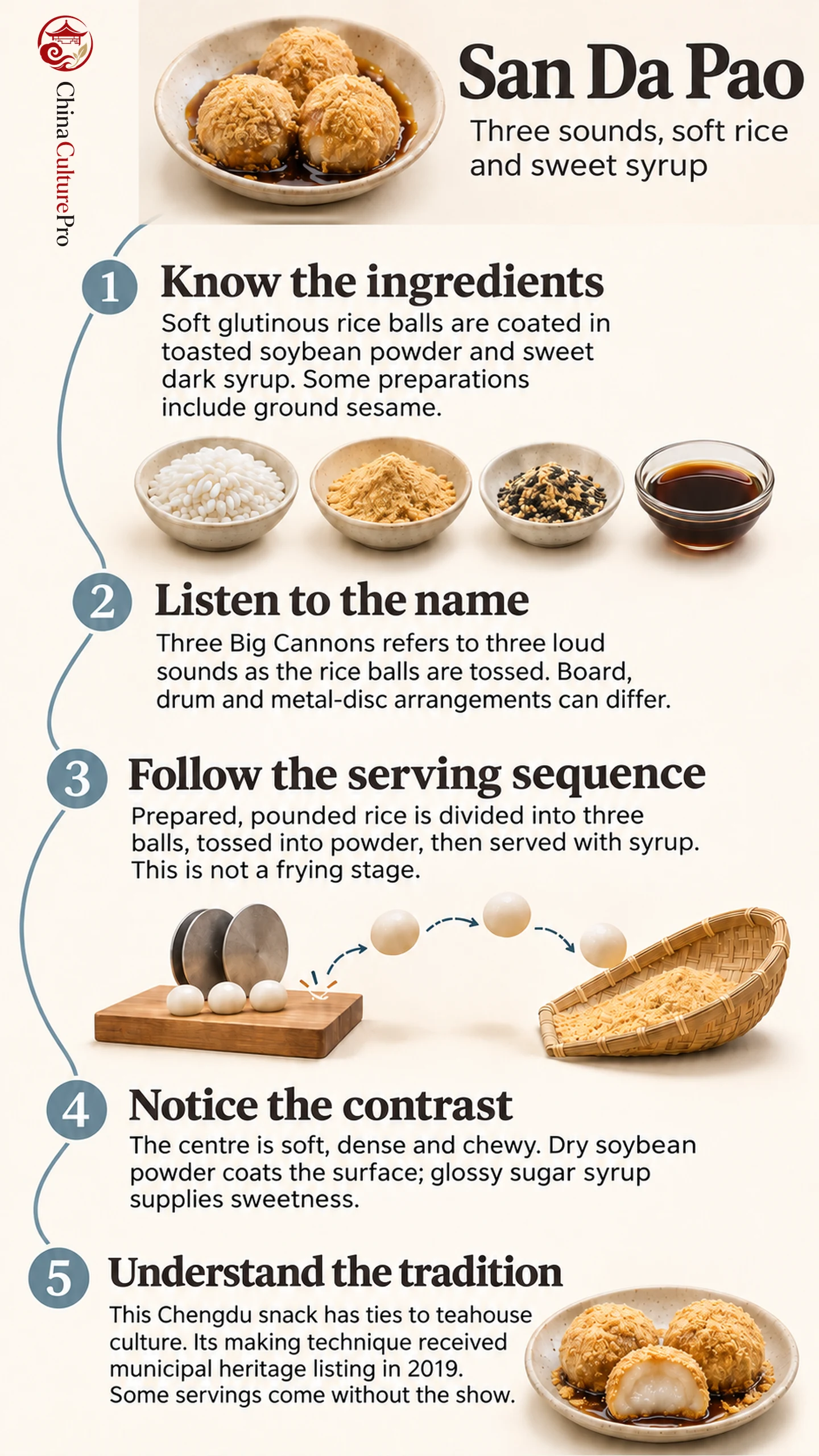
Sticky Rice, Soybean Powder and Sweet Syrup
The recipe has a short ingredient list, but each part creates a different sensation:[2][4]
| Component | Role |
|---|---|
| Cooked, pounded glutinous rice | The soft, chewy centre |
| Toasted soybean powder | A dry coating with a nutty character |
| Ground sesame, in some versions | Additional toasted fragrance |
| Brown or dark sugar syrup | A sweet coating over the finished balls |
Sesame appears in observed preparations, while the official core description centres on rice, soybean powder and sugar syrup. Coatings can vary.[1][4]
How the Three-Sound Performance Works
The rice is prepared before the show begins. In one interview, a maker explained that preparing it the previous evening and steaming it twice helped produce the desired chewiness. This is a reported craft practice, not a universal household timetable.[2]
At the serving stand, the sequence is easier to follow:
- Pull portions from the prepared, pounded sticky rice and form three balls.
- Throw them in succession against the striking surface, producing the three-sound rhythm.
- Let them land in a sloping basket and roll through soybean powder.
- Transfer the coated balls to a bowl and add sweet syrup.[1][3]
Accounts describe different board, drum and metal-disc arrangements. The important connection is between the toss, the clatter and the powder-coated landing, rather than one identical piece of equipment.[1][2][3]
Soft Rice and a Dry, Nutty Coating
Firsthand descriptions emphasise soft, dense, yielding rice. The powder creates a drier surface and helps separate the sticky balls; syrup adds a contrasting glossy sweetness. This is a rice-and-coating snack, rather than a crisp pastry.[3][4]
Its combination of sound and texture makes it distinctive within Sichuan cuisine, which includes sweets as well as its better-known savoury dishes.
A Chengdu Snack with a Living Craft Tradition
The city’s heritage record traces the developing craft to Li Hongxing and his son Li Changqing, who came to Chengdu in the 1930s–1940s and worked from a family rice-cake technique. It records municipal intangible-cultural-heritage listing in 2019.[1]
An account of earlier selling places connects the snack with teahouses, where tea drinkers could step outside to buy a portion. Watching the preparation is part of its street-food appeal.[2]
FAQs About San Da Pao
Why is it called Three Big Cannons?
The name refers to three loud sounds made while the rice balls are tossed at the serving stand.[1]
Are the rice balls deep-fried?
The traditional process described here uses prepared steamed, pounded glutinous rice. The tossing stage is for presentation and coating, rather than frying.[2][3]
Does every serving come with the performance?
Not necessarily. A firsthand account notes that some sellers serve the snack without the throwing-and-clanging show.[4]
Sources
[1] Chengdu Intangible Cultural Heritage Protection Centre. Traditional San Da Pao Making Technique
[2] GoChengdu. San Da Pao: Snack of Shows and Sounds
[3] Frank Kasell. China’s Most Percussive Street Food
[4] Itchy Feet on the Cheap. Three Big Cannons