


Quick Answer: What Is This Record of the Pavilion of the Drunken Old Man?
Record of the Pavilion of the Drunken Old Man (醉翁亭記, Zuìwēng Tíng Jì) is a calligraphy scroll catalogued by the National Palace Museum, Taipei, as a work by Wen Zhengming (文徵明, Wén Zhēngmíng), dated 1551. Its 53.5 × 28.6 cm paper surface uses small regular script (小楷, xiǎokǎi) to copy a classical essay, followed by a long colophon. The museum retains this attribution, but scholars have challenged the work’s authenticity.[1][3]
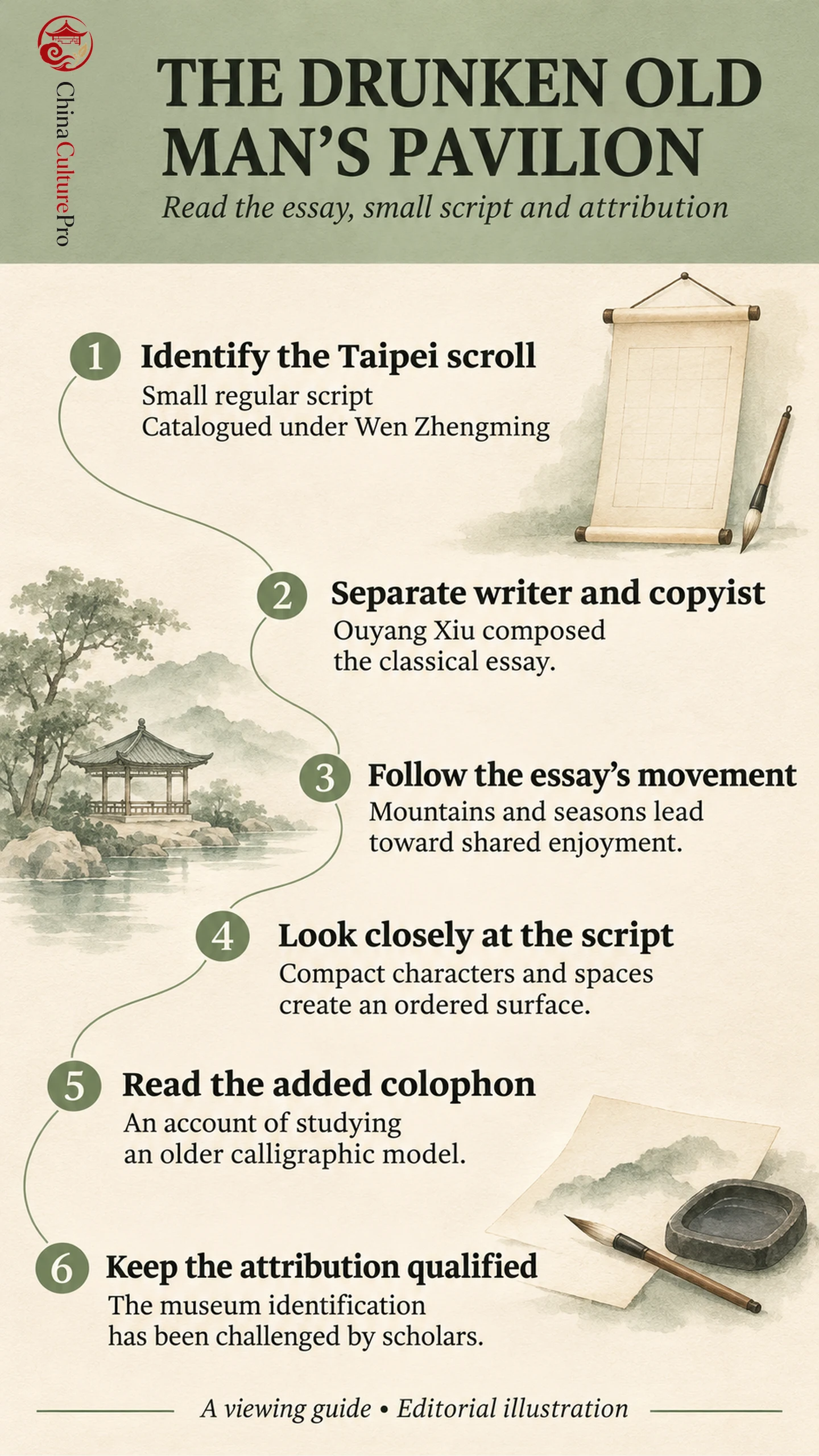
At a distance, the tiny characters form a quiet rectangle on a tall mounting. Enlarge the writing and the surface becomes more active: angled strokes, compact interiors and carefully maintained spaces carry a long essay and an additional commentary. Reading it involves both literary meaning and the identity of the hand that copied it.
The Taipei Small-Regular-Script Scroll at a Glance
| Field | Identification |
|---|---|
| Collection attribution | Wen Zhengming |
| Date carried in the colophon | 1551 |
| Medium and format | Ink on paper; hanging scroll |
| Written surface | 53.5 cm high × 28.6 cm wide |
| Script | Small regular script |
| Contents | Classical essay followed by a colophon |
| Collection number | 故書000017 |
The size belongs to the written paper rather than the tall mounting surrounding it.[1] This guide concerns the compact small-script scroll, whose identity and attribution should be kept separate from other versions of the same essay. The wider artistic setting appears in Wen Zhengming’s works and legacy.
Ouyang Xiu’s Essay Moves from Scenery to Shared Joy
The essay’s author is Ouyang Xiu (歐陽修, Ōuyáng Xiū), a Northern Song writer, rather than the Ming calligrapher named on this scroll. It begins with the mountains around Chuzhou, narrows toward the pavilion, and expands again into changing seasons, an outing and a feast. The closing passage identifies the governor who shares the gathering’s enjoyment.[1]
Three selected passages show that movement. These are plain English senses translated from the classical text:
- 醉翁之意不在酒。在乎山水之間也。: The old drunkard’s interest is not in wine, but in the mountains and waters.
- 四時之景不同。而樂亦無窮也。: The scenery differs through the four seasons, and the enjoyment is inexhaustible.
- 醉能同其樂。醒能述以文者。太守也。: The one who shares their enjoyment when drinking and describes it in writing when sober is the governor.
The title’s drinking is therefore part of a larger subject. Landscape provides pleasure, but the essay also asks what it means to share that pleasure with others. Its ending connects experience with the ability to describe and preserve it in prose. For more of the author’s literary and public life, see Ouyang Xiu.
Small Characters Build a Dense, Ordered Surface
Look first at the overall rhythm. The writing proceeds in narrow vertical columns, with characters small enough to maintain a close, relatively even texture. Faint ruling supplies a framework, while white spaces between strokes keep the interiors from becoming a solid black pattern.
Now choose one character. A horizontal stroke may begin with a distinct edge, turn into a longer line and end with a controlled change of pressure. Upright and diagonal elements balance within a compact area. The interest lies in these adjustments as much as in the even appearance of the whole sheet.
This is different from expecting a continuous cursive sweep. Individual character structures remain explicit, even though their proportions and spacing participate in a larger rhythm. The guide to Chinese regular script explains that balance between legibility and brush movement.
The Colophon Describes Learning from an Older Model
After the essay, the colophon describes studying calligraphy associated with Wang Xizhi (王羲之, Wáng Xīzhī). The named model is the Huangting Jing (黃庭經, Huángtíng Jīng), or Yellow Court Classic. The writer presents prolonged examination of that model as preparation for this small-script transcription.[1][2]
That account links reading and copying. An older text prompts a new act of writing, while an older calligraphic model supplies an artistic ambition. It gives the viewer a second subject to consider after the essay itself. Wang Xizhi’s calligraphic legacy explains why later writers repeatedly returned to works associated with him.
Because the scroll’s attribution is contested, the colophon should be read as a claim made within the object. Its first-person narrative is not independent proof of Wen’s authorship.
The Attribution Has Been Challenged
The museum continues to catalogue the scroll under Wen Zhengming. A different position appears in Ming-lee Huang’s scholarly reappraisal, which builds on earlier objections by Zhou Daozhen and Zhang Hui. Those objections concern the colophon, handwriting and other features; Huang adds an analysis of textual mistakes in the copied essay.[1][3]
One example is the writing of 野簌 where the essay’s vegetable dishes call for 野蔌. The two similar-looking characters do not carry the same meaning. Huang treats such errors as part of a cumulative argument against the attribution, rather than merely a question of elegant penmanship.[3]
The practical distinction is between a museum’s current identification and agreement among all scholars. You can examine the scroll’s visible structure and its reception without presenting either unquestioned authorship or a settled consensus that it is a forgery.
How to Read the Essay, Script and Colophon Together
- Identify the object: Confirm the Taipei paper scroll and its small regular script.
- Read selected passages: Follow the essay from landscape pleasure toward shared enjoyment.
- Enlarge a few characters: Compare their interiors, turns and spacing within the ruling.
- Separate the colophon: Read its account of artistic study alongside the attribution debate.
FAQs About Record of the Pavilion of the Drunken Old Man
Did Wen Zhengming write the essay?
No. Ouyang Xiu composed the essay centuries earlier. Wen is the calligrapher named in the museum attribution, which remains the subject of scholarly disagreement.
Is this the same as the long running-script version?
No. This guide concerns the small-regular-script hanging scroll in Taipei. Other copies of the essay have different formats and scripts; they should not supply this object’s measurements or attribution evidence.
Does the title mean the work is mainly about drinking?
The essay itself shifts attention from wine toward landscape and shared pleasure. Reading the text reveals a broader social and literary purpose behind the pavilion’s memorable name.
Sources
[1] National Palace Museum, Taipei. Record of the Pavilion of the Drunken Old Man: Collection Record and Text
[2] National Palace Museum, Taipei. Record of the Pavilion of the Drunken Old Man: Selected Collection Commentary
[3] Ming-lee Huang, National Taiwan Normal University. Revaluation of the Small-Regular-Script Record of the Pavilion of the Old Drunkard, 2017