

Quick Answer: What Is Lin Bu’s Two Letters?
Two Letters(手札二帖,Shǒuzhá èr tiè)by Lin Bu(林逋,Lín Bū)preserves two personal messages by the Song poet and calligrapher in the National Palace Museum, Taipei.[1]
- Content: Greetings, a food gift, visits and practical arrangements.
- Viewing focus: The main writing’s open columns, slender strokes and angular turns.
- Format: Two original letter leaves within a larger album containing later additions.
The album’s surrounding writing should be distinguished from Lin’s own letters.
Wide gaps separate the main columns, while much smaller writing fills the margins beside them. Even before reading the messages, that difference in scale raises a useful question: whose writing are we looking at? This Chinese calligraphy guide begins with the two letters, then examines the later material that frames them.
Two Letters within a Larger Album
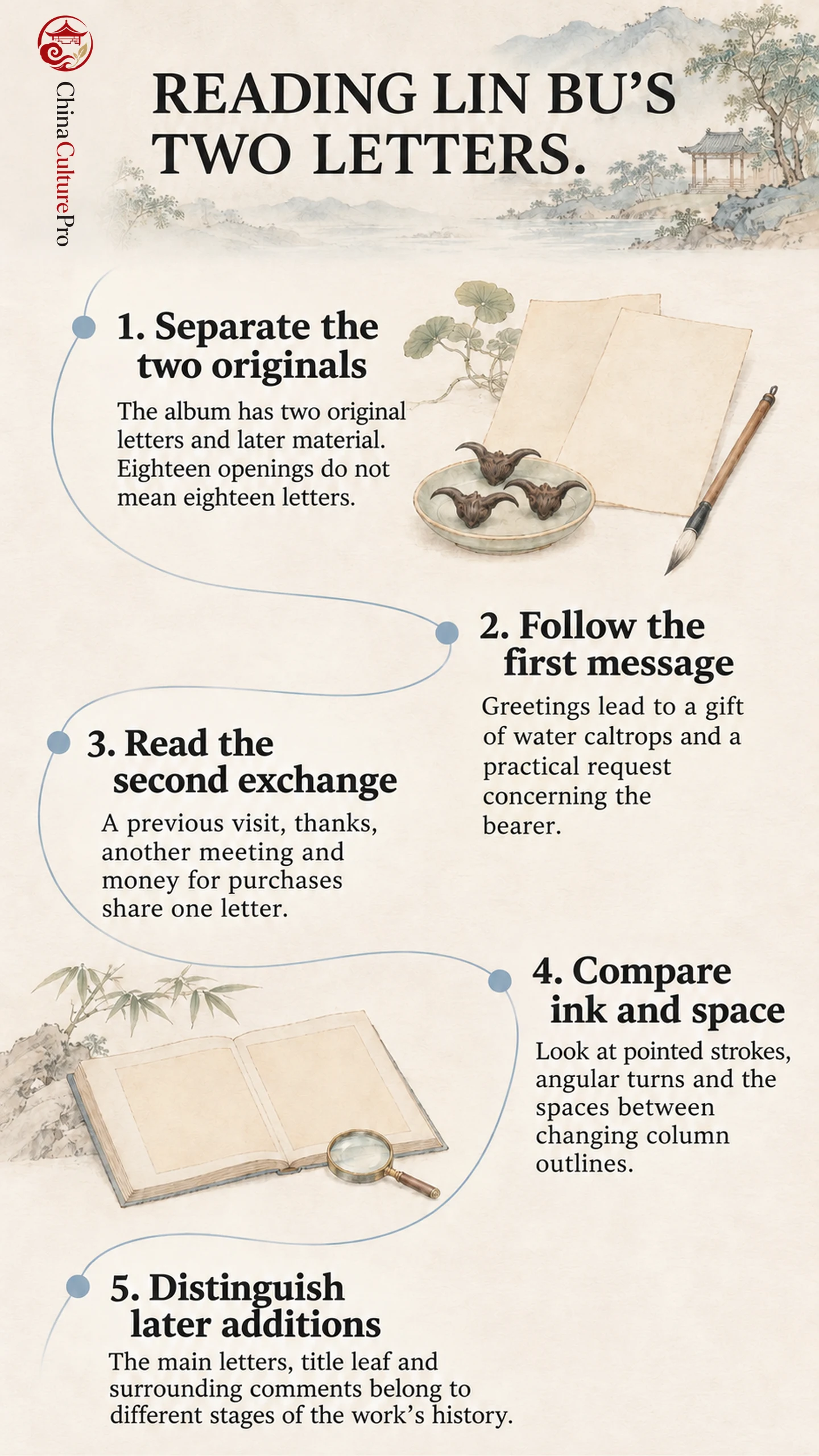
The catalog records eighteen album openings: four preliminary, two containing the original letters, and twelve at the back.[1] Eighteen openings therefore does not mean eighteen letters by Lin. The individual letter records give the following dimensions.[2][3]
| Letter identified by its opening | Height | Width |
|---|---|---|
| Informing from Bu(逋奉白,Bū fèng bái) | 31.4 cm | 35.4 cm |
| Letter to Sanjun(逋奉简三君,Bū fèng jiǎn sān jūn) | 31.5 cm | 38.2 cm |
Both are on paper. These measurements belong to the letter sheets, not the entire mounted openings. In the museum images, the central paper carrying each letter differs visibly from the surrounding area. Begin there before treating the complete opening as a single composition made at one moment.
The First Letter: Greetings and a Small Gift
The first message opens with a wish for well-being in the autumn coolness. Lin asks whether news has arrived since a master’s departure and whether affairs at the recipient’s establishment continue as usual. He then mentions sending a small quantity of water caltrops. At the end comes an additional practical request: someone is to guide the bearer to another household.[2]
The message has a gentle progression from concern to gift to errand. Its modest description of the food keeps the gift within the ordinary language of correspondence, rather than presenting it as a ceremonial offering. Water caltrops are the item named in the text; they should not be silently changed into the different food commonly called Chinese water chestnuts.
The letter bears the twenty-second day, but not a complete dated year. Its reference to autumn is useful for understanding the greeting. It does not establish a precise modern calendar date for the sheet.
The Second Letter: Visits, Thanks and Money
The second letter addresses Sanjun and recalls a visit a few days earlier. Lin explains that other matters prevented him from offering thanks, then asks about another meeting when time permits. A note concerning money for purchases follows: the amount left may be insufficient, with the balance to be dealt with face to face.[3]
Repeated expressions of thanks give the exchange a personal tone. The later money note also changes how the page can be read: correspondence carries courtesies and small unsettled accounts together. Neither feature turns the letter into a formal financial document.
Its written date is the seventeenth day of the fourth month, without a year. Retaining that partial date is more accurate than converting it into an unsupported Gregorian anniversary. The album’s present order does not establish the time between the two letters.
Reading the Spacing and the Brushwork
The museum classifies the letters as running script(行书,xíngshū)and emphasizes their pointed strokes, angular turns and spacious columns.[4] The running-script tradition provides a useful starting point, but the visible differences within these particular pages deserve closer attention.
In the first letter, follow the main columns downward. The tall forms leave open paper beside their narrower strokes, and the shorter concluding areas interrupt any expectation of an even lower boundary. Some strokes appear as firm dark accents; others taper to fine ends. The changing column outlines give the intervening spaces different shapes.
Compare that with the second sheet, where the principal message and the smaller additional writing occupy different portions of the central paper. Resist the temptation to read every size change as a different author: first match the marks to the letter’s transcription. Then compare the main sheet with the much denser texts on its surrounding margins.
The Recluse and the Work’s Later Collectors
Lin lived in reclusion at West Lake in Hangzhou and had studied with Li Jianzhong(李建中,Lǐ Jiànzhōng).[4] His reputation as a recluse can sit alongside the letters’ requests, visits and gifts. The messages show communication with other people; they do not describe a life without social ties. Comparing the letter by Li Jianzhong offers another way to consider everyday correspondence as a vehicle for calligraphy.
The pair later belonged to Shen Zhou(沈周,Shěn Zhōu). Li Yingzhen(李应祯,Lǐ Yìngzhēn)supplied a title leaf for the collection during the Ming dynasty.[5] That title is a later act of appreciation, not a third letter by Lin. The scroll-and-album format guide helps explain why a surviving work may include material added across different periods.
For a focused viewing, compare the two central letters first, then examine how surrounding comments and collection marks change the complete openings. A separate guide to inscriptions and seals can help organize those layers without merging their authors.
FAQs About Lin Bu’s Two Letters
Does Two Letters mean the album has only two leaves?
No. It contains two original letter leaves within eighteen recorded openings, including preliminary and later material.[1]
Do the letters give complete dates?
No. The first supplies a day; the second supplies a month and day. Neither establishes a full year.[2][3]
Can the letters be appreciated without reading Chinese?
Yes. Compare spacing, stroke weight and column outlines, while using a transcription or explanation to understand the messages.
Sources
[1] National Palace Museum, Taipei. Two Letters: Album Record
[2] National Palace Museum, Taipei. Informing from Bu: First Letter
[3] National Palace Museum, Taipei. Offering Letter to San Jun from Bu: Second Letter
[4] National Palace Museum, Taipei. Spotlight on National Treasures: Two Letters
[5] National Palace Museum, via Google Arts & Culture. Title Frontispiece for Two Letters by Lin Bu