

Quick Answer: What Is Leaving the Capital?
Leaving the Capital(去国帖,Qùguó tiè)is a handwritten letter by Xin Qiji(辛弃疾,Xīn Qìjí), preserved as an album leaf in the Palace Museum, Beijing. It records an explanation for delayed correspondence amid official duties.[1]
- Form: Ink on paper, arranged in vertical columns.
- Message: Continuing regard for the recipient despite an interruption in greetings.
- Viewing focus: How a courteous personal message ends with an extended official signature.
The title comes from the letter’s opening situation; this is prose correspondence rather than one of Xin’s lyric poems.
The final column runs far below the short phrases nearby, carrying official titles and the writer’s name. Red seals occupy much of the paper below the message. This Chinese calligraphy guide follows the letter from its seasonal opening to its formal ending, keeping the words distinct from later collecting marks.
The Album Leaf and Its Format
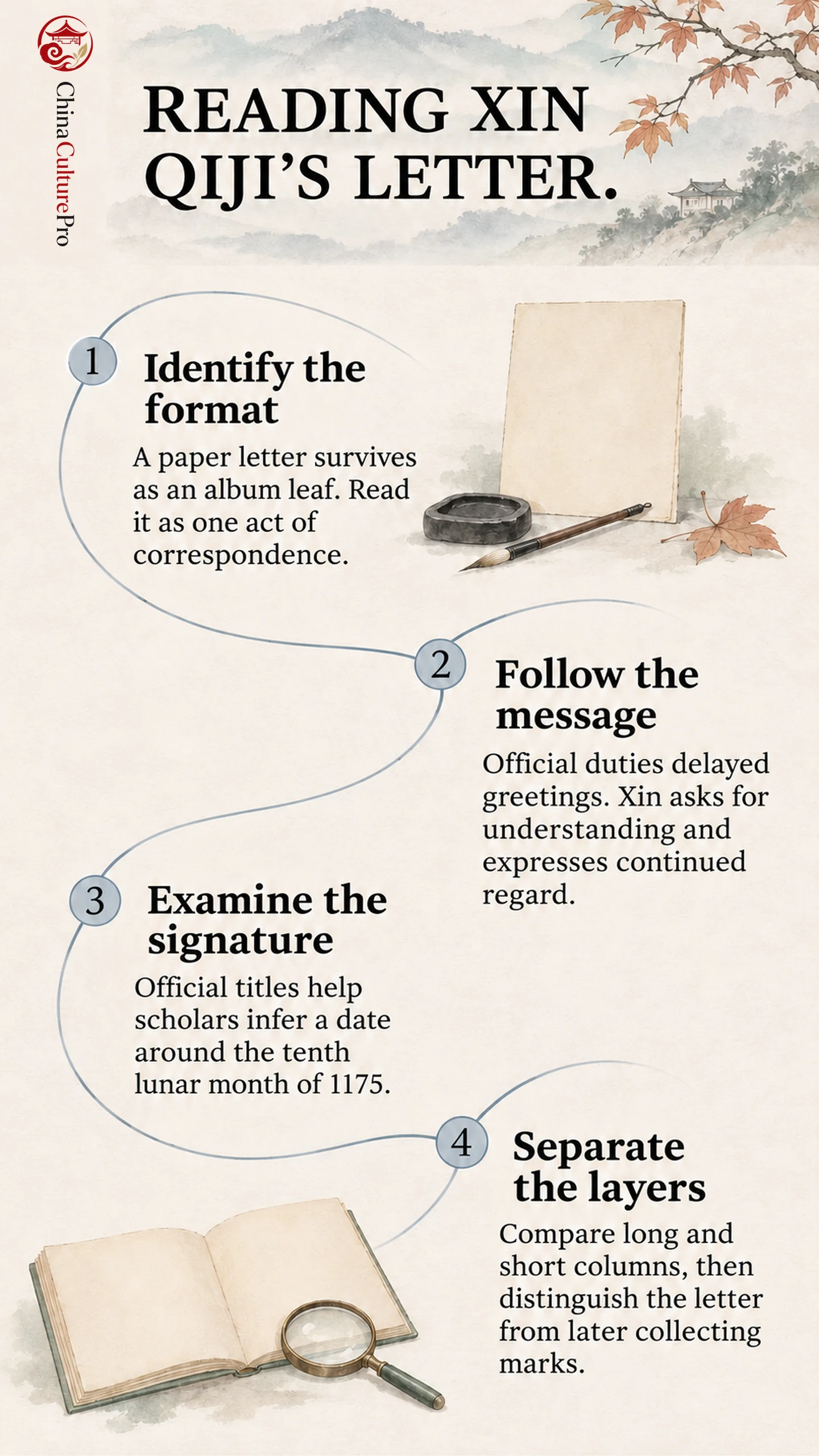
The museum records a paper leaf measuring 33.5 × 21.5 cm, with ten written columns and 110 characters. Its collection identifier is 新00133450-7/16, and it forms part of an album of Song writers’ letters.[1]
“Album leaf” describes the work’s preserved format. It does not mean the message was composed as a page in a continuous literary book. Read the text as an individual act of correspondence, with its own opening, explanation and submission formula. Its placement in an album lets viewers encounter a once-addressed message as a collected work of handwriting.
The narrow upright surface matters to the experience. Several columns finish high on the page, leaving a large area of paper below them. A long column near the right and the closing signature at the left extend much farther downward. The brief message occupies the page unevenly.
What the Letter Says
The opening looks back to departure from the capital in early autumn and registers the arrival of winter. Here the capital is Lin’an(临安,Lín’ān), the Southern Song court’s seat, rather than a reference to leaving China as a modern country.[2]
Xin first assures the recipient that his regard has continued morning and evening. He then explains the interruption: after hurrying to his post, he became absorbed in supervising an operation and dealing with military business and urgent communications. In that pressure, he had scarcely any leisure.
The apology follows from this explanation. His failure to send inquiries about the recipient’s well-being should not be understood as indifference, and he asks for sympathetic understanding. The letter then turns toward a hoped-for meeting. No reunion has been fixed, but his thoughts travel toward the other person.[1]
This progression gives the short message a clear social purpose. It repairs a lapse in correspondence while affirming an ongoing relationship. The official signature does not erase that purpose: the preceding sentences explain how public responsibilities have interfered with private attention.
Compare the two letters by Lin Bu in the Two Letters guide for another example of practical matters surviving within collected calligraphy. The comparison concerns correspondence as a form; the letters have different writers, recipients and circumstances.
Why the Date Is Inferred
There is no explicit year-and-month date in the letter’s closing. The Palace Museum places it around the tenth lunar month of 1175 by connecting its official titles with recorded appointments.[1]
A study by museum researcher Zhao Yi explains the reasoning: the newly awarded title in the signature followed Xin’s role in suppressing an armed tea-trader uprising in Jiangxi. The appointment was granted near the end of the intercalary ninth month, so the study places the earliest likely writing in the following month. This is a historical inference from his career and the letter’s wording, not a date copied directly from the sheet.[2]
That context also keeps the subject precise. The military pressure mentioned here belongs to a domestic operation. It should not automatically be read as an account of campaigning north against the Jin simply because that ambition is prominent in Xin’s wider reputation.
Looking at the Columns and Seals
The museum classifies the writing as running-regular script(行楷,xíngkǎi).[1] The calligraphy-styles guide helps locate that description between more separately formed and more continuously moving kinds of writing.
Begin at the upper right. The opening name is small beside the broader forms in the next column. Across the main message, compare compact characters with long descending strokes, and short horizontal strokes with more expansive curved movements. The spacing changes within the columns as well as between them.
Near the left, the formal submission occupies short columns before the long line of titles and signature descends toward the lower edge. The long closing line gives formal rank a prominent place within a message about personal regard. Read it with a transcription: apparent empty areas do not turn the prose into separate lines of poetry.
The red impressions form another pattern, concentrated below and around the black writing. The museum identifies numerous collectors’ seals on the leaf.[1] Their prominence is evidence of later attention to the object, not an instruction to treat every mark as Xin’s own signature. For closer study, the guide to reading Chinese calligraphy explains how to separate a written text from accompanying material.
FAQs About Leaving the Capital
Is Leaving the Capital a poem by Xin Qiji?
No. It is a prose letter explaining delayed greetings and expressing continued regard for its recipient.[1]
Does the letter give an exact date?
No. The proposed 1175 date is inferred from its wording and official titles.[1][2]
Does the title mean Xin left China?
No. In this context, the opening refers to departure from the Southern Song capital.[2]
Sources
[1] Palace Museum, Beijing. Xin Qiji: Leaving the Capital, Object Record and Transcription
[2] Zhao Yi, Forbidden City. An Investigation into the Writing Context of Xin Qiji’s Quguo Tie (no. 5, 2025)