


Quick Answer: What Is the Rawap?
The rawap (热瓦普, rèwǎpǔ), also written rewap, is a long-necked plucked lute played in Uyghur musical traditions. Regional forms vary in their shape, string arrangement and use of strings that resonate without being plucked directly.[1][2]
- Kashgar example: A museum object has a small skin-faced body, frets and five steel strings.[1]
- Dolan example: A separate museum instrument has three playing strings and ten resonating strings.[2]
- Playing method: The player supports the instrument across the body and plucks with a pick.[3]
Check the regional name and string layout when looking at a rawap.
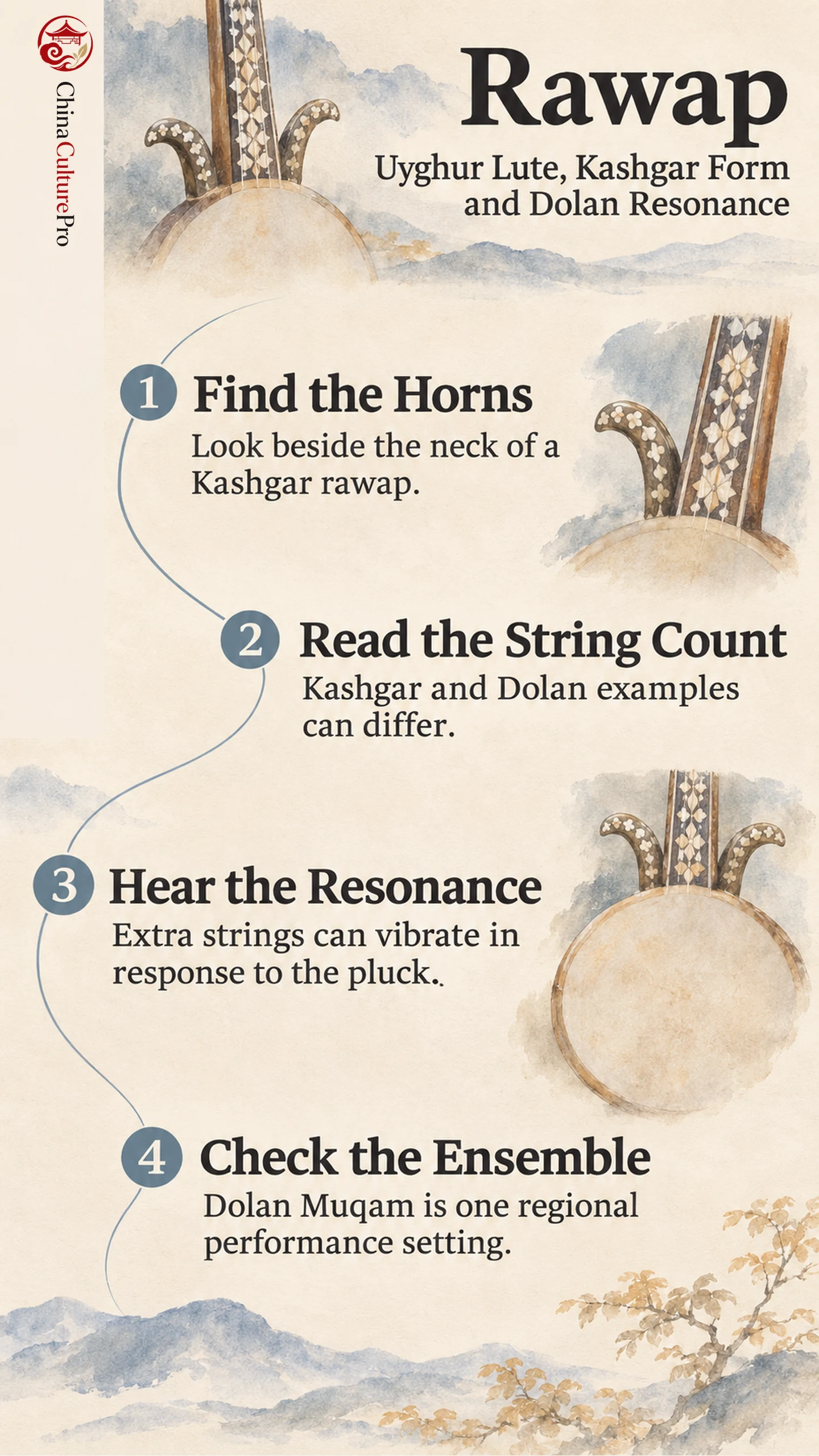
A rawap can announce a note with a sharp pluck and continue sounding after the attack. In a recording, follow one note from its sharp onset into the fading resonance. A close photograph shows which design features can contribute to it.
Identify the Body and Neck
On a Kashgar rawap in the University of Würzburg collection, a narrow fretted neck extends from a small rounded resonator with a skin face. Strings run over a short bridge on the face. Decorative projections shaped like curved horns extend to either side of the neck near the body. Look there, as well as at the tuning pegs, when identifying the lute.[1]
The Kashgar prefecture’s account also records a redesigned form with a shorter neck, larger body and metal frets. Check the neck, body and fret material together when comparing a redesigned instrument with a museum object.[3]
Compare Kashgar and Dolan Examples
The Kashgar object De 154 measures 56 centimeters and has five steel strings. The museum calls it unusually small and compares it with longer Kashgar examples. Its collection also records a smaller Qoychi form associated with the Khotan region. The dimensions belong to the individual objects.[1][6]
The Dolan instrument De 191 measures 92 centimeters. Its catalog distinguishes three strings for playing and ten for resonance. A group of side pegs on the neck serves the additional strings. The catalog counts the two sets separately. That matters when a caption gives just the number of playing strings.[2]
How Playing and Resonating Strings Work
In the playing posture described by Kashgar prefecture, the left hand stops the strings along the neck while the right hand uses a plectrum. Moving the stopping point changes the pitch. A rapid series of strokes can give a tune a pointed, rhythmic edge.[3]
On a Dolan model with sympathetic strings, the player sounds the playing strings directly. The additional strings can vibrate in response, adding another layer to what you hear. Listen for resonance after a sharply plucked note. Use the recording credits and regional name to identify the instruments that contribute to the ensemble sound.[2][5]
Hear the Rawap in Its Musical Setting
Uyghur Muqam brings together song, instrumental playing and dance in several regional traditions. UNESCO identifies Dolan Muqam as one of four main styles. Music scholarship on Dolan repertory describes how instruments with sympathetic strings, including the rawap, contribute to its sound.[4][5]
The sanxian also has a long neck and a skin-covered resonator. Check the neck and outline when comparing these two musical instruments.[7] The guide to Uyghur culture places the rawap in its broader setting.
FAQs About the Rawap
Is the rawap played with a bow?
The rawap is plucked. The Kashgar account describes a performer using a small pick with the right hand.[3]
How many strings does a rawap have?
It depends on the form. One documented Kashgar example has five strings. A Dolan example has three playing strings and ten resonating strings.[1][2]
Is the rawap the same in every Muqam ensemble?
The instrumentation varies by region and practice. Dolan Muqam gives one context for hearing a rawap with sympathetic strings.[4][5]
Sources
[1] University of Würzburg, Institute for Music Research. Kashgar Rawap, De 154
[2] University of Würzburg, Institute for Music Research. Dolan Rawap, De 191
[3] Kashgar Prefecture. Uyghur Musical Instruments
[4] UNESCO. Uyghur Muqam of Xinjiang
[5] Chuen-Fung Wong, Popular Music and Society. Singing Muqam in Uyghur Pop
[6] University of Würzburg, Institute for Music Research. Central Asian and Middle Eastern Instruments from the Fritz Degel Collection
[7] The Metropolitan Museum of Art. Sanxian, Nineteenth Century