

Quick Answer: What Is the Ruan?
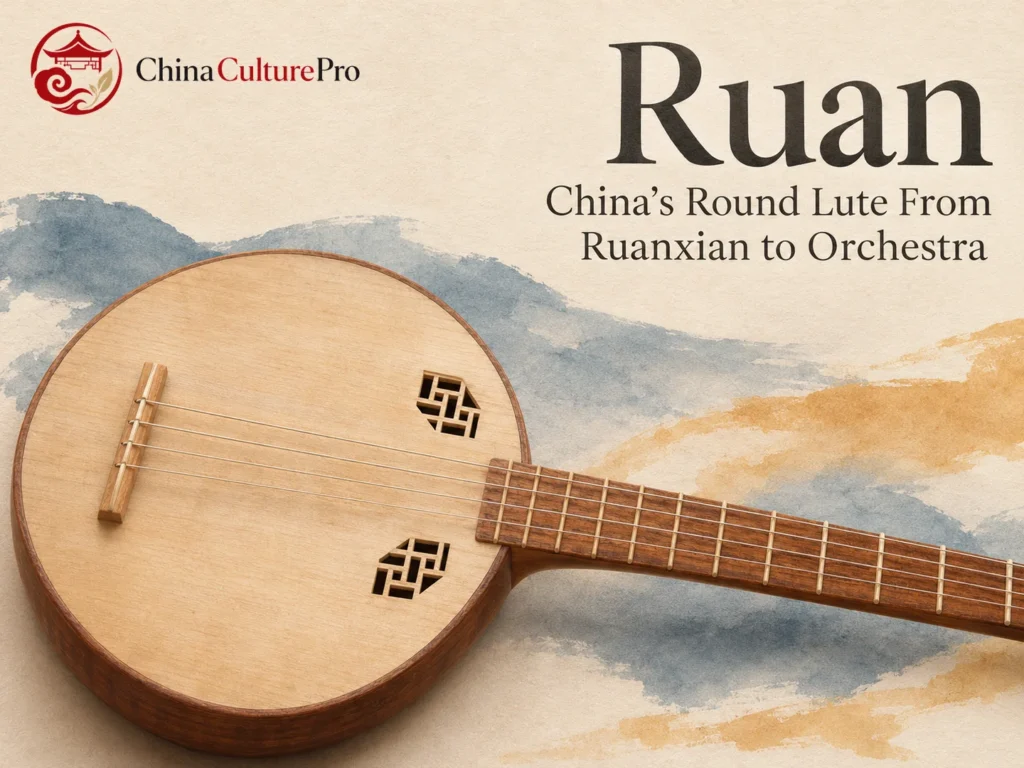
The ruan (阮, ruǎn) is a Chinese plucked lute with a round wooden body and a fretted neck. Modern forms typically have four strings. The name also refers to a family of different sizes used in concert music.[1]
- Shape: Look for the round body and the length of the neck together.[1][3]
- History: The name ruanxian (阮咸, ruǎnxián) is associated with the musician Ruan Xian.[2][3]
- Ensemble: Modern orchestras use the middle and larger ruan as separate instruments in the plucked section.[4]
Check which member of the family is named in a recording or program.

A round body makes the ruan recognizable at a glance, while the fretted neck and strings help distinguish it from other lutes. In an orchestra the word can describe a whole section of related instruments. In a museum it may lead to a much earlier use of the name.
Read the Round Body and Long Neck
The ruan in Middle Tennessee State University’s instrument gallery has a round wooden body, four strings and 24 frets. The frets set where the player stops the strings for different notes. The player presses a string near a fret to select a pitch and plucks with the other hand. A plectrum can give the sound a clear initial attack.[1][5]
The circular outline can resemble a yueqin, a lute usually identified by its shorter neck. Some qinqin bodies are round too. In a collection, compare the label and neck proportions before relying on silhouette alone.[5][6]
What Early Evidence Says About Ruanxian
A Southern Dynasties tomb relief at Nanjing Museum depicts the Seven Sages of the Bamboo Grove and Rong Qiqi. The figure labeled Ruan Xian plays a four-string instrument. The scene dates from a later period than the man it portrays. The depiction links his name to a four-string instrument in the tradition represented by the relief.[2]
The Shōsōin treasury in Japan catalogs a decorated ruanxian with a round body and long neck. It measures 100.4 centimeters in length, with a body about 39 centimeters across. Its dimensions let you compare the proportions of a surviving instrument with the outline in a relief.[3]
How the Modern Ruan Family Is Used
Modern ensemble practice uses several sizes, including xiaoruan (小阮, xiǎoruǎn), the small ruan, zhongruan (中阮, zhōngruǎn), the middle ruan, and daruan (大阮, dàruǎn), the large ruan. They cover different registers. The middle instrument also appears in solo music.[1][5]
The Hong Kong Chinese Orchestra lists zhongruan and daruan as separate members of its plucked-string section, alongside pipa and other instruments. The section brings together instruments with different pitch ranges and ways of articulating a phrase.[4]
Listen for the Attack and Decay
Start with one low note. Notice its clear beginning and how the sound fades. The China Culture instrument guide describes a mellow tone. Listen for that quality after the initial pluck.[5]
In a solo recording, follow a phrase through sustained effects or short, separated notes. In an ensemble recording, follow the lower plucked line and check the credits to see which ruan is playing. The Chinese traditional music guide places the instrument among other strings and winds.
FAQs About the Ruan
Are ruan and yueqin the same instrument?
Both can have round bodies. In modern usage, a ruan usually has a long fretted neck, while yueqin commonly names a short-necked lute.[1][5]
Is zhongruan another name for every ruan?
Zhongruan names the middle member of the ruan family. Ensemble listings can distinguish it from the larger daruan.[1][4]
Did Ruan Xian invent the ruan?
Ruan Xian’s name became associated with the instrument. The Nanjing relief shows him playing a four-string lute and gives evidence for that association. Who first made the instrument remains uncertain.[2][3]
Sources
[1] Middle Tennessee State University, Center for Chinese Music and Culture. Instrument Gallery: Ruan
[2] Nanjing Museum. Brick Relief of the Seven Sages of the Bamboo Grove and Rong Qiqi
[3] Shōsōin, Imperial Household Agency. Ruanxian with Mother-of-Pearl Inlay
[4] Hong Kong Chinese Orchestra. Plucked-String Instruments
[5] China Culture. Plucked Instruments
[6] Macao Museum. Qinqin, Object MM4354