


Quick Answer: What Are Ox-Tongue Pastries?
The English name can describe different foods. Taiwanese Niu She Bing (牛舌餅, niú shé bǐng) are tongue-shaped flour pastries. In Hong Kong, “ox-tongue pastry” also describes Niu Li Su (牛脷酥, niú lì sū in Mandarin), a fried flour dough.[1][2]
- Yilan style: typically long, thin and crisp.
- Lukang style: generally thicker, flaky and malt-filled.
- Hong Kong usage: an elliptical fried dough.[2][3]
The name describes shape, rather than an ox-tongue filling.[1][2]
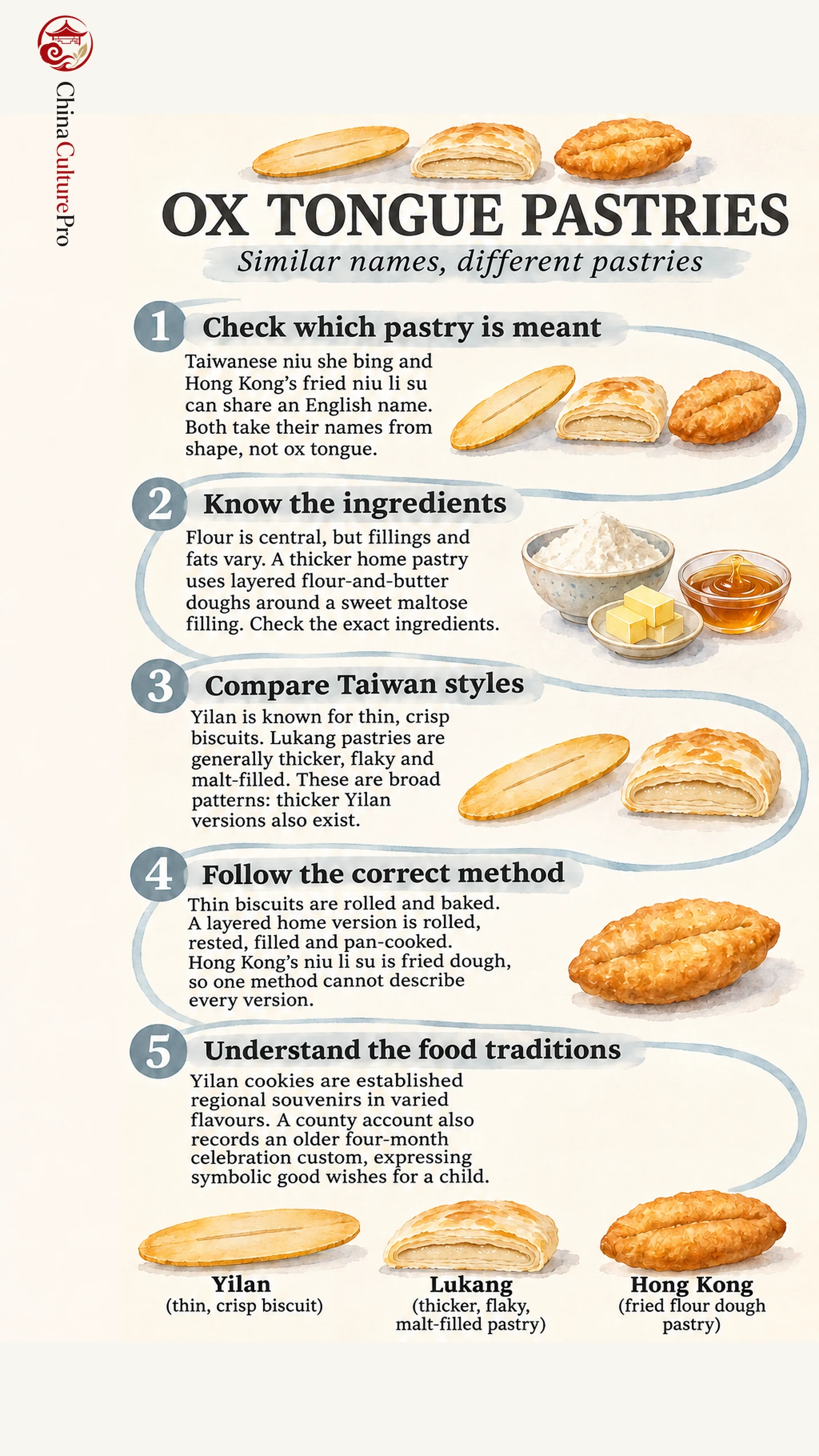
Knowing which pastry is meant helps explain differences in texture, ingredients and cooking.[1][2][3]
Two Pastry Names Behind One English Label
These names identify separate food traditions:
| Name | Meaning in this guide |
|---|---|
| Niu She Bing | Taiwanese flour pastries associated with Yilan and Lukang; both sweet and savoury versions exist. |
| Niu Li Su | The fried flour dough called ox-tongue pastry in Hong Kong. |
The Taiwan dictionary explains the first name through its tongue-like shape. Hong Kong’s food-safety authority gives the same shape-based explanation for the second.[1][2]
Flour, Sweetness and Recipe-Specific Fats
Wheat-flour dough is central, but the English label does not specify one recipe.[1][2]
A thick, Lukang-style home formula uses separate water dough and flour-and-butter “oil dough,” enclosing a sweet maltose filling. Butter and several flours appear in that particular preparation.[4]
Malt sugar also features in the tourism authority’s description of Lukang pastries.[3] Check the actual ingredients when butter, milk or other fats matter; a shape-based name is not a complete ingredient list.
Yilan and Lukang: Two Taiwanese Textures
Taiwan’s tourism authority distinguishes these broad styles:[3]
| Style | Shape and texture | Preparation described |
|---|---|---|
| Yilan | Long, narrow, thin and biscuit-like | Dough is rolled flat, marked along the centre and baked crisp. |
| Lukang | Thicker and oval, with flaky pastry and a lightly sweet malt filling | Can be baked or fried. |
These are useful patterns, not a rule for every bakery. A Yilan producer also makes a thicker, malt-filled baked version, showing that a place name alone does not settle the thickness.[5]
How the Pastries Are Made
For the thin Yilan biscuit, flattening and baking create the crisp result.[3]
One home adaptation of the thicker pastry follows a different sequence:[4]
- Enclose the flour-and-butter oil dough inside the water dough.
- Flatten, roll up and rest the dough to develop its layers.
- Enclose the maltose filling and flatten into an oval about 0.5 cm thick.
- Pan-cook over low heat; this recipe uses eight minutes covered, then four minutes after turning, uncovered.
Those instructions belong to that complete home formula, not to every regional pastry.
Hong Kong’s Niu Li Su is fried flour dough, a distinct preparation from the thin baked biscuit.[2]
Souvenirs, Flavour Choices and Food Traditions
Yilan’s county government presents ox-tongue cookies as a local souvenir, with flavours including honey, black sugar, milk, kumquat and seaweed.[6] They are part of the wider range of regional food gifts found in Taiwan.
The county’s cultural account also records an older custom involving these cookies at an infant’s four-month celebration, expressing symbolic good wishes for the child’s future.[6]
FAQs About Ox-Tongue Pastries
Do these pastries contain ox tongue?
The names discussed here refer to shape. Hong Kong’s authority explicitly says its fried pastry contains no ox tongue.[1][2]
Are all ox-tongue pastries baked?
No. Hong Kong’s version is fried, and the tourism description allows baking or frying for Lukang pastries.[2][3]
Are Yilan ox-tongue biscuits always thin?
No. Thin biscuits are familiar, but a current Yilan producer also offers a thicker version.[3][5]
Sources
[1] Taiwan Ministry of Education. Niu she bing: dictionary definition
[2] Hong Kong Centre for Food Safety. Does the name of a food truly reveal its nature?
[3] Taiwan Tourism Administration. Souvenirs: ox tongue biscuits
[4] A Dessert Diet. Sourdough ox-tongue pastry: a home adaptation
[5] Yilan Pastry. Thick ox-tongue-shaped pastry
[6] Yilan County Government. Food: ox-tongue cookie