


Quick Answer: Who Was Mi Fu?
Mi Fu (米芾, Mǐ Fú) was a Northern Song poet, calligrapher, painter and art collector.[1]
- Surviving work: His calligraphy includes energetic running script (行书, xíngshū).[2]
- Painting tradition: No reliable example of his own painted work is known today.[4]
- Legacy: Later landscapes carried forward the style associated with his name.[6]
Begin with his surviving writing, then compare paintings by his son and later followers.
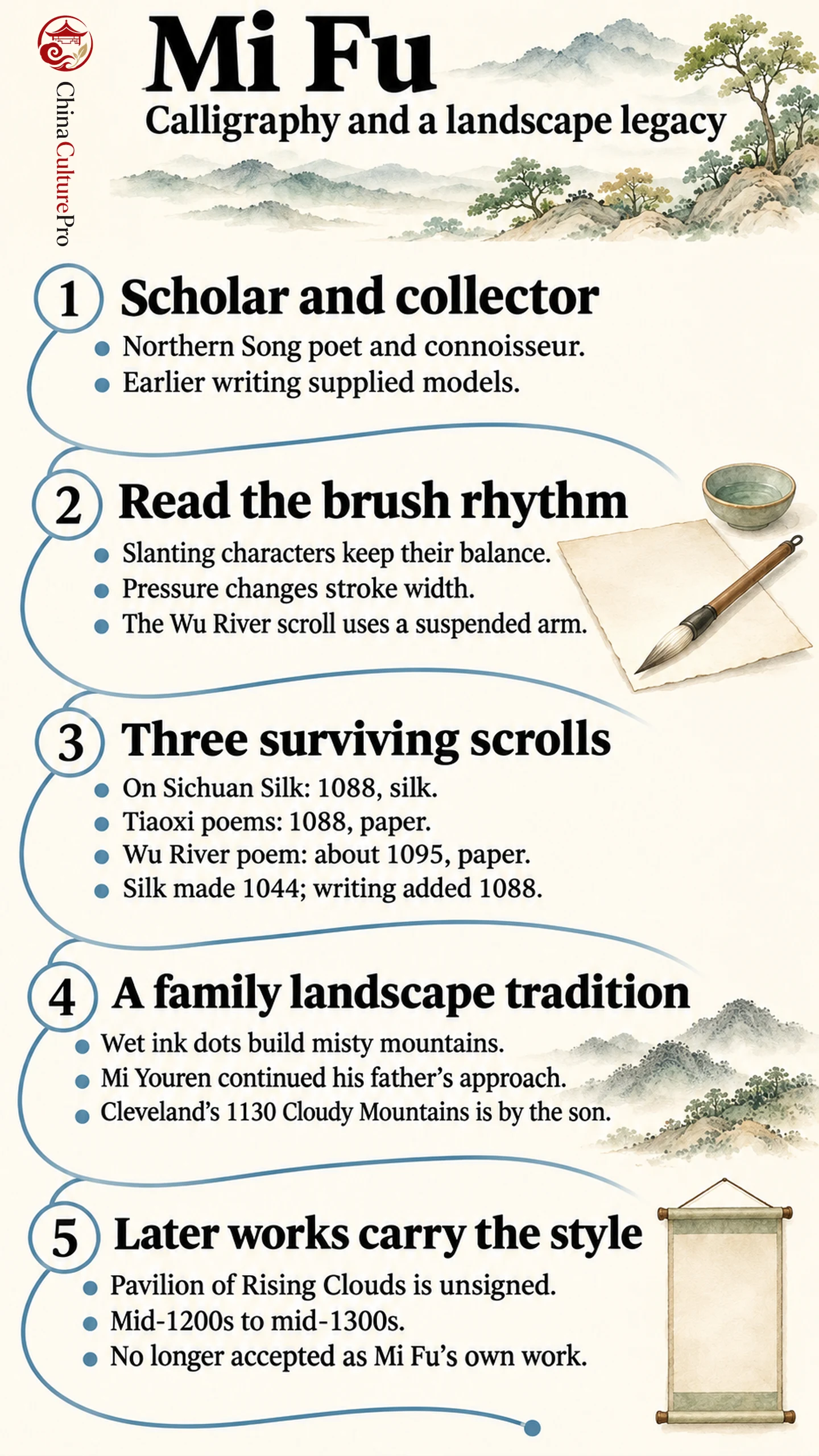
The edge of an ink stroke can be broad, thin, sharp or broken within a few movements. Reading those changes gives an English-speaking viewer a way into Mi Fu’s art before translating every character.
A Scholar, Collector and Student of Earlier Writing
Mi Fu belonged to the cultural world of the Northern Song dynasty. He combined poetry and art with collecting and connoisseurship.[1] His career also included official service and a calligraphy post under Emperor Huizong.[2]
His calligraphy drew on Wang Xizhi, Wang Xianzhi and Yan Zhenqing, before taking on a personal character.[2] Earlier models supplied a foundation for experimentation with balance, weight and movement.
How to Look at His Calligraphy
In Poems on the Tiaoxi River, characters lean slightly left while maintaining their balance. Long strokes extend outward, and changes of pressure give the writing an uneven, lively rhythm.[2]
Compare a thick stroke with its fine ending, then look at the spacing around the next character. This way of reading calligraphy attends to visible structure as well as written meaning.
Cursive script (草书, cǎoshū) gives Poem Written in a Boat on the Wu River a different expressive range. Mi Fu worked with a suspended arm, moving from the elbow; compressed and distorted characters convey force and motion.[3] Look for changes in scale and direction across the scroll, rather than judging each character in isolation.
Three Surviving Calligraphy Scrolls
These objects provide a firmer starting point than paintings carrying an inherited attribution.
| Work | Date, medium and format | Collection and dimensions |
|---|---|---|
| On Sichuan Silk | 1088; ink on silk, running-script handscroll | National Palace Museum, Taipei; main section 27.8 × 270.8 cm.[1] |
| Poems on the Tiaoxi River | 1088; ink on paper, running-script handscroll | Palace Museum, Beijing; 30.3 × 189.5 cm.[2] |
| Poem Written in a Boat on the Wu River | About 1095; ink on paper, handscroll | Metropolitan Museum of Art; 31.1 × 556.9 cm.[3] |
The prized silk used for On Sichuan Silk was made in 1044; the calligraphy dates to 1088. Mi Fu wrote eight poems on it, working within a prepared grid.[1][7] Distinguish the age of the support from the date of the writing.
The Tiaoxi scroll contains six of his own poems. Its closing date also places it in 1088.[2] Together, the two works allow comparison of his handling of silk and paper during the same year.
Misty Mountains and the Mi-Family Tradition
Mi-family dots (米点, mǐdiǎn) are wet ink marks that build soft, cloud-covered mountain forms. Mi Fu’s son Mi Youren carried this approach forward.[4] The method offers a different way to build landscape from carefully outlining each ridge. This expressive approach forms part of scholar painting.
Mi Youren’s Cloudy Mountains of 1130, in Cleveland, is ink and color on silk, with an image measuring 43.7 × 192.6 cm. He gave it to a host at Xinchang in thanks for shelter after fleeing south.[5] This is a painting by the son, and a concrete work through which to study the family tradition.
Later Attributions and an Enduring Name
Pavilion of Rising Clouds is an unsigned ink-on-silk painting dated to the mid-thirteenth through mid-fourteenth century. Traditionally attributed to Mi Fu, it is no longer accepted as his own work.[6]
The landscape uses layered washes and horizontal dots to suggest depth. Later admiration is visible in Dong Qichang’s title writing and added commentaries.[6] Such inscriptions and collecting records show how an artist’s reputation can continue to shape a painting’s reception long after its creation.
FAQs About Mi Fu
Are there any securely accepted paintings by Mi Fu?
No reliable painted work by his own hand is currently known; his calligraphy survives.[3][4]
Why is the date 1088 important for his calligraphy?
Both On Sichuan Silk and the Tiaoxi poems belong to that year, allowing a close comparison of two major scrolls.[1][2]
Is Cloudy Mountains a painting by Mi Fu?
The Cleveland painting of 1130 is by his son, Mi Youren.[5]
Sources
[1] National Palace Museum. On Sichuan Silk
[2] Palace Museum. Mi Fu’s Poems on the Tiaoxi River
[3] Metropolitan Museum of Art. Poem Written in a Boat on the Wu River
[4] Metropolitan Museum of Art. Cloudy Mountains by Mi Youren
[5] Cleveland Museum of Art. Cloudy Mountains, 1130
[6] National Museum of Asian Art. Pavilion of Rising Clouds
[7] National Palace Museum. On Sichuan Silk: Materials and Brushwork