

Quick Answer: What Is Serradura?
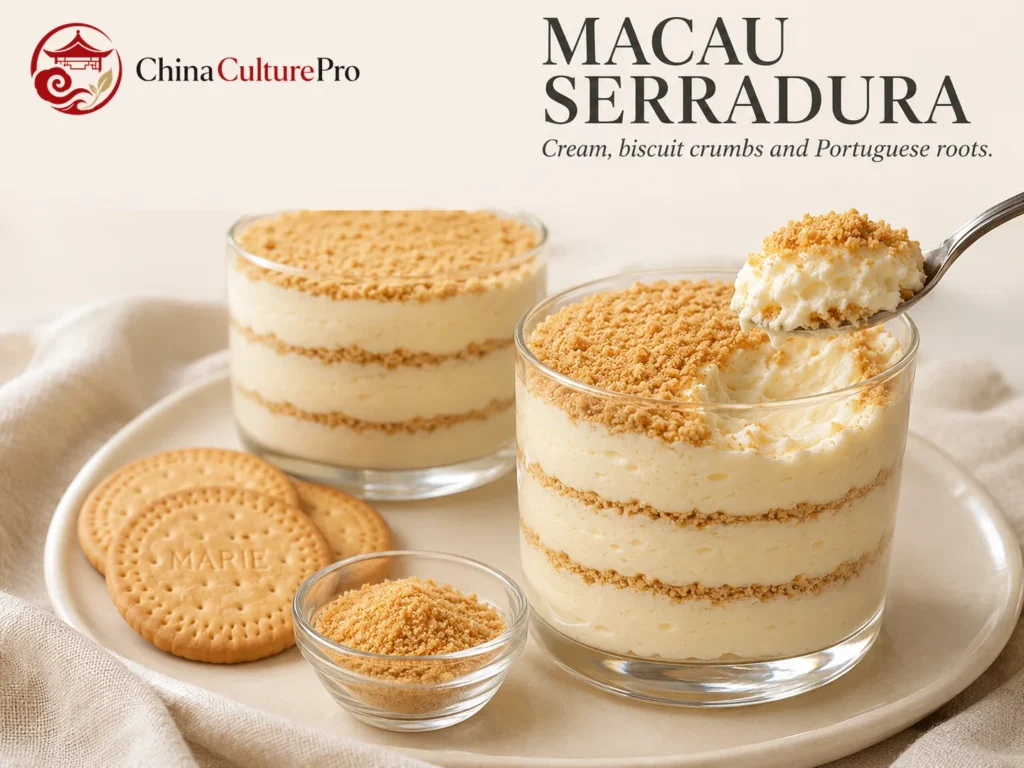
Serradura is a Portuguese dessert popular in Macau, made by layering sweetened cream with crushed biscuits. Its creamy and sandy textures are enjoyed cold with a spoon.[1][4]
- Main ingredients: cream, condensed milk and biscuit crumbs.
- Appearance: pale cream alternating with fine, golden crumbs.
- Preparation: whip, layer and chill or briefly freeze, depending on the recipe.[2][3][6]
“Sawdust” describes the biscuit crumbs, not a wooden ingredient.[1]
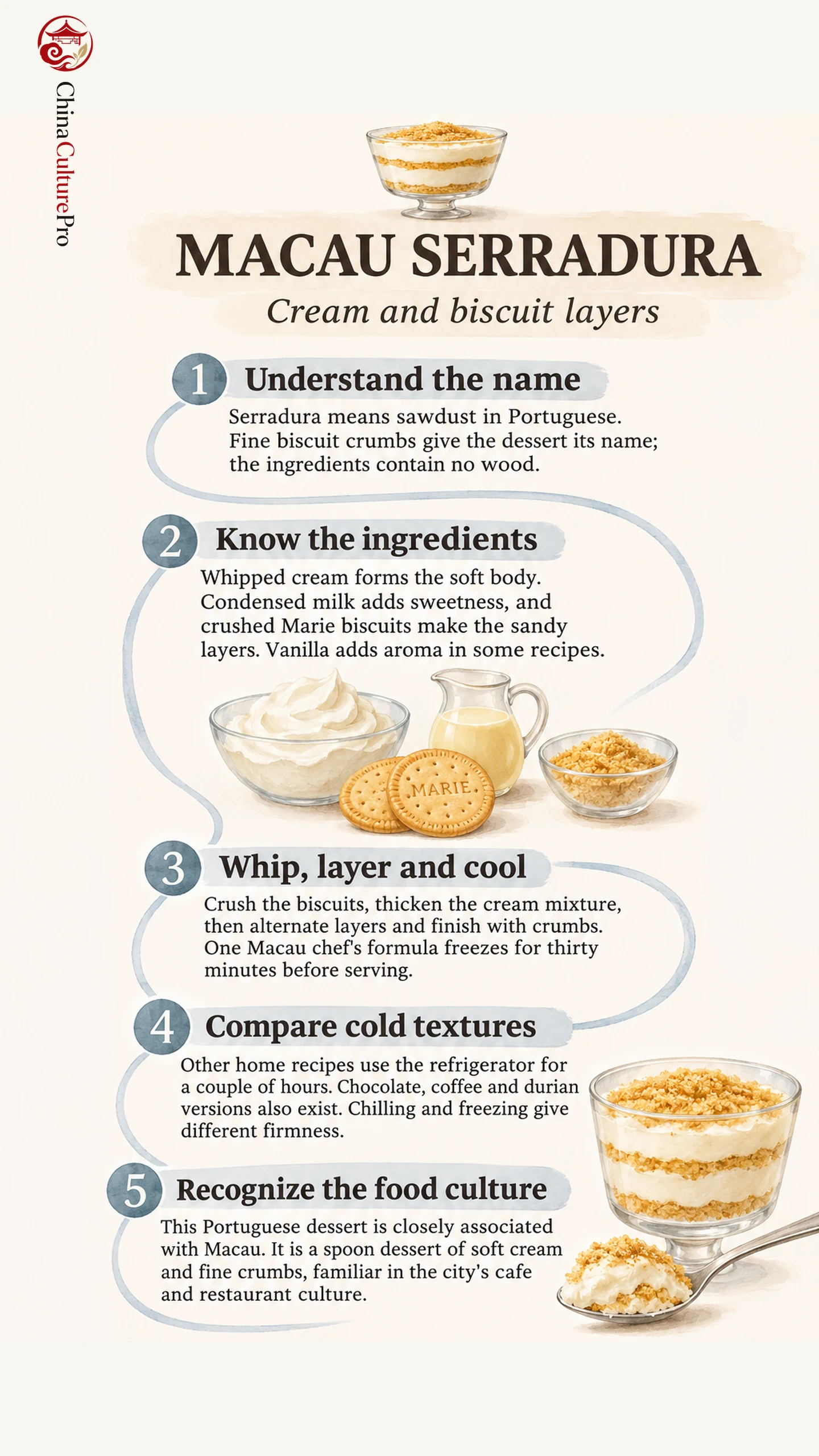
Distinct layers bring cream and crumbs together in each spoonful.[3]
Why Serradura Is Called Sawdust Pudding
The Portuguese word serradura means sawdust. Finely crushed biscuits give the pudding its descriptive name.[1]
On Chinese menus it can appear as Mu Kang Bu Dian (木糠布甸, mù kāng bù diàn). A Portuguese restaurant’s own menu pairs this name with serradura and describes biscuits with cream.[7]
Cream, Condensed Milk and Biscuit Crumbs
The familiar components have separate roles:
- Whipping cream provides the soft, airy body.
- Condensed milk sweetens the cream mixture.
- Marie biscuits, crushed finely, form the sandy layers.
- Vanilla adds aroma in these formulas.[3]
One home method pipes the cream into glasses and gently levels the crumbs without pressing them tight. This helps keep the layers distinct rather than turning the dessert into one compact biscuit mass.[3]
Whipping, Layering and Chilling the Pudding
A published Macau chef’s version uses four stages:[2]
- Crush Marie or butter biscuits into a fine powder, reserving some for the top.
- Whisk cold cream with condensed milk and vanilla until thickened.
- Alternate layers of cream mixture and crumbs, finishing with the reserved crumbs.
- Freeze for thirty minutes before serving.
That short freezing time belongs to this formula. Follow its full ingredient quantities rather than treating it as a universal setting time for every serradura.
Soft Cream, Sandy Crumbs and Flavour Variations
The tourism office describes a soft whipped-cream dessert with biscuit crumbs, eaten by spoon.[4] Chilling and freezing can produce different degrees of firmness: another home version rests in the refrigerator for a couple of hours and includes crushed cashews.[6]
The basic flavour is not the only option. An official food brochure also records chocolate, coffee and durian versions.[5] These are variations around the cream-and-biscuit idea, rather than compulsory additions to every cup.
A Portuguese Dessert in Macau Food Culture
Macau’s tourism office places serradura among the city’s familiar Portuguese desserts and café sweets.[4] Its identity is therefore both Portuguese in origin and closely associated with Macau’s food culture.[1][4]
FAQs About Macau Serradura
Does serradura contain actual sawdust?
No. The name refers to the appearance of finely crushed biscuits.[1]
Does this pudding need baking?
No baking is used in the featured chef’s version: it is whipped, layered and briefly frozen.[2]
Is serradura always served frozen?
No. Some recipes refrigerate it, while others use a short period in the freezer.[2][3][6]
Sources
[1] Macao Ideas, IPIM. Serradura pudding: name and dessert description
[2] Ana Manhao, SBS Food. Serradura: a Macau chef’s preparation
[3] Wendy, Table for 2. Serradura: home preparation and layering
[4] Macao Government Tourism Office. Macanese and Portuguese dishes: serradura
[5] Macao Government Tourism Office. 15 must-eat delicacies and two recipes: serradura
[6] Rafeeda, The Big Sweet Tooth. Serradura: a chilled home variation
[7] António. Restaurant menu: serradura and its Chinese name