

Quick Answer: Who Was Lin Xiangru?
Lin Xiangru (蔺相如, Lìn Xiāngrú) was a diplomat and senior official of Zhao (赵, Zhào) in the Warring States period. He is remembered for defending Zhao’s position in negotiations with Qin (秦, Qín).[4]
- The jade mission: Qin offered cities in exchange for a prized jade disc. Lin returned to Zhao without surrendering it.[4]
- The meeting: At Mianchi (渑池, Miǎnchí), he answered a show of Qin’s superiority with a request of his own.[4]
- The rivalry: Zhao promoted him above the general Lian Po (廉颇, Lián Pō). The two eventually reconciled.[4]
The best-known version of these episodes comes from Sima Qian. His biography gives Zhao’s diplomat and general a shared story about how they handled pressure from Qin.

Lin’s two best-known missions turned on gestures that might have seemed small in a less unequal relationship. One concerned who would hold a jade disc while an exchange was negotiated. The other concerned what court officials would write down after a banquet.
How Lin Returned the Jade Disc to Zhao
Qin offered fifteen cities for the He family jade disc (和氏璧, Héshì Bì). Lin advised Zhao to entertain the offer. That would leave Qin responsible if it failed to honor the agreement.[1]
At court Lin retrieved the disc on the pretext of showing the Qin ruler a flaw. He threatened to break it, then had an attendant take it back to Zhao during preparations for a formal audience. The jade was already back in Zhao by the time Lin explained what he had done. Qin let him go and gave Zhao none of the promised cities.[1]
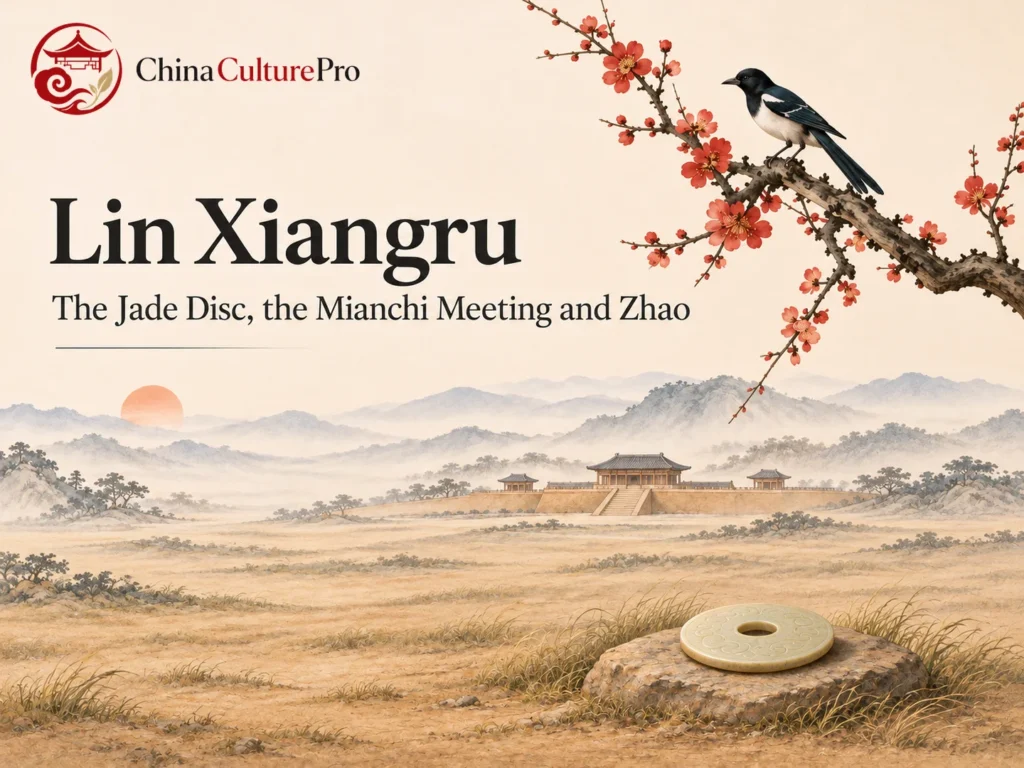
Surviving objects help show why the disc is often drawn as a flat ring. A Warring States example in the Cleveland Museum of Art has a central opening and a surface patterned with small raised dots. It illustrates a type of Chinese jade carving from the period.[5]
Why the Meeting at Mianchi Mattered
The Zhao annals place a meeting between the two kings in the twentieth year of King Huiwen’s reign.[2]
In the biography’s account of the banquet at Mianchi, the king of Qin asked Zhao’s ruler to play a zither. A Qin official wrote down the performance. Lin got Qin’s king to strike an earthenware vessel and had a Zhao official record it in turn. The parallel entries kept the written record from showing only one king performing for the other.[1]
How Lin and Lian Po Ended Their Rivalry
After Mianchi the court ranked Lin above Lian Po. The general resented the promotion. Lin avoided a confrontation, and the two eventually reconciled.[4]
The biography says Lin feared a feud would leave Zhao exposed to Qin.[1]
FAQs About Lin Xiangru
What Does the Jade Disc Idiom Mean?
The expression “return the jade intact to Zhao” (完璧归赵, wán bì guī zhào) refers to returning something intact to its rightful owner.[3]
What Was a Bi Disc?
A bi is a flat round disc with a central hole. Jade examples survive from the Warring States period. Museum examples help illustrate the shape of the object in the story.[5]
When Did Lin Xiangru Live?
He served Zhao in the Warring States period under King Huiwen. His birth and death years are uncertain.[4]
Sources
[1] Sima Qian. Records of the Grand Historian, Biographies of Lian Po and Lin Xiangru
[2] Sima Qian. Records of the Grand Historian, Hereditary House of Zhao
[3] Ministry of Education, Taiwan. Dictionary of Chinese Idioms, Returning the Jade Disc Intact to Zhao
[4] Ministry of Education, Taiwan. Revised Dictionary of Mandarin Chinese, Lin Xiangru
[5] Cleveland Museum of Art. Ceremonial Disk with Grain Pattern