

Quick Answer: Who Was Li Hongzhang?
Li Hongzhang (李鸿章, Lǐ Hóngzhāng, 1823–1901) was a senior official of the late Qing dynasty. He organized the Huai Army (淮军, Huáijūn), supported military and industrial reforms, and negotiated with foreign powers.[1]
- Regional power: He became governor-general of Zhili (直隶, Zhílì) and held the Beiyang portfolio from 1870.[1]
- Reform: He helped establish the Jiangnan Arsenal (江南制造总局, Jiāngnán Zhìzào Zǒngjú) and backed naval development.[1][2]
- Diplomacy: He signed the Treaty of Shimonoseki (马关条约, Mǎguān Tiáoyuē) in 1895 and the Boxer Protocol (辛丑条约, Xīnchǒu Tiáoyuē) in 1901.[3][6]
His career links efforts to strengthen the Qing with settlements negotiated after defeats.[6]
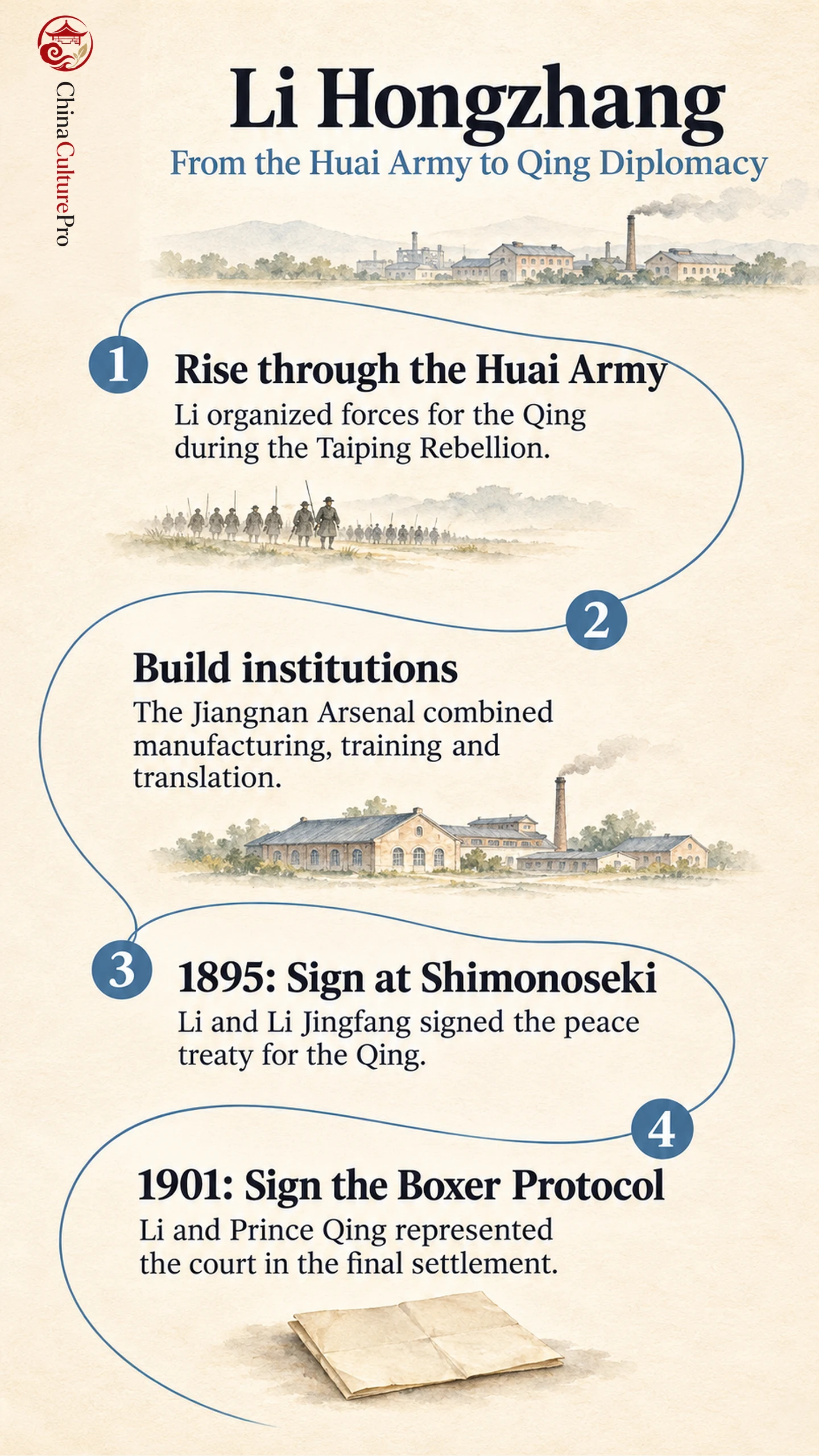
The same official who helped build an arsenal later represented the Qing at peace talks after a naval defeat. Li’s career shows how regional authority could support industrial change and make him a central figure in foreign negotiations.
From the Huai Army to Power in Zhili
Li came from Hefei in present-day Anhui and passed the highest level of the examinations in 1847. He rose under Zeng Guofan (曾国藩, Zēng Guófān) and organized troops for the Qing during the Taiping Rebellion.[1]
In 1870, Li took charge of Zhili and northern foreign and commercial affairs through the Beiyang portfolio. Holding both roles gave him a position from which to oversee defense projects and deal with foreign representatives.[1]
What Li Built Through Self-Strengthening
The Self-Strengthening Movement (洋务运动, Yángwù Yùndòng) sought to build industrial and military capacity. In 1865 Li helped establish the Jiangnan Arsenal in Shanghai. The arsenal combined machine shops with training and translation. Its translation department gave readers access to foreign scientific and technical writing, while its schools trained people for the work these institutions required.[2]
Li also promoted naval development, including the Beiyang Fleet (北洋舰队, Běiyáng Jiànduì). The forces under him suffered defeat in the war with Japan of 1894–95.[6]
Historian Benjamin Elman traces achievements in shipbuilding, training and translation alongside problems of coordination across regionally controlled institutions. The defeat exposed weaknesses in a system that had acquired industrial and naval capabilities.[2]
How Li Negotiated After the War with Japan
Li and Li Jingfang (李经方, Lǐ Jīngfāng) represented the Qing at Shimonoseki. They signed the peace treaty on April 17, 1895, with Japanese plenipotentiaries Itō Hirobumi and Mutsu Munemitsu.[3]
The treaty required the Qing to recognize Korea’s independence. Its initial terms ceded Taiwan, the Penghu Islands and the Liaodong Peninsula to Japan and imposed an indemnity of 200 million Kuping taels.[4]
Russia, France and Germany then pressed Japan to relinquish Liaodong. The peninsula was returned to the Qing later that year under a separate agreement.[7]
What the Boxer Protocol Required
In September 1901, Li and Yikuang (奕劻, Yìkuāng), known as Prince Qing, represented the Qing after the Boxer crisis. The protocol imposed an indemnity of 450 million Haikwan taels and reserved the Beijing legation quarter for foreign control and allowed the powers to keep permanent guards there.[5]
FAQs About Li Hongzhang
Why is Li Hongzhang associated with both reform and concessions?
He helped develop military and industrial institutions and later negotiated treaties after military defeats. Both roles grew from his positions in the Qing government.[1][6]
Was Li Hongzhang shot during the peace talks?
Yes. A Japanese attacker shot him on March 24, 1895, as he was returning to his lodging in Shimonoseki. The Japanese archive holds a report of the incident. It also notes that a contemporary print imagined the assailant at the conference itself.[3]
Who signed the Boxer Protocol for the Qing?
Li Hongzhang and Yikuang signed as the Qing representatives. The agreement was with eleven foreign powers.[5]
Sources
[1] Berkshire Encyclopedia of China. Li Hongzhang, 1823–1901
[2] Benjamin A. Elman. Naval Warfare and the Refraction of China’s Self-Strengthening Reforms
[3] Japan Center for Asian Historical Records. The Shimonoseki Peace Treaty, signed copy and related archives
[4] The World and Japan Database. Treaty of Shimonoseki, English text
[5] University of Southern California, US–China Institute. Boxer Protocol, 1901
[6] Japan Center for Asian Historical Records. Li Hongzhang, chronology and archival documents
[7] Japan Center for Asian Historical Records. Towards Peace, the Shimonoseki Treaty and Triple Intervention