


Quick Answer: Who Was Li Cheng?
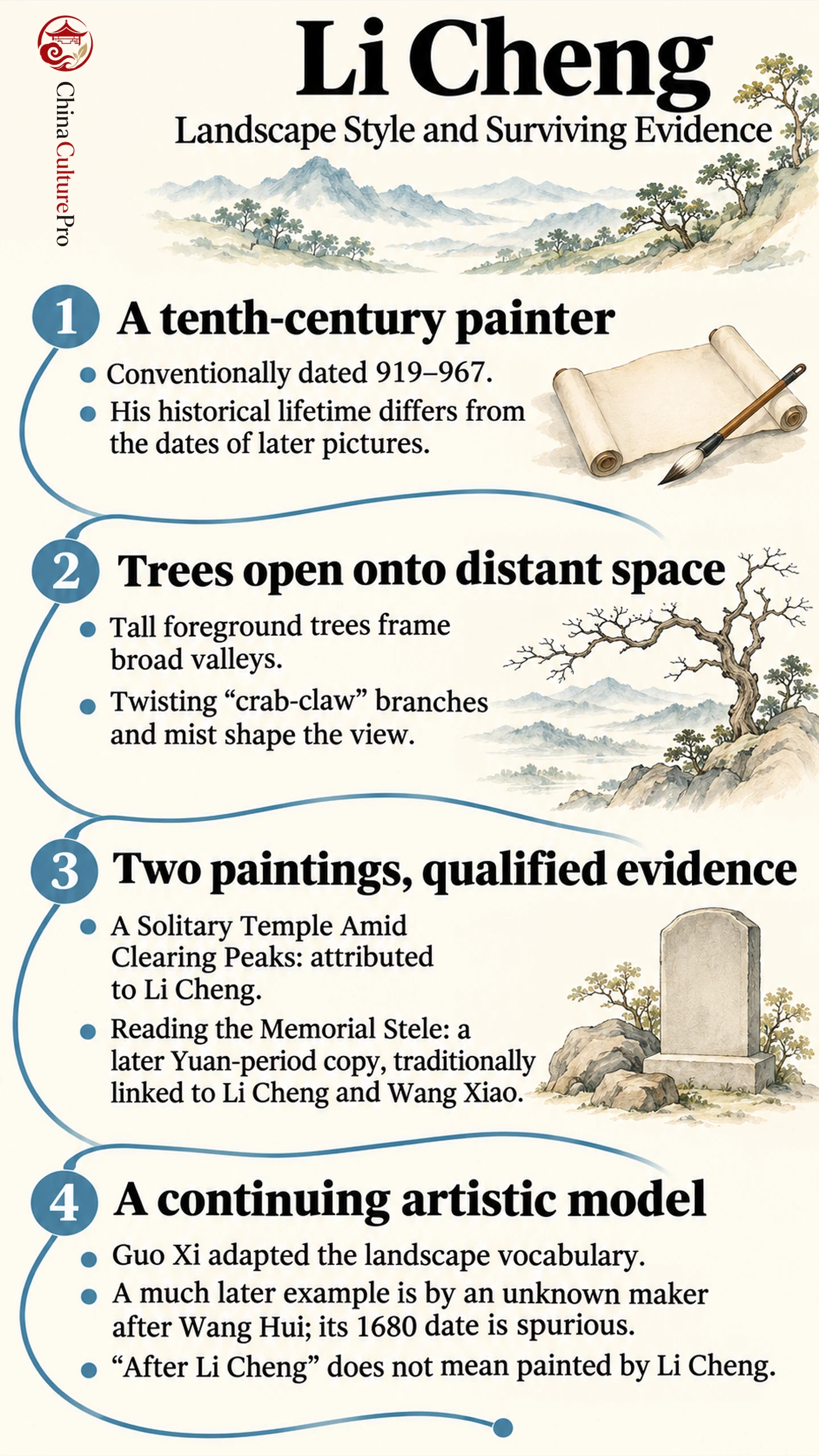
Li Cheng (李成, Lǐ Chéng) was a tenth-century Chinese landscape painter, conventionally dated 919–967. His influence reaches far beyond the small and disputed group of paintings associated with his own hand.[1][2][4]
- His name is associated with winter trees, misty water and finely controlled ink washes.[7]
- Tall foreground trees and broad river valleys became important elements of his legacy.[3]
- A traditional attribution, a later copy and a work painted “after” him are different kinds of evidence.
Read an object’s date and attribution together to distinguish its relationship to the historical painter.
Li Cheng’s importance is easier to grasp through two connected questions: what kind of landscape did his name come to represent, and how do surviving paintings transmit that tradition? Keeping the questions separate allows close looking without overstating certainty.
A Tenth-Century Painter and a Long-Lived Tradition
His family settled at Yingqiu in Shandong during the Five Dynasties period. His lifetime crossed the transition into the Song dynasty.[1][7]
The historical painter and the later tradition should be considered together. A traditional attribution can preserve an old association, while a later imitation demonstrates how another artist understood his manner.
Winter Trees and Level-Distance Space
Level distance (平远, píngyuǎn) organizes a view across lowland space rather than chiefly upward toward a summit. Tall trees close to the viewer can frame an expansive valley beyond them.[3]
Another recognizable feature is the branching pattern often described as crab-claw branches (蟹爪枝, xièzhǎo zhī): angular, twisting limbs reach outward in varied directions. Mist and ink washes make the spaces around trees as important as their outlines.[7]
When looking at Chinese landscape painting, compare the scale of the foreground trunks with the openness behind them. A sense of breadth can be built through contrast, even without a sharply receding road.
Two Paintings Associated with His Name
| Painting | Material and format | What the attribution allows us to say |
|---|---|---|
| A Solitary Temple Amid Clearing Peaks | Hanging scroll; ink and slight color on silk; image 111.76 × 55.88 cm. | Cataloged as Northern Song and attributed to Li Cheng.[2] |
| Reading the Memorial Stele (读碑窠石图) | Ink and light color on silk; 126.3 × 104.9 cm. | Traditionally linked to Li Cheng and Wang Xiao; interpreted as a Yuan-period copy.[4][5] |
In A Solitary Temple, a traveler enters from the lower left and leads the eye toward a Buddhist temple and its pagoda among the mountains.[2] Follow that small figure to understand how human movement gives access to a much larger setting.
Reading the Memorial Stele includes an inscription assigning figures to Wang Xiao and trees and rocks to Li Cheng. Yet the museum’s explanation identifies signs of copying, and its 2018 exhibition dated the surviving work to the fourteenth century.[4][5] The inscription transmits an attribution; it does not settle the age of the silk painting now in front of us.
From Guo Xi to Much Later Copies
Guo Xi continued and transformed Li’s landscape vocabulary. Old Trees, Level Distance adapts the foreground-tree and broad-valley arrangement, while its fuller brushwork differs from the sparer manner associated with Li.[3]
A much later Landscape after Li Cheng is cataloged as an unidentified artist’s work after Wang Hui, dating to the eighteenth century or later. Its date of 1680 is spurious.[6] Here Li’s name identifies a historical model transmitted through another painter, not the maker of the surviving object.
FAQs About Li Cheng
Are his surviving paintings securely signed originals?
That should not be assumed. A Solitary Temple retains an “attributed to” designation, while Reading the Memorial Stele is understood as a later copy.[2][4][5]
Is Reading the Memorial Stele a tenth-century painting?
The surviving version is interpreted as a Yuan-period copy, several centuries later than the artists named in its inscription.[4][5]
Does “after Li Cheng” mean he painted the picture?
No. In the later example discussed here, the title refers to an earlier artistic model; the catalog identifies an unknown maker working after Wang Hui.[6]
Sources
[1] Getty Research Institute. Li Cheng, Union List of Artist Names
[2] Nelson-Atkins Museum of Art. A Solitary Temple Amid Clearing Peaks
[3] Metropolitan Museum of Art. Anatomy of a Masterpiece: Old Trees, Level Distance
[4] Osaka City Museum of Fine Arts. Reading the Memorial Stele
[5] Osaka City Museum of Fine Arts. Abe Fusajiro and Chinese Painting and Calligraphy, 2018
[6] Metropolitan Museum of Art. Landscape after Li Cheng
[7] National Palace Museum. Wintry Forests