

Quick Answer: What Is Lady Ban Holding a Round Fan?
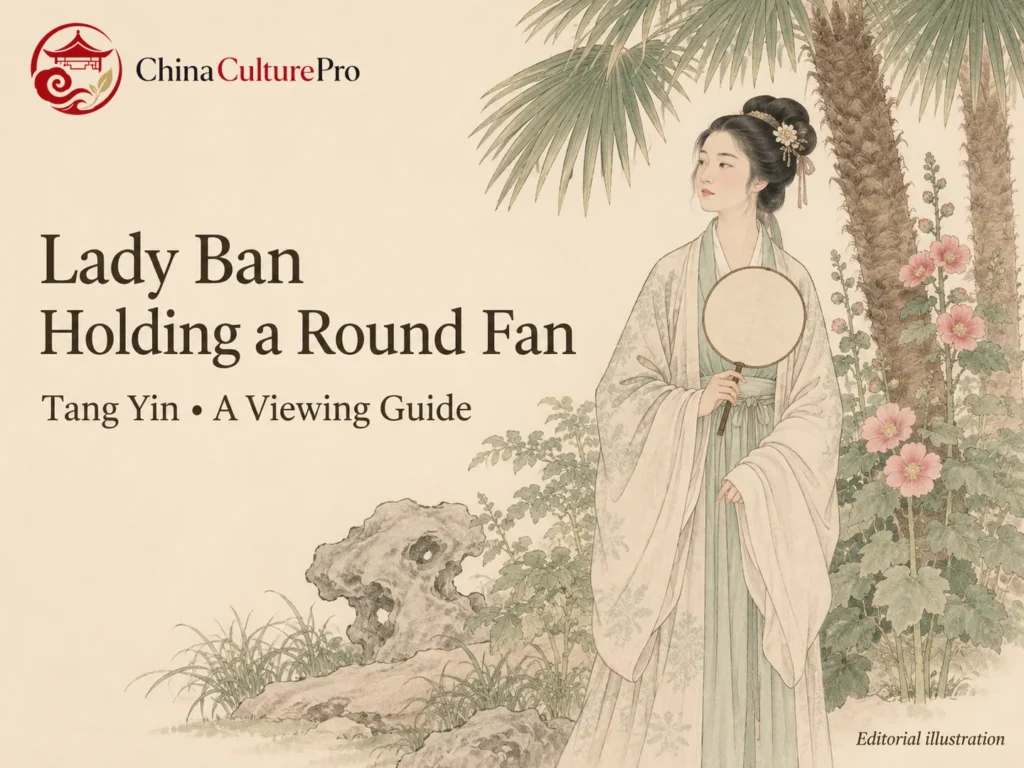
Lady Ban Holding a Round Fan (班姬团扇图, Bān Jī Tuánshàn Tú) is a Ming-dynasty hanging scroll by Tang Yin in the National Palace Museum, Taipei. A solitary woman holds a round silk fan beside palm trees, while hollyhocks signal late summer and approaching autumn. The scene draws on an older literary association between a fan discarded in cool weather and a woman losing favor.[1]

The setting gives the held fan its particular meaning. Begin with the woman’s posture and the space around her, then consider why she still holds an object associated with summer as the season changes. This is a work of Chinese figure painting that joins a visible scene with a remembered poem.
The Painting at a Glance
| Field | Identification |
|---|---|
| Artist | Tang Yin, Ming dynasty |
| Format | Hanging scroll |
| Medium | Ink and color on paper |
| Recorded dimensions | 150.4 cm high × 63.6 cm wide |
| Proposed date | Around 1509, inferred through inscriptional evidence |
| Collection | National Palace Museum, Taipei |
The paper support and dimensions identify the painting as a substantial vertical work.[2] The silk belongs to the fan represented within it; the artwork itself is not painted on a fan.
The collection record also uses the English title Lady Pan Holding the Autumn Fan. Its proposed date around 1509 depends on interpreting Wen Zhengming’s inscription and writing style.[3] Treat that as an approximate curatorial dating, rather than an exact year written by the painter. Match title variants through the Chinese object name, maker and dimensions.
Lady Ban as a Literary Figure
The subject is Consort Ban (班婕妤, Bān Jiéyú), associated with the Han court. The image draws on Yuan Ge Xing (怨歌行, Yuàn Gē Xíng), often translated as Song of Reproach and traditionally associated with her. Its fan imagery links an object’s seasonal usefulness to the insecurity of affection and favor.[1][4]
This is a Ming painter’s literary representation, made many centuries after the woman’s lifetime. It should not be treated as an eyewitness portrait establishing her appearance. The conventional title directs the viewer toward a story, not a claim of physical likeness.
The name also needs care. The figure linked with the fan poem is distinct from the historian Ban Zhao. Older labels and the broad expression “Lady Ban” can make those identities seem interchangeable. The poem and the fan supply the relevant context for this painting.[3]
The scene has also been read as an indirect expression of Tang Yin‘s own disappointments.[4] That interpretation can deepen a viewing, but it does not turn every detail into a documented episode from his life. The woman’s literary role remains the clearest starting point.
Why the Fan Matters When the Season Changes
The round silk fan, or tuanshan (团扇, tuánshàn), carries a pointed seasonal comparison here. In the poem’s conventional reading, a fan is cherished in summer and put away when cooler weather removes the need for it. That change becomes an image of favor withdrawn.[4]
Notice that the painting does not need to show the act of discarding the fan. The woman still holds it. The approaching change of season makes the object’s future usefulness uncertain, allowing a quiet gesture to carry more than its immediate practical meaning.
The relationship among figure, object and garden is therefore essential. A cropped image of the fan alone cannot carry the same evidence as the full composition. Ask how the season modifies what you see, rather than treating the object as a fixed code with one meaning in every work.
The broader range of Chinese fan types helps distinguish this round form from a folding fan. That distinction matters visually as well as culturally: a round, continuous surface and a set of folding ribs create different shapes in the hand. The present interpretation belongs to this fan, this literary reference and this seasonal setting.
Reading the Figure, Garden and Inscriptions
The clothing lines are a major part of the figure’s expression, while the palm trees and foreground hollyhocks establish the garden around her.[1][2] Give those elements separate attention before drawing them into an interpretation.
- Read the figure’s outline. Follow the posture, the direction of the gaze and the drapery lines. Compare the stillness of the pose with the movement carried by the clothing. Describe what the lines do before choosing a word such as sadness or resignation.
- Reconnect the fan with the garden. Restore the full view if you have enlarged the figure. Locate the palms and flowers, then consider the approach of autumn alongside the held fan. Keep that relationship visible when discussing the poem’s allusion.
- Examine the writing as another layer. Find the inscriptions and use a catalogue or reliable transcription to identify their authors. Separate what the painting shows, what an inscription says and what a later interpretation proposes.
The record identifies inscriptions by Zhu Yunming, Wen Zhengming and Wang Guxiang.[3] Their presence makes the work more than an isolated image with a modern caption. The guide to painting inscriptions and seals explains how such writing contributes to meaning and object history.
For a final comparison, move between the entire vertical composition and a close view of the fan-holding figure. The detail reveals handling; the full view restores the relationships that give that handling a purpose. Neither view needs to replace the other.
FAQs About Lady Ban Holding a Round Fan
Is Lady Ban the historian Ban Zhao?
The fan-poem subject is Consort Ban, or Ban Jieyu. Ban Zhao is a different historical figure. Use the literary allusion to identify the intended subject here.[1][3]
Is this painting made on a fan?
No. It is a hanging scroll painted on paper, with a recorded size of 150.4 × 63.6 cm. A round silk fan appears within the scene.[1][2]
Does every round fan symbolize rejection?
No. The reading here comes from the poem and the approach of cool weather. Other fan images require their own context; the object alone does not establish the same meaning.[4]
Sources
[1] National Palace Museum. She & Her: Lady Ban’s Round Fan
[2] Ministry of Culture, Executive Yuan Gazette. Important Antiquities Designation: 明唐寅畫班姬團扇軸
[3] National Palace Museum Open Data. Lady Pan Holding the Autumn Fan
[4] National Palace Museum. 舊典新詮—唐寅仕女人物畫中的典故再現