


Quick Answer: Who Was Kuncan Shixi?
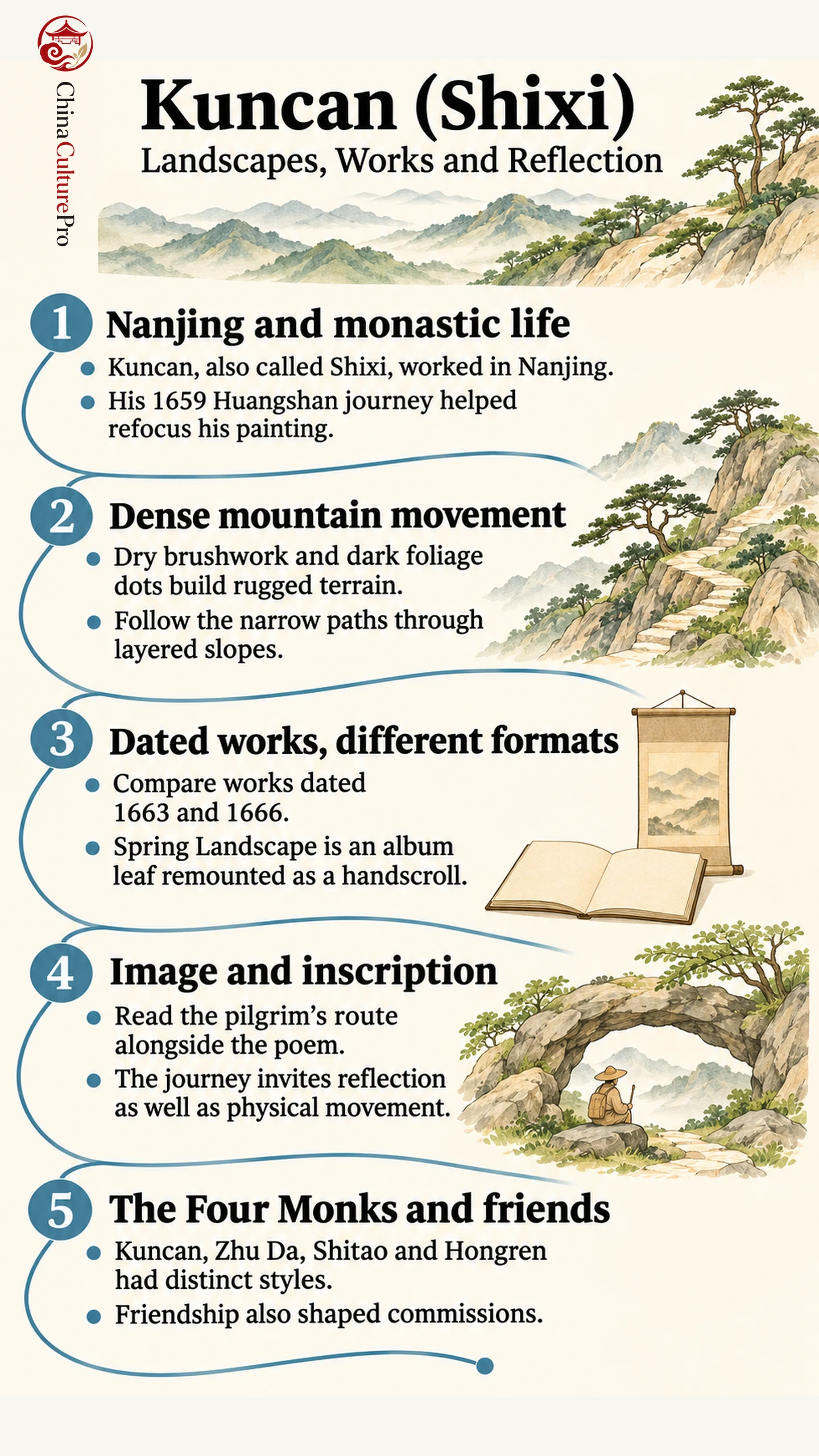
Kuncan (髡残, Kūn Cán), born in 1612, was a seventeenth-century Buddhist monk and landscape painter. Shixi (石谿, Shí Xī) is another name for the same artist.[1]
- Style: Dense mountain structures and rugged handling are important features of his painting.[2][3]
- Context: He is grouped with the Four Monks of the early Qing (清初四僧, Qīngchū Sìsēng).[3][4]
- Reading: Inscriptions can turn a mountain scene into an account of movement and reflection.[2]
Compare individual works and their formats rather than expecting one uniform appearance from every painting or every monk-painter.
Kuncan’s mountains can demand a slow reading. Paths, rocks and densely worked surfaces lead the eye through the picture, while a small figure or an inscription gives that movement a human scale.
Nanjing, Monastic Life and the Ming–Qing Transition
After the establishment of the Qing, Kuncan lived in Nanjing among poet-painters whose circle included Ming loyalists. A visit to Huangshan in 1659 helped direct his attention toward painting. His practice was closely connected with Chan Buddhism (禅宗, chán zōng) and self-examination.[2]
That relationship belongs within the broader history of Chinese Buddhism. Looking, traveling and reflecting can all contribute to the picture’s meaning.
How His Landscapes Create Density and Movement
Kuncan drew on the densely textured landscape tradition of Wang Meng.[2] His own handling often feels rough and worked, giving the surfaces a strong material presence.
In Layered Rocks and Ravines (层岩叠壑图), dated 1663, dry strokes texture the rocks while dark dots articulate the vegetation. A winding path climbs through the crowded terrain and helps keep the composition navigable.[3]
Follow that path in relation to the heavier passages around it. Density is not simply the number of trees or rocks; it also depends on how marks overlap, interrupt one another and leave room for the eye to move.
Four Dated Works from the 1660s
| Work | Date | Form and medium | Collection |
|---|---|---|---|
| Layered Rocks and Ravines | 1663 | Hanging scroll; ink and color on paper | Palace Museum.[3] |
| Wooded Mountains at Dusk | 1666 | Hanging scroll; ink and color on paper | Metropolitan Museum of Art.[2] |
| Spring Landscape | 1666 | Double album leaf mounted as a handscroll; ink and color on paper | Cleveland Museum of Art.[4] |
| Painting and Calligraphy | 1666 | Handscroll; ink and color on paper | Shanghai Museum.[1] |
Spring Landscape once belonged to an album with other seasonal leaves now in Berlin and London.[4] Its remounting changes the present viewing format.
Reading the Landscape with Its Inscription
In Wooded Mountains at Dusk, a pilgrim sits beneath a natural rock bridge. The accompanying poem connects difficult travel and physical fatigue with reflection on the self; the figure is interpreted as Kuncan himself.[2]
Consider how the route, resting figure and written meditation work together. Read an available transcription beside the image, keeping the speaker and occasion in view.
A Distinct Voice among the Four Monks
The other members of the familiar grouping are Zhu Da, Shitao and Hongren.[3][4] The label identifies monk-painters, while close comparison still depends on each artist’s own brushwork. Shitao provides a separate profile for that comparison.
Kuncan also painted for friends. Spring Landscape was made for Cheng Zhengkui, with whom he shared interests in painting and poetry.[4] The commission gives the work a specific social occasion.
For other compositional traditions, continue with Chinese landscape painting as a wider reference.
FAQs About Kuncan
Are Kuncan and Shixi different artists?
No. Shixi is another name used by Kuncan; museum records may present either form.[1]
Did all Four Monks paint in the same style?
The grouping does not define a single visual formula. Kuncan’s rugged handling should be identified in his own works, not assumed for all four painters.[3][4]
Was Spring Landscape originally a handscroll?
It is a double album leaf now mounted as a handscroll. Its original seasonal context differs from that present form.[4]
Sources
[1] Shanghai Museum. Painting and Calligraphy, handscroll
[2] Metropolitan Museum of Art. Wooded Mountains at Dusk
[3] Palace Museum. 髡残层岩叠壑图轴
[4] Cleveland Museum of Art. Spring Landscape