


Quick Answer: What Is Hung Gar?
Hung Gar (洪家拳, hóngjiāquán), also written Hung Ga or Hung Kuen, is a southern Chinese martial tradition associated with firm stances, bridge-hand work (桥手, qiáoshǒu) and varied animal qualities.
- Familiar routines include tiger-taming, tiger-crane, five-animal and iron-wire forms.
- Its curriculum also includes weapons and partner training.
- The Wong Fei-hung (黄飞鸿, Huáng Fēihóng) lineage is important to its transmission in Hong Kong (香港, Xiānggǎng).
These features describe a family of practices; they do not make every school’s syllabus identical.
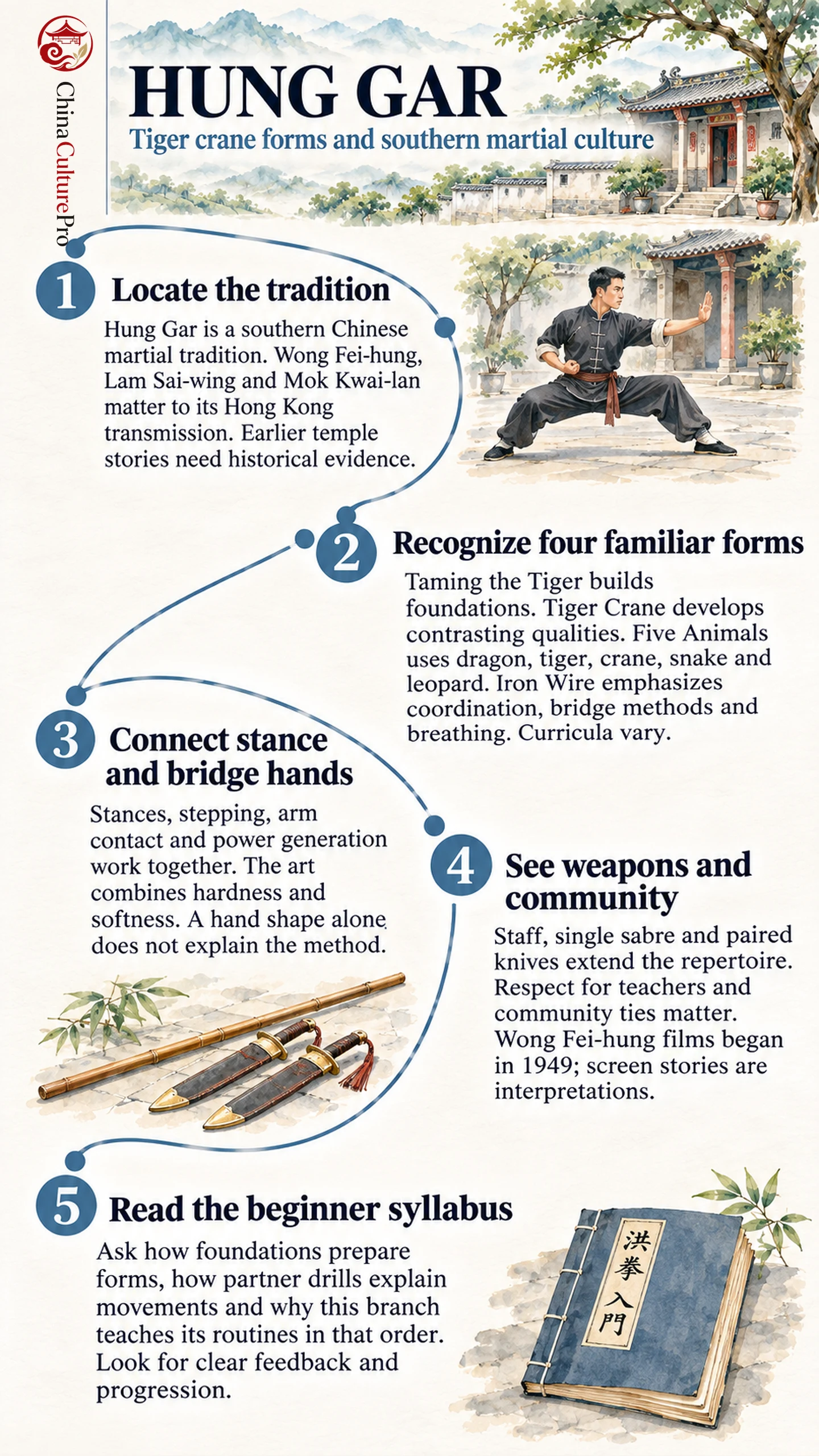
Hung Gar rewards attention to how a teacher connects stance, hand method and movement. A tiger-claw pose is recognizable, but cannot explain the whole system. Read this guide alongside the wider range of Chinese martial arts styles, then look at a particular lineage’s actual curriculum.
Southern History and the Wong Fei-hung Lineage
Hung Gar means Hung-family boxing. Its southern setting includes Guangdong (广东, Guǎngdōng) and Foshan (佛山, Fóshān). Wong Fei-hung and his student Lam Sai-wing (林世荣, Lín Shìróng) are central names in familiar transmission accounts. Lam established teaching in Hong Kong; Wong’s wife Mok Kwai-lan (莫桂兰, Mò Guìlán) also figures in local transmission.[1][5]
Origin traditions invoke Hung Hei-gun (洪熙官, Hóng Xīguān) and a destroyed southern Shaolin temple. These stories require evidence before they can establish a founder’s biography. The distinction matters when comparing Shaolin kung fu with martial history and legend.[1][2]
The regional record is broader than one famous family. The Nanhai (南海, Nánhǎi) museum’s heritage account identifies several lines, including those associated with Wong, Lam and Tang Fong (邓芳, Dèng Fāng). A lineage label helps locate a teaching relationship; it should not erase the wider southern tradition.[6]
Four Familiar Hand Forms and Their Different Jobs
These names provide a useful starting map:
- Taming the Tiger in an I Pattern: 工字伏虎拳 (gōngzì fúhǔquán), often written Gung Ji Fuk Fu Kuen, is a foundational routine. Its name points to a pattern, rather than a literal encounter with a tiger.[6][3]
- Tiger Crane Paired Form: 虎鹤双形拳 (hǔhè shuāngxíngquán), or Fu Hok Seung Ying Kuen, combines contrasting tiger and crane qualities. It develops applications beyond foundational work in one curriculum.[3]
- Five Animals Form: 五形拳 (wǔxíngquán), or Ng Ying Kuen, organizes material through dragon, tiger, crane, snake and leopard qualities.[3]
- Iron Wire Fist: 铁线拳 (tiěxiànquán), or Tit Sin Kuen, emphasizes opening and closing, floating and sinking, bridge methods and breathing within its own teaching system.[3]
Do not turn this map into a universal four-level ladder. One contemporary curriculum instead lists Ten Forms (十形拳, shíxíngquán), combining five animals with Five Phases (五行, wǔxíng), among its pillar forms. It also teaches supplementary hand routines. Names, contents and teaching order need the branch attached.[4]
Stances, Bridge Hands and Animal Qualities
Stance work provides a base for movement and power, but Hung Gar is not simply a contest to remain low. Bridge-hand training concerns the arms as a means of contact and connection. Stances, bridging and power generation work together with both hardness and softness.[5]
Animal imagery distinguishes movement qualities. One curriculum contrasts forceful tiger expression with the crane’s softer whipping quality. Both belong within the same tradition.[3]
For a learner, the useful question is how a posture works with stepping and a partner. A recognizable hand shape or a completed routine is only part of that answer. Ask for clear explanations and corrections instead of assuming that an evocative animal name supplies the missing method.
Weapons, Community and the Screen Image
Hung Gar extends beyond empty-hand forms. Staff methods, single sabre and paired knives belong to the Hong Kong repertoire. Compare them within the wider vocabulary of Chinese martial arts weapons; a named routine identifies a particular practice, not a universal weapon syllabus.[5]
Transmission also carries social responsibilities. Respect for teachers, loyalty and community ties are explicit themes in Hong Kong heritage presentations. The school is a setting for relationships and shared practice as well as technique. This makes martial arts etiquette part of understanding the tradition.[5]
Wong’s screen image is another layer. The film series began in 1949 and developed changing portrayals of a virtuous martial teacher. A heritage exhibition also included lion dance by practitioners. These connections help explain Hung Gar’s place in Hong Kong culture, while martial arts film history requires attention to choreography, character and storytelling.[7]
Reading a Beginner Syllabus
When observing teaching, ask:
- Foundations: How do stances, stepping and conditioning prepare the first routine?
- Application: How do individual drills and partner practice explain movements in a form?
- Progression: Which hand and weapon routines belong to this branch, and why are they introduced in that order?
These questions reflect a curriculum that connects foundations, drills, forms and applications. They help distinguish learning a sequence from understanding how it is used. Ask how the actual class adapts demands and provides feedback; a famous routine’s name cannot answer that for you.[4]
FAQs About Hung Gar
Is Hung Gar the same as all southern kung fu?
No. It is one southern tradition. Regional heritage records recognize multiple lines within Hung Gar itself.[6]
Are the four forms taught identically everywhere?
No. Some curricula distinguish a five-animal form, while others feature a ten-form combination and additional routines.[4]
Does Iron Wire Fist mean hitting metal wires?
It names a coordination, bridge-method and breathing form, rather than wire-striking practice.[3]
Are Wong Fei-hung films historical records of training?
They are screen interpretations of a historical figure. They reveal cultural ideals and changing cinema styles, rather than documenting every portrayed fight or lesson.[7]
Sources
[1] Chinese Traditional Martial Arts Study Association. About Hung Gar Kuen
[2] Yee’s Hung Ga International Kung Fu Association. History of Hung Ga Kung Fu
[3] Yee’s Hung Ga International Kung Fu Association. Our Style Forms
[4] Paul Fauteux’s Hung Gar. Curriculum
[5] Hong Kong Intangible Cultural Heritage Office. Meet the Masters 2026: Hung Gar programme
[6] Nanhai Museum. Nanhai Hung Kuen heritage record
[7] Hong Kong Film Archive. The Cinematic Legend of Wong Fei-hung exhibition