


Quick Answer: What Is Shaolin Kung Fu?
Shaolin Kung Fu (少林功夫, Shàolín gōngfu) is a martial and cultural tradition associated with a Buddhist monastery in Henan, China. Its meaning includes physical training, religious culture and teacher–student transmission, rather than one uniform routine. [1]
- The monastery’s foundation date, documented military activity and later martial curricula belong to different stages of its history. [2][7]
- Training includes basic skills, hand routines, weapons and partner work, with different emphases in different programs. [9]
- Modern research distinguishes practitioner roles; a martial identity does not automatically establish that someone is fully ordained. [3]
Understand a Shaolin claim by asking what source, historical period and kind of practice it describes.
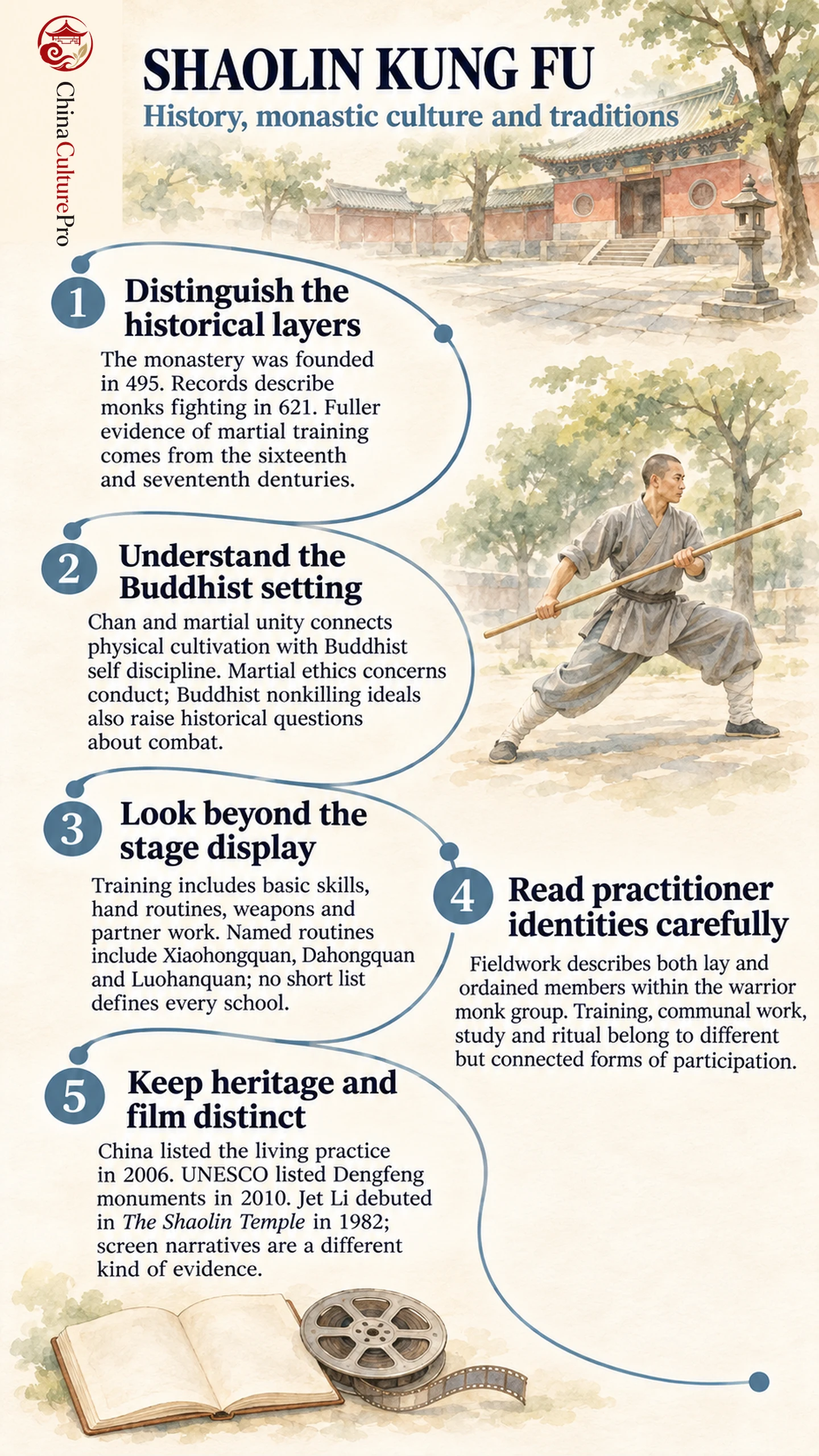
The familiar image of flying kicks and saffron-colored clothing is only one way Shaolin reaches audiences. Its martial practices also belong to the broader world of Chinese martial arts, where training, ethics, community and performance can meet in different combinations. [10]
Shaolin History: Temple, Evidence and Legend
Shaolin Monastery (少林寺, Shàolínsì), near Dengfeng (登封, Dēngfēng) and Mount Song (嵩山, Sōngshān), was founded in 495. The date establishes the Buddhist institution’s history; it does not date every empty-hand form now bearing the Shaolin name. [1]
Early military evidence concerns particular events. Historian Meir Shahar examines inscriptions recording monks’ defense against bandits around 610 and their participation in the campaign of Li Shimin (李世民, Lǐ Shìmín), the future Tang emperor, in 621. Participation in fighting is not the same evidence as a detailed record of a continuous training curriculum. [2]
The documentary picture becomes much fuller in the sixteenth and seventeenth centuries. Shahar identifies military writings, martial manuals, inscriptions and other sources showing martial practice integrated into late Ming monastic life. The staff is especially prominent in accounts of Shaolin’s martial reputation, while empty-hand methods developed over time. [2][7]
Bodhidharma (菩提达摩, Pútídámó) is important in the monastery’s religious memory. Stories associating him with spiritual transmission should be distinguished from proof that he invented Chinese boxing or every Shaolin exercise. Religious narrative, dated inscriptions and later manuals answer different historical questions. The history and legend guide offers a useful framework for reading them. [7]
Chan Buddhism and Martial Ethics
Chan (禅, chán) Buddhism provides the tradition’s religious setting. The ideal of Chan and martial unity (禅武合一, chán wǔ hé yī) connects physical cultivation with Buddhist self-discipline. [1]
In a study based on fieldwork from 2018 to 2020, anthropologist Marta Nešković explains how shared monastic life shapes the meanings practitioners find in movement. The setting matters, alongside the movement itself. [3]
Martial ethics (武德, wǔdé) concerns conduct as well as technique. Shaolin’s heritage description relates monastic discipline to restraint and humility. [1]
Buddhist prohibitions on killing also create a real historical tension with monks’ military activity; that tension should not disappear under a claim that all martial conduct is automatically peaceful. For context, read about Chinese Buddhism and the Chan tradition in their wider settings. [7]
What Shaolin Martial Training Includes
Four components help explain the curriculum beyond a dramatic stage display:
- Basic skills: Stances, footwork, flexibility and coordination provide a foundation for more complex practice. [9]
- Hand routines: Connected techniques are practiced as named sequences, with emphasis on transitions and control. [8]
- Weapon practice: Staff, sabre, straight sword and spear belong to a wider martial curriculum. [9]
- Partner work: Practitioners work with another person through agreed drills or application practice. [9]
Basic training is often called jibengong (基本功, jīběngōng). A linked routine is a taolu (套路, tàolù). Learning such material involves repetition and correction; a polished performance represents a practiced result, not the whole process of acquiring it. [8][9]
Named routines include Xiaohongquan (小洪拳, xiǎohóngquán), Dahongquan (大洪拳, dàhóngquán) and Luohanquan (罗汉拳, luóhànquán). For example, these names appear in a published Shaolin competition division alongside other forms. Such a list documents recognized entries in that setting, not one complete syllabus for every teacher. [5]
Weapons also require their own methods and learning context. The Chinese martial arts weapons guide explains the distinctions between the staff, straight sword, sabre and spear. Before interpreting a course or demonstration, establish whether its purpose is traditional routine practice, partner application, sport or stage performance.
Monastic Life, Teachers and Practitioner Identities
Nešković’s fieldwork describes warrior monks (武僧, wǔsēng) as a group containing both lay Buddhists and fully ordained monks. It also distinguishes ordained members with religious and administrative responsibilities. This is a more precise picture than assuming that every martial practitioner seen at a monastery has the same status. [3]
The research places training within ritual, communal meals, study and work. School enrolment, troupe performance and religious vows mark different kinds of participation. Martial arts etiquette provides context for teaching relationships and community responsibilities. [3]
Heritage, Film and Modern Transmission
Two heritage recognitions should be kept distinct. Shaolin Kung Fu entered China’s national intangible cultural heritage list in 2006. UNESCO inscribed the Historic Monuments of Dengfeng in “The Centre of Heaven and Earth,” including Shaolin-related monuments, on the World Heritage List in 2010. The living practice and the architectural property are different subjects of recognition. [1][4]
Cinema created another powerful image. Jet Li (李连杰, Lǐ Liánjié) made his screen debut in The Shaolin Temple (1982). Hong Kong Film Archive’s account highlights its cast of martial arts athletes and its choreographed action. Their physical skill enriches the film, while its characters and conflicts belong to a screen narrative. The history of Chinese cinema provides context for that influence. [6]
Modern sporting and performance settings also reshape presentation. Judged routines have their own criteria, while a monastic tradition includes cultural and religious contexts that a scoring system cannot fully represent. The wushu and kung fu comparison explains why a traditional label and a competition category do not answer the same question. [8]
FAQs About Shaolin Kung Fu
Did all Chinese martial arts come from Shaolin?
No. Shahar’s historical account places Shaolin within a larger martial landscape. Its contributions are important, but individual traditions need their own evidence. The wider guide to martial arts styles helps explain that diversity. [7]
Is every Shaolin practitioner an ordained monk?
No. Research distinguishes lay and ordained participants within the warrior-monk community. A martial role, school attendance and religious ordination should not be treated as interchangeable credentials. [3]
Is Shaolin Kung Fu the same as modern wushu competition?
No. Shaolin is a martial and cultural tradition; modern taolu competition evaluates performances under sporting criteria. Schools may teach both, but the purpose and context of instruction should be made clear. [8]
Does a spectacular demonstration prove invulnerability?
No. Read a prepared demonstration as evidence of a particular skill under particular conditions. Inferring immunity to injury or supernatural powers goes beyond what a performance establishes. Treat the display as performance, rather than an exercise to copy.
Sources
[1] China Intangible Cultural Heritage Network. Shaolin Kung Fu
[2] Meir Shahar. Ming-Period Evidence of Shaolin Martial Practice
[3] Marta Nešković. Embodied Spirituality: Shaolin Martial Arts as a Chan Buddhist Practice
[4] UNESCO World Heritage Centre. Historic Monuments of Dengfeng in “The Centre of Heaven and Earth”
[5] International Martial Arts Open. Shaolin Kung Fu Division
[6] Hong Kong Film Archive. The Shaolin Temple: Film and Choreography
[7] Meir Shahar. The Shaolin Monastery: History, Religion, and the Chinese Martial Arts
[8] International Wushu Federation. Taolu
[9] Shaolin Worldwide. Shaolin Training: Basic Skills, Forms and Weapons
[10] International Wushu Federation. Traditional Wushu