


Quick Answer: How Are Chinese Martial Arts Styles Classified?
Chinese martial arts styles are distinct traditions within wushu (武术, wǔshù), with different techniques, teaching relationships and cultural settings. Several classifications overlap: a style can have a regional history, a family lineage and a place within an internal or external grouping at the same time.[1]
- Internal, or neijia (内家, nèijiā), and external, or waijia (外家, wàijiā), are historical labels whose boundaries have also been criticized within martial traditions.[2]
- Northern and southern connections help locate traditions, but they do not determine every movement a practitioner uses.[4][8]
- Names may refer to a family or teacher, or to a monastery-associated cultural tradition.[10][11]
- Modern competitive categories organize sporting tasks; they are not interchangeable with a complete traditional curriculum.[3]
Use broad categories to orient yourself, then identify the actual style, branch and teaching purpose.
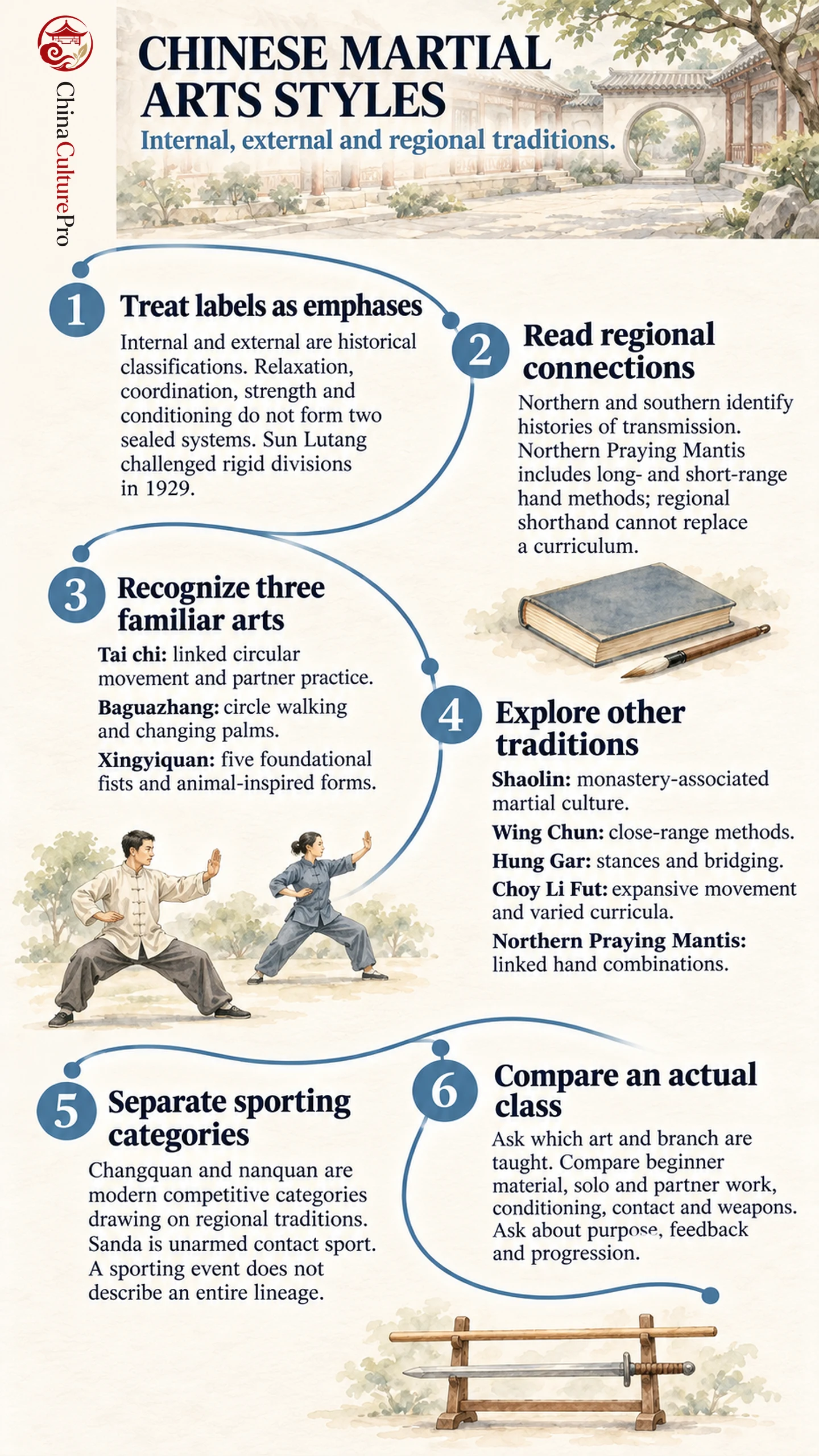
A list of style names is easier to understand when it separates geography, inherited methods and sporting formats. This guide maps those relationships within Chinese martial arts, then introduces eight representative traditions. It is a starting map, rather than a ranking or an exhaustive family tree.
Internal and External Are Historical Labels
Introductory teaching descriptions often associate internal practice with relaxed coordination, attention and body organization, and external practice with speed, strength and conditioning. Treat these as descriptions of emphasis. They do not establish that one group uses no strength, or that the other requires no attention or refinement.[12]
The division has never been beyond dispute. In a 1929 essay, Sun Lutang (孙禄堂, Sūn Lùtáng) criticized the automatic equation of Shaolin kung fu (少林功夫, Shàolín gōngfu) with external practice and Wudang (武当, Wǔdāng) with internal practice, as well as the equation of Buddhist and Daoist affiliations with those categories. He argued that a temple or mountain name does not establish technical superiority, and that training can approach hardness and softness from different directions. This is a historical practitioner’s argument, not a scientific classification of bodies.[2]
Consequently, do not use internal as a synonym for gentle exercise or external as a synonym for unrefined force. A more useful description names what students train: stance, stepping, coordination, partner work, conditioning or applications. The Wudang traditions deserve their own historical and religious context rather than serving as a label for every art called internal.
Northern and Southern Describe Regional Connections
Regional labels point toward histories of teaching and circulation. They are less useful as rigid movement rules. Northern Praying Mantis (螳螂拳, tánglángquán), for example, has strong connections with Shandong (山东, Shāndōng), but its linked hand methods include both long- and short-range work. Northern therefore does not mean a curriculum consisting mainly of high kicks.[8]
The place where an art developed is also different from the place where it is now taught. Northern Praying Mantis appears in Hong Kong’s (香港, Xiānggǎng) martial heritage programming alongside southern traditions. Movement of teachers and students makes regional classifications a guide to transmission, rather than a rule about a practitioner’s present address.[9]
When you encounter the familiar contrast of northern kicks and southern hands, ask which named tradition it describes. Specific curricula supply better evidence than a slogan or an explanation based only on landscape.
Eight Traditions to Recognize
These examples show different levels of naming: an art with several family branches, a monastery-associated tradition, and more specifically identified regional systems. The features below help recognition; they do not describe every branch or replace a teacher’s syllabus.
| Tradition | Regional or cultural connection | What to recognize |
|---|---|---|
| Tai chi (太极拳, tàijíquán) | Early development in Henan (河南, Hénán); subsequently spread through several family traditions. | Relaxed circular movement, linked routines and partner practice within several family traditions.[11] |
| Baguazhang (八卦掌, bāguàzhǎng) | Nineteenth-century teaching in Beijing (北京, Běijīng). | Circle walking, changing palms and turning movement, with branches shaped by different teachers.[4] |
| Xingyiquan (形意拳, xíngyìquán) | Important transmission in Shanxi (山西, Shānxī) and Hebei (河北, Héběi). | Five foundational fists and animal-inspired forms, with an emphasis on coordinated intention and movement.[5] |
| Shaolin kung fu | The monastery and its cultural setting in Henan. | A monastery-associated tradition combining empty-hand, weapon and partner routines with a Buddhist cultural context.[10] |
| Wing Chun (咏春拳, yǒngchūnquán) | Strong regional connections with Guangdong (广东, Guǎngdōng), including its Foshan (佛山, Fóshān) tradition. | Close-range methods, center-line relationships, hand routines, wooden-dummy practice and partner exercises.[6] |
| Hung Gar (洪拳, hóngquán) | A southern tradition with documented transmission in Hong Kong. | Stances, bridging methods and power generation, with both hard and soft movement in the Hong Kong tradition.[9] |
| Choy Li Fut (蔡李佛拳, Càilǐfóquán) | A Guangdong tradition with roots in the nineteenth century. | Expansive movement, agile but stable footwork, and varied empty-hand, weapon and partner curricula.[7] |
| Northern Praying Mantis | A Shandong-associated tradition with wider transmission. | Linked long- and short-range hand methods, rapid combinations and several distinct branches.[8] |
Even within one named art, teachers and branches can preserve different emphases. Baguazhang’s early students often brought previous martial experience into their learning, helping produce different branches. A precise lineage name can therefore be more informative than a broad style label alone.[4]
Traditional Styles and Modern Sporting Categories
Modern taolu competition draws on traditional martial material while evaluating performance under sporting rules. Changquan (长拳, chángquán), or long fist, and nanquan (南拳, nánquán), or southern fist, are recognizable competitive categories. They draw from regional traditions but do not replace the separate curricula of every northern or southern school. Traditional arts also have routines, so performing a form does not by itself make a practice modern sport.[3]
Sanda (散打, sǎndǎ) is a different sporting discipline: unarmed contact competition involving punches, kicks, throws and defensive techniques. A contact bout and a judged routine test different tasks. Neither format alone describes the whole range of Chinese martial traditions.[13]
For the terminology behind those distinctions, see wushu and kung fu. Where a curriculum includes equipment, the weapons traditions also need to be understood in their particular teaching context.
Compare the Curriculum Before Choosing
A broad category cannot tell you how an individual class works. Ask questions that turn an attractive name into a clear description of learning.
- Name and transmission: What art and branch are taught, and how does the teacher explain its curriculum and teaching background?
- Practice content: What do beginners learn, and how do solo routines, partner work, conditioning, contact or weapons enter the syllabus?
- Purpose and feedback: Is the focus cultural study, recreation, martial application or competition? How are students corrected and helped to progress?
Respectful conduct is part of the learning environment; the guide to martial arts etiquette explains that context. These practical details are more useful than choosing solely because a style is advertised as internal, external, northern or southern.
FAQs About Chinese Martial Arts Styles
How many Chinese martial arts styles are there?
There is no single useful total without defining what counts as a style, branch or family system. Chinese martial practice includes numerous overlapping traditions; a short representative list is an orientation tool rather than a complete inventory.[1]
Are internal styles always slow and gentle?
No. Internal is a historical classification, not a guaranteed speed or intensity level. Sun Lutang’s discussion of hardness and softness already challenged a rigid separation; ask about the actual exercises and teaching demands.[2]
Do southern styles avoid kicks?
No. The documented Choy Li Fut curriculum includes leg methods as well as hand techniques and footwork. Regional shorthand cannot replace the content of a named system.[7]
Are modern wushu events the same as traditional styles?
No. Competitive categories organize sporting performance, while a traditional curriculum can include material serving other purposes. Related movements do not make a competition event and an entire lineage interchangeable.[3]
Sources
[1] International Wushu Federation. Traditional Wushu
[2] Sun Lutang, translated by Paul Brennan. Discussing Distinctions Between the Internal and External Schools of Martial Arts
[3] International Wushu Federation. Taolu
[4] China Intangible Cultural Heritage Digital Museum. Baguazhang: Beijing
[5] China Intangible Cultural Heritage Digital Museum. Xingyiquan: Taigu
[6] China Intangible Cultural Heritage Digital Museum. Foshan Wing Chun
[7] China Intangible Cultural Heritage Digital Museum. Choy Li Fut
[8] China Intangible Cultural Heritage Digital Museum. Praying Mantis Boxing
[9] Hong Kong Intangible Cultural Heritage Office. Meet the Masters 2026: Martial Arts Heritage
[10] China Intangible Cultural Heritage Digital Museum. Shaolin Kung Fu
[11] UNESCO. Taijiquan
[12] Luohan Wushu Kung Fu Center. Styles of Chinese Martial Arts
[13] International Wushu Federation. Sanda