

Quick Answer: What Is Baguazhang?
Baguazhang (八卦掌, bāguàzhǎng), usually translated as Eight Trigram Palm, is a Chinese martial tradition recognized by circular stepping, turning and changing palm methods. The movement of the body and feet matters as much as the shape of the hands.[3][6]
- Its public transmission is closely associated with Dong Haichuan (董海川, Dǒng Hǎichuān) in nineteenth-century Beijing (北京, Běijīng).[1]
- Circle walking is a foundation within a wider curriculum, not the whole art.[4]
- Eight-palm and animal-system names need to be read within a particular teaching tradition.[4]
Start with the relationship between movement, palm changes and lineage. A photograph of an open hand or an eight-trigram diagram cannot explain the complete practice.
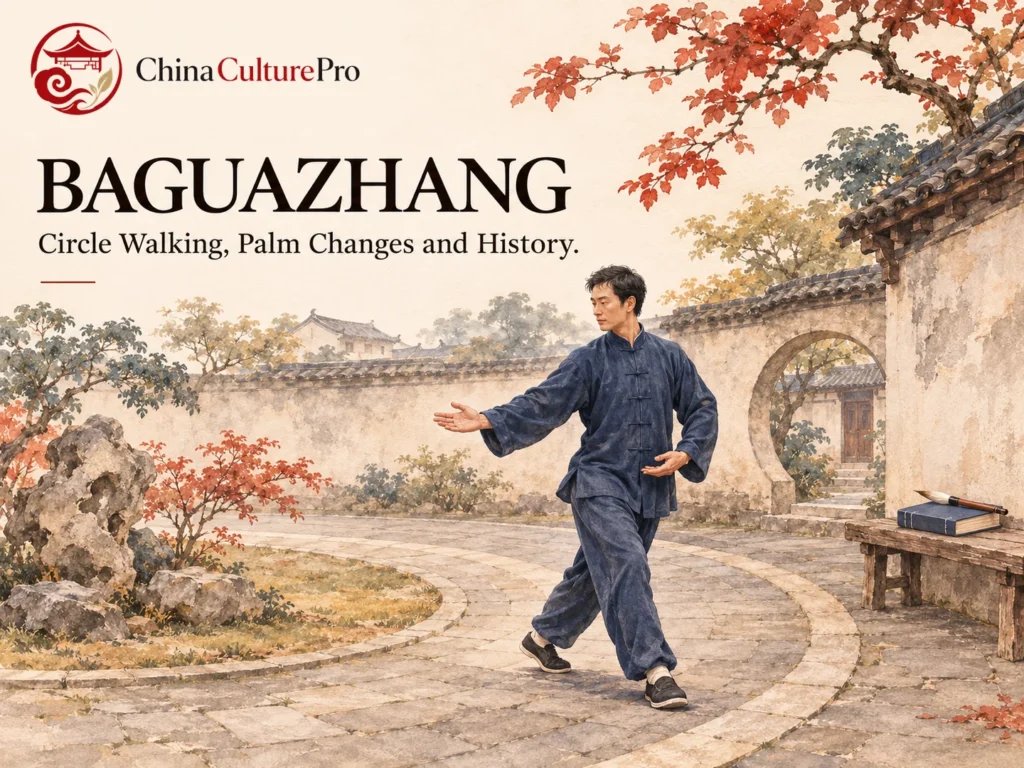
The circling figure is immediately recognizable, but it can conceal several different learning tasks. A practitioner may be maintaining a posture, changing direction or linking movement with a partner. This guide places those tasks within Chinese martial arts and distinguishes historical evidence from familiar origin stories.
Dong Haichuan and the Historical Record
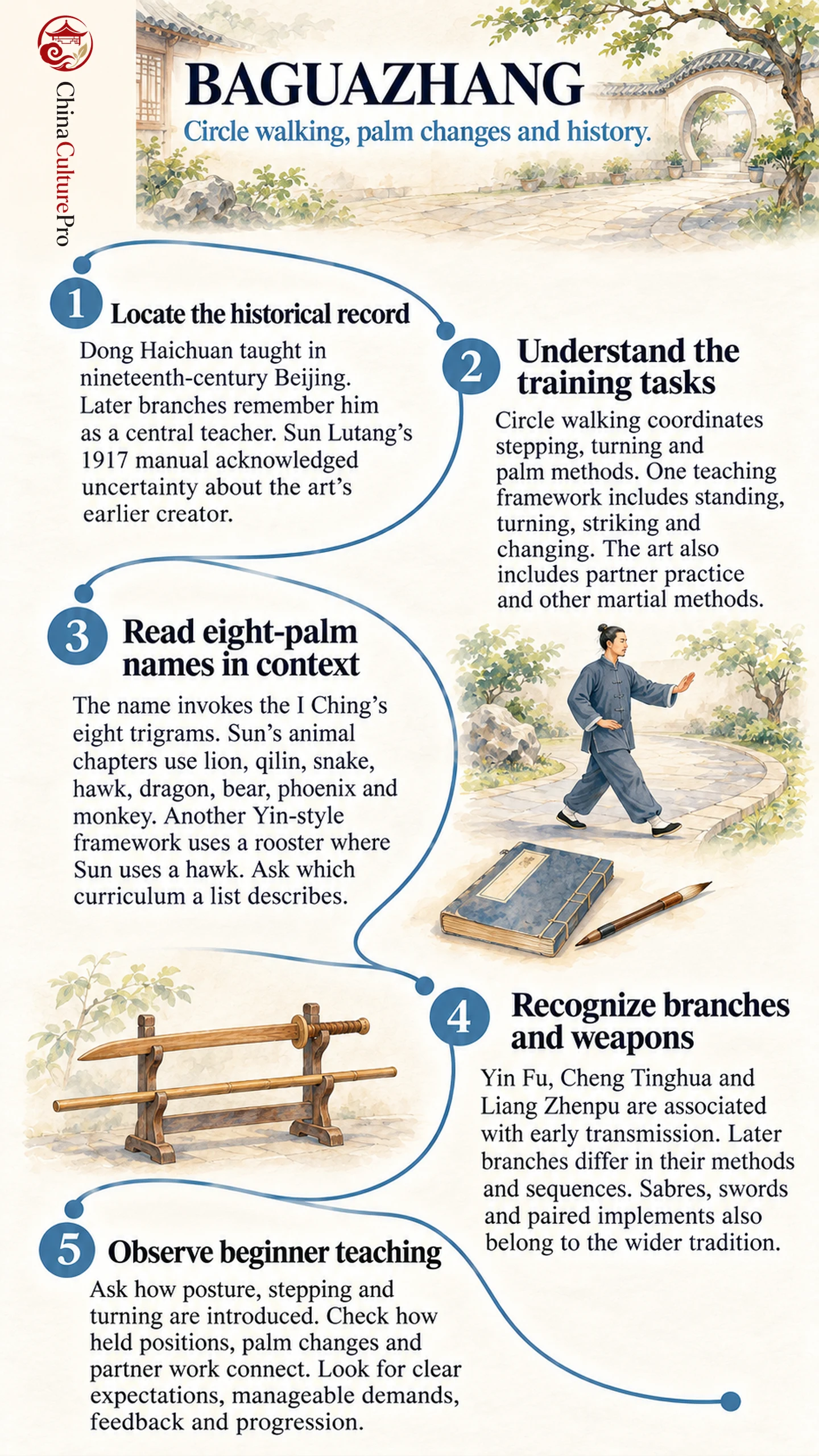
Dong Haichuan taught in Beijing during the nineteenth century, and later branches remember him as a central teacher. His students included people with previous martial training, whose backgrounds helped shape different expressions of the art. That teaching setting is a sound starting point for understanding its transmission.[1]
Earlier origins are less straightforward. In his 1917 manual, Sun Lutang (孙禄堂, Sūn Lùtáng) described learning from Cheng Tinghua (程廷华, Chéng Tínghuá), while acknowledging uncertainty about who originally created the art and when. Stories about Dong meeting an unusual teacher during his travels should therefore be read as transmitted accounts rather than a fully verified biography.[2]
The distinction does not make lineage memory worthless. It means asking what a source establishes: a teaching relationship, a remembered journey, a published interpretation or a later story. The guide to Chinese history and legend develops that reading method.
Circle Walking, Palm Changes and Wider Training
Circle walking organizes movement around a center while the practitioner maintains or changes an upper-body configuration. Turning and stepping are coordinated with the palm methods, rather than added after a stationary hand technique. Direction changes, body rotation and the relationship between hands and feet are recurring features.[3]
Named changes include the single palm change (单换掌, dānhuànzhǎng) and double palm change (双换掌, shuānghuànzhǎng). These are connected movement patterns, not simply changing from one hand to the other. A teacher must explain how a particular version links its steps, turns and palm actions.[3]
One published teaching framework divides training into four areas. This is a useful example of why the art extends beyond continuous walking:[4]
- Standing: Holding strengthening postures.[4]
- Turning: Circle-turning practice.[4]
- Striking: Practicing martial techniques.[4]
- Changing: Varying and transforming methods.[4]
Wider training can include kicks, throws, grappling and partner practice. The name palm should not be taken to mean that legs and the rest of the body are absent. Nor does a well-rehearsed solo sequence establish how someone performs with an opponent.[5]
Eight Trigrams and Different Eight-Palm Lists
The name invokes bagua (八卦, bāguà), the eight trigrams associated with the I Ching (易经, Yìjīng), or Book of Changes. Sun’s manual uses this cultural framework to interpret change, rather than mechanically determine technique.[2]
Eight Mother Palms (八母掌, bāmǔzhǎng) is a name used for foundational palm material, but the name alone does not identify one universally identical sequence. It is worth distinguishing a held posture, a dynamic change and a longer linked form. One Cheng-related curriculum explicitly teaches these as different parts of its progression.[6][7]
A concrete historical example is Sun’s eight animal-associated chapters: lion, qilin (麒麟, qílín), snake, hawk, dragon, bear, phoenix and monkey. In another published Yin style (尹式, Yǐnshì) framework, the comparable animal grouping includes a rooster where Sun uses a hawk. These are specific systems of organization, not interchangeable lists that every school must follow.[2][4]
For the diagrams and their wider cultural associations, continue with the eight trigrams. Keeping that subject distinct helps avoid confusing a martial curriculum with a divination diagram.
Branches, Teachers and Weapons
Names associated with early transmission include Yin Fu (尹福, Yǐn Fú), Cheng Tinghua and Liang Zhenpu (梁振普, Liáng Zhènpǔ). Their students and later teachers developed branches with different palm configurations, sequences and emphases. Because Dong’s students often brought earlier martial experience, variation belongs within the transmission history rather than automatically indicating that one branch is an error.[1]
Weapons also belong to the wider tradition. Heritage descriptions include large sabres, swords and distinctive paired implements alongside empty-hand practice. Their presence is another reason not to reduce baguazhang to eight hand shapes. Particular schools preserve and teach different selections; the weapons guide explains the broader terminology.[1]
When comparing schools, a branch name provides a starting relationship. It does not replace an explanation of what is taught, how it is practiced and how a student is helped to improve.
What to Look for in a Beginner Class
Observe how a teacher turns broad ideas into manageable material. Useful questions include:
- Foundations: How are posture, stepping and turning introduced before longer sequences?
- Connections: How do held positions, palm changes and any partner work relate to one another?
- Expectations: What physical demands, feedback and progression should a beginner expect?
Traditional descriptions often join bodily training with attention and cultivation. That states a purpose of practice; it does not by itself establish clinical claims about curing illness. Look for clear teaching rather than promises of effortless force or automatic benefits.[6]
The wider style map offers context, while martial arts etiquette explains respectful participation in a school.
FAQs About Baguazhang
Is baguazhang just walking in circles?
No. Circle turning sits alongside other training areas, including postures, martial techniques and changing methods. The circle is a recognizable foundation, not a complete description of the curriculum.[4]
Are the Eight Mother Palms identical in every school?
No. Foundational changes, held postures and longer forms can be organized differently. Identify the teacher’s curriculum before assuming that two lists with eight entries describe the same material.[7]
Is baguazhang the same as the eight-trigram diagram?
No. Baguazhang is a martial tradition. The eight trigrams supply an associated symbolic framework; understanding a diagram is not the same as learning the physical practice.[6]
How is baguazhang related to tai chi and xingyiquan?
They have often been discussed together as internal martial arts. Sun’s early account contrasted tai chi (太极拳, tàijíquán), baguazhang and xingyiquan (形意拳, xíngyìquán) through different emphases on continuity, change and directness. That comparison does not make them one identical curriculum.[2]
Sources
[1] China Intangible Cultural Heritage Digital Museum. Baguazhang: Beijing
[2] Sun Lutang, translated by Paul Brennan. A Study of Bagua Boxing
[3] China Intangible Cultural Heritage Digital Museum. Baguazhang: Langfang
[4] He Jinbao, translated by Matt Bild. Yin Style Bagua Isometric Strengthening Practices
[5] Yin Style Baguazhang International. What Is Yin Style Bagua?
[6] Tianjin University of Sport. Eight Trigrams Palm: Traditional Martial Arts Teaching Feature
[7] Lotus Nei Gong. Baguazhang Curriculum