


Quick Answer: What Are Cocktail Buns?
Cocktail buns (雞尾包, jīwěibāo) are Hong Kong-style sweet bread buns with a coconut filling. Gai mei bao is the familiar Cantonese menu spelling, rather than Mandarin pinyin.[1]
- Bread: Soft, lightly sweetened baked dough.
- Filling: Coconut mixed with sugar and other ingredients.
- Surface: Piped sweet topping and sesame are familiar decorations.
- Texture: Fluffy bread contrasts with the denser coconut center.
The name does not require either chicken meat or an alcoholic cocktail.[2][3]
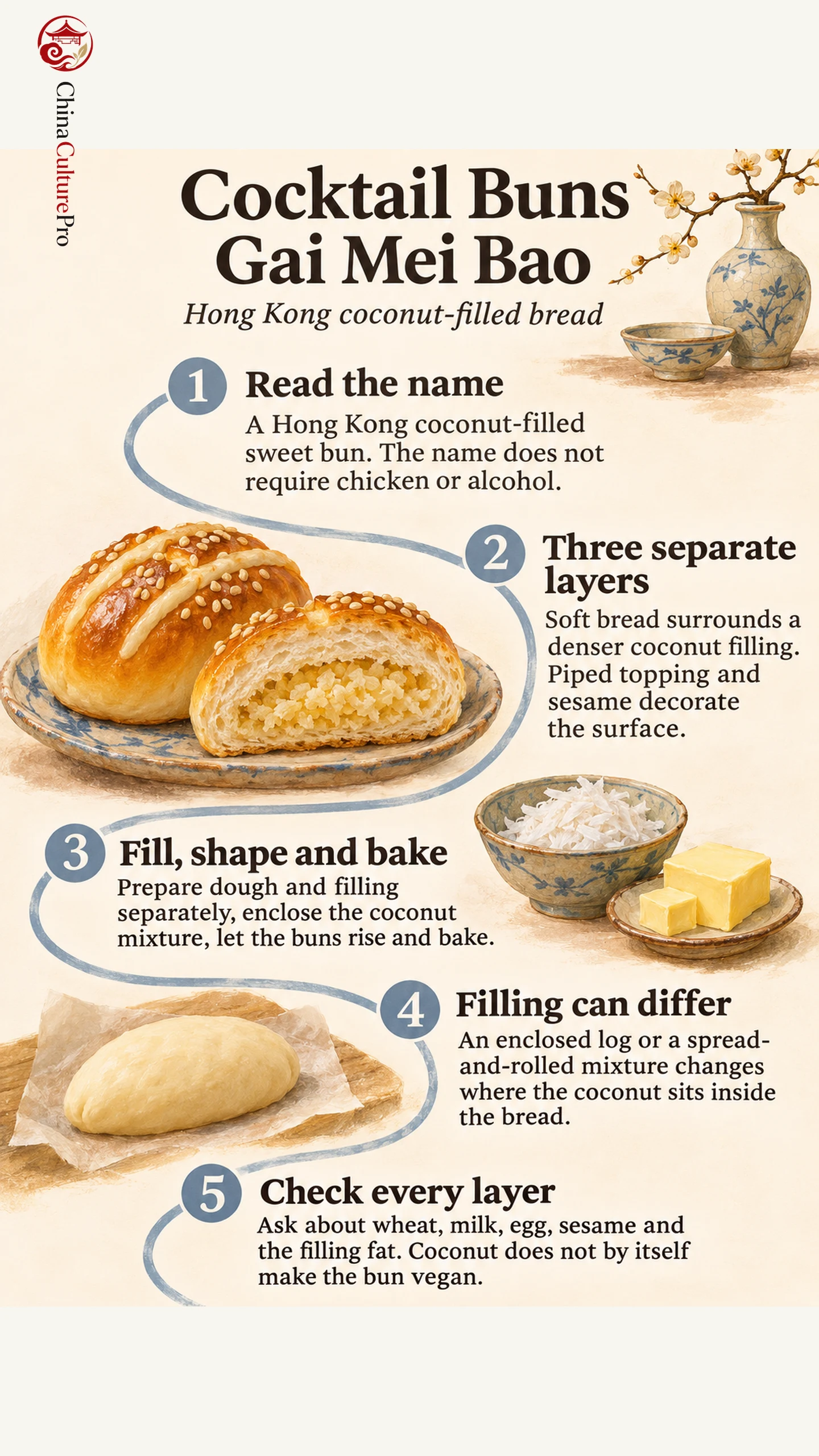
A golden oval bun can hide a distinctly textured filling. Breaking it open reveals why coconut, rather than the English word “cocktail,” is the useful clue.
Bread, Coconut Filling and Surface Toppings
The outer bread and inner filling are prepared separately. Milk-bread versions use wheat flour, yeast and enriching ingredients such as milk, egg or cream. The baked crumb stays soft around a filling that has a more compact, coconut-rich bite.[3]
| Layer | Typical components | Job in the bun |
|---|---|---|
| Bread dough | Wheat flour, yeast and recipe-specific enrichments | A soft structure around the filling |
| Coconut filling | Shredded coconut, sugar, fat and often milk powder | Sweet coconut flavor and a denser texture |
| Surface finish | Egg wash, piped sweet topping or sesame | Golden color and recognizable decoration |
Butter, milk powder and a little flour appear alongside coconut and sugar in one documented filling. The mixture is crumbly when combined but holds together when pressed. This is a baked filling, not simply a spoonful of whipped cream inserted after baking.[2]
Fat choice varies. Published formulations include butter-based and margarine-based approaches, and a Hong Kong bakery report records a producer changing the fat in its coconut filling. “Coconut bun” alone therefore does not identify every dairy or fat ingredient.[4][5]
How Cocktail Buns Are Filled and Baked
The main sequence keeps dough, filling and decoration distinct:[4]
- Mix and develop the yeast dough, then let it rise.
- Prepare the coconut filling separately.
- Divide and flatten the dough, enclose the filling and shape the buns.
- Let the shaped buns rise, then add the chosen surface finish.
- Bake until the bread and filling form the finished golden bun.
Shape affects where the filling lands. One approach encloses a small log in the dough; another spreads the coconut mixture before rolling the dough into an elongated bun. The second distributes filling through more of the bread rather than keeping it all in one central pocket.[2][3]
Two pale piped stripes and a scatter of sesame seeds are familiar visual signals. They are separate from the coconut inside. Surface decoration is useful for recognition, but an unfamiliar pattern should prompt a question about the filling rather than an automatic judgment.[3][4]
Why the Name and Shape Can Be Misleading
The Chinese characters literally suggest “chicken tail bun.” The dictionary definition, however, identifies a sweet coconut-filled Hong Kong bread, not a meat bun. English menus commonly use the Cantonese-based spelling gai mei bao.[1]
A commonly repeated explanation connects “cocktail” with mixing bakery ingredients into a filling. That account helps explain the name, but it is not a reason to assume that a modern bakery uses yesterday’s bread, or that all buns follow one historical formula. Contemporary published versions make their coconut filling directly.[2]
Elongated individual buns are familiar, while pull-apart arrangements also appear in published baking. Exact length, shape and spacing are presentation choices; the coconut-filled sweet bread remains the central identification.
Cocktail Buns in Hong Kong Bakery Culture
The bun sits within the wider Hong Kong bakery tradition. It shares counters and bakery boxes with other sweet and savory breads, rather than being restricted to a single annual celebration.[1][3]
When choosing among similar-looking buns, use the filling as your first question. Pineapple buns and custard buns have their own identifying features. A shared soft bread base does not make those names, or cream buns, interchangeable with cocktail bun.
Choosing and Eating Cocktail Buns
Ask for the coconut-filled version and check the display description. If sesame seeds, a particular fat or a dairy ingredient matters, ask about the topping and filling separately from the dough. A garnish can be absent while the same ingredient remains elsewhere.
The documented versions contain wheat and commonly dairy or egg. Removing visible sesame does not change those ingredients. A coconut filling is not evidence that the bun is vegan or gluten-free, and the name is not a complete ingredient declaration.
Eat a comfortably warm bun or one served at room temperature. Breaking off bread with some filling lets you taste the soft crumb and coconut together. An individually baked bun may have more browned sides than one baked against its neighbors; that does not establish a better filling.
FAQs About Cocktail Buns
Do Cocktail Buns Contain Alcohol or Chicken?
Neither is required by the name. The preparations discussed here are coconut-filled sweet breads. Check a specific product’s ingredients when avoiding alcohol or animal ingredients.
Are Cocktail Buns Filled with Whipped Cream?
The familiar filling is a coconut mixture baked inside the bread. If you want a cream bun, check the bakery’s separate description rather than relying on a similar shape.
Must the Filling Sit in One Central Lump?
No. Enclosed logs and spread-and-rolled fillings are both documented. The distribution can differ without removing coconut as the bun’s defining filling.
Sources
[1] Words.hk. 雞尾包
[2] Kristina Cho / The Splendid Table. Cocktail Buns: Gai Mei Bao
[3] Sarah / The Woks of Life. Coconut Buns: Chinese Cocktail Buns
[4] PT SMART. Cocktail Bun: Gai Mei Bao
[5] Hong Kong Centre for Food Safety. 本地麵包的鈉、總脂肪及反式脂肪含量