


Quick Answer: What Is Hainan Yi Bua?
Yi Bua (薏粑, Mandarin: yì bā) is a Hainanese filled glutinous-rice cake. Its soft, chewy skin encloses a sweet filling, often with coconut, peanuts and sesame.[1][2]
- Skin: glutinous rice dough, rather than a fluffy wheat bun.
- Filling: coconut sweetness with nuts, seeds and sometimes ginger.
- Method: enclose the filling, support with a leaf and steam.[3][4]
Fillings and occasions differ between Hainan localities and overseas families.
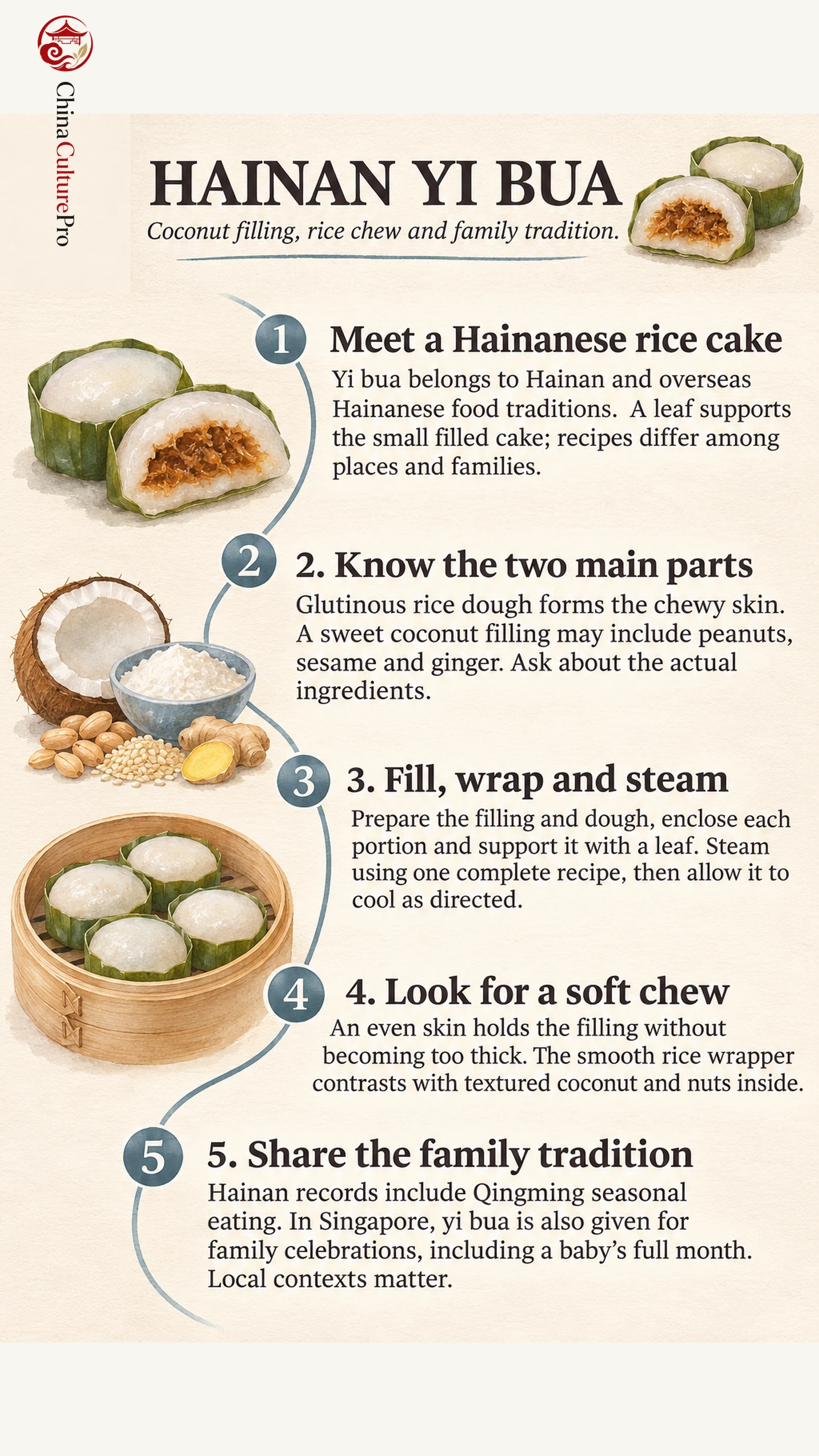
A leaf-supported yi bua pairs a smooth rice skin with a textured sweet filling.[1][2]
A Hainanese Rice Cake at Home and Overseas
Yi bua belongs to the snack traditions of Hainan. Local reporting particularly identifies Haikou, Ding’an, Qionghai and Wenchang with the cake.[1]
It also survives in overseas Hainanese families. A Singapore community programme documents a third-generation maker teaching the hand shaping and wrapping learned through her grandmother’s craft.[6]
The Rice Skin and Coconut Filling
The core structure is simple, but its parts do different jobs:[2][3]
- Glutinous rice dough gives the skin its pliable chew. Ordinary rice flour does not behave identically.
- Grated coconut supplies a fibrous, fragrant centre; palm sugar or other sugar sweetens it.
- Crushed peanuts, sesame and ginger can bring nuttiness, small crunchy pieces and a warm bite.
One Singapore stall recipe adds dried persimmon and uses both brown sugar and gula melaka palm sugar. Those additions identify that version rather than a rule for all Hainan yi bua.[4]
How Yi Bua Is Shaped and Steamed
A family stall’s shared method follows four main stages:[4]
- Cook the sweet coconut filling, then cool it before adding the nuts and sesame.
- Knead the glutinous rice flour, water and oil into dough and divide it into portions.
- Enclose the filling, flatten gently and wrap a banana-leaf strip around each cake.
- Steam, brush the surface with a little oil and let the cakes cool slightly before eating.
Steaming times belong to the particular dough formula and cake size. Follow one complete recipe rather than transferring a timing from another version.
What the Texture Should Be Like
The rice skin should be soft and chewy, with enough strength to contain the filling. Hainan reporting emphasizes an even thickness: too thin can expose the filling, while too thick makes the cake heavy with dough.[1]
In a coconut-and-ginger version, the filling is sweet and nutty with a gentle spicy edge. The cake has a dense rice-dough chew rather than an airy, bread-like crumb.[3]
Celebration, Sharing and Local Differences
On Hainan, yi bua appears among seasonal foods in the provincial regulator’s 2025 Qingming Festival notice. That documents one island context without making it the cake’s only occasion.[5]
The Singapore Hainanese clan association describes giving yi bua to congratulate friends and relatives. A community maker programme specifically records gifts for a baby’s full-month celebration. Together these accounts show food carrying family goodwill across generations and places.[2][6]
FAQs About Hainan Yi Bua
Is yi bua made from barley?
The documented cake uses glutinous rice flour for its skin. Do not infer a barley recipe from the written name.[3]
Are all yi bua fillings the same?
No. Coconut, peanuts, sesame, ginger and sugar recur, but particular recipes add ingredients such as dried persimmon. Ask about the actual filling, especially if avoiding peanuts or sesame.[2][4]
Can ordinary rice flour replace glutinous rice flour?
Not directly in the same formula. The glutinous rice flour is responsible for the characteristic chew; use the flour specified by the recipe.[3]
Sources
[1] Zhang Wanqian, Hainan Daily. A guide to Hainan’s ba rice foods
[2] Hainan Lim Clan Association, Singapore. Hainanese snacks: yi bua
[3] Marvellina. Hainanese Yi Bua Kueh
[4] Joshua Lee, Mothership. Yi bua recipe shared by a Hainanese family stall
[5] Hainan Administration for Market Regulation. Qingming food consumption notice, 2025 No.5
[6] My Community Festival. Meet Hainanese yi bua maker Jocelyn Loi