
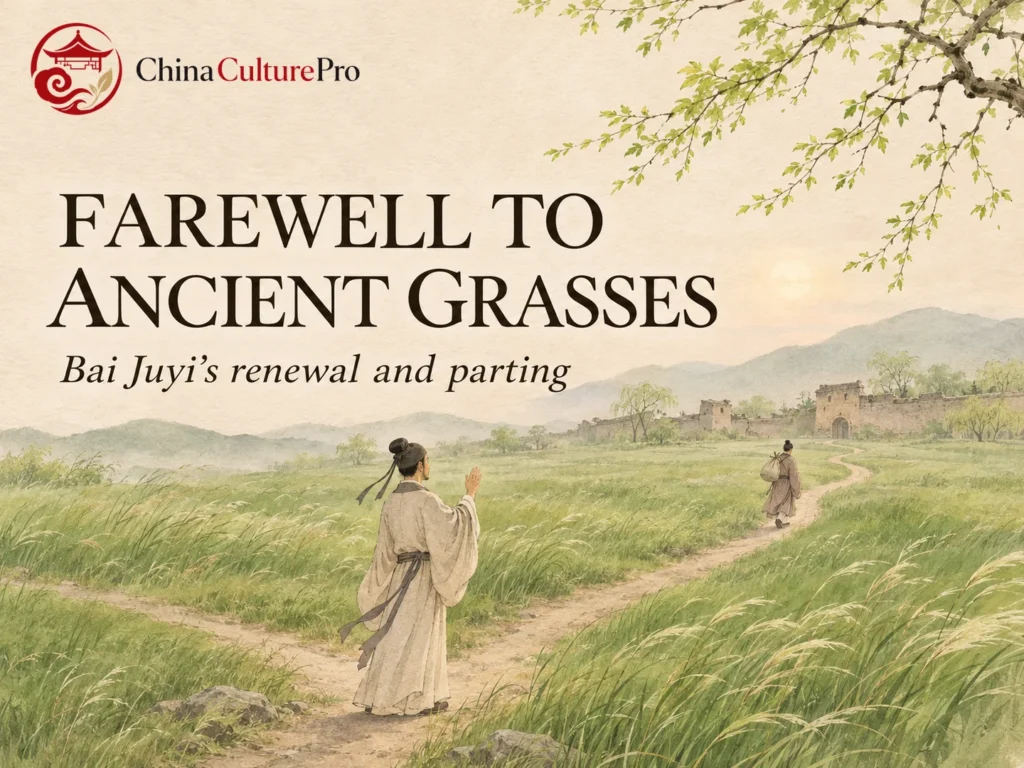

Quick Answer: What Does Farewell to Ancient Grasses Mean?
Farewell to Ancient Grasses (賦得古原草送別, Fù Dé Gǔ Yuán Cǎo Sòngbié), by Bai Juyi (白居易, Bái Jūyì), connects the recurring growth of grass with the emotion of seeing someone off.[1]
- Renewal: Each year brings withering and fresh growth; even wildfire fails to end the grass’s return.
- Landscape: Fragrance and green colour spread toward an old road and an abandoned town.
- Parting: The last couplet reveals a farewell, letting the abundant grass carry an equally abundant feeling.
Its resilient grass is memorable on its own, but the complete eight-line poem also asks us to stay with the sorrow of departure.

Grass returns after fire, but a friend is leaving. Those two movements belong to the same poem. Reading beyond its famous opening half reveals how a scene of renewal becomes a landscape filled with the feeling of parting.
The Complete Eight-Line Poem and an English Sense Translation
The full text is five-character regulated verse (五言律詩, wǔyán lǜshī): eight lines, 40 Chinese characters and four couplets. The familiar four-line excerpt stops before the road, town and farewell. Here is the complete poem with an original English sense translation.[1]
| Chinese text | English sense |
|---|---|
| 離離原上草, 一歲一枯榮。 | Thickly grows the grass across the plain; each year it withers, each year it flourishes. |
| 野火燒不盡, 春風吹又生。 | Wildfire cannot consume it entirely; the spring wind blows, and it grows once more. |
| 遠芳侵古道, 晴翠接荒城。 | Its spreading fragrance reaches the ancient road; its sunlit green extends to the deserted town. |
| 又送王孫去, 萋萋滿別情。 | Once again I see a dear friend leave; the luxuriant grass is filled with the feeling of farewell. |
The paired lines let one idea develop through another: withering against flourishing, fire against spring wind, fragrance against colour. The Tang poetry guide explains the wider family of regulated verse.
Why Grass Survives Fire in the Poem
The first couplet puts the grass within a cycle. Withering is real, yet it is not the last event in that cycle. The next couplet gives this pattern a dramatic test: fire seems destructive, then spring brings another beginning.
The contrast between “cannot entirely” and “once more” makes the renewal emphatic. The first phrase holds back a complete ending; the second supplies a return. Read together, the lines move forward across their break instead of forming two unrelated descriptions.
This is why the couplet lends itself to readings of endurance. But its immediate subject remains grass in a seasonal landscape. The poem does not promise that every individual survives every loss, and its image need not become a universal claim about how all plants respond to fire.
There is another reason to keep reading: renewal does not resolve the farewell that follows. Nature can flourish while a human relationship undergoes separation. The full poem allows those experiences to coexist.
From the Old Road to a Farewell
The third couplet changes the scale of attention. Instead of grass through a whole year, we encounter its fragrance and colour spreading through a particular scene. The road offers a line along which someone can depart; the deserted town adds the traces of human life to the plain.
Wangsun (王孫, wángsūn), literally a noble descendant, serves here as a respectful literary address for the departing friend.[2] It does not identify a named royal traveller. The English translation uses “dear friend” to carry that function without inventing a biography.
The ending recalls Summons for the Recluse (招隱士, Zhāo Yǐnshì), a work in the Songs of Chu (楚辭, Chǔcí). There, a wandering figure has not returned while spring grass grows luxuriantly.[2][3] The Songs of Chu reading guide gives that collection’s broader context.
Here the speaker is seeing someone leave. The repeated idea of abundant grass joins the earlier tradition of longing to this moment of departure. The field does not need to look barren to feel sad: its fullness becomes the very means of expressing feeling.
What the Full Chinese Title Tells You
The title’s opening label fude (賦得, fùdé) signals composition on a set theme, a practice associated with literary exercises and examination preparation.[2][4] The remaining words bring together the ancient plain, grass and seeing someone off. The poem must make those elements work as one scene.
That helps explain its design. The early lines establish grass, the middle opens out the old landscape, and the final couplet explicitly supplies the farewell. The title gives us a reader’s destination before the poem gradually reaches it.
The label alone does not prove that these words were composed during an actual examination. The imperial examinations overview explains the wider institution; the Bai Juyi profile places this youthful work alongside his longer literary career.
How to Read the Grass and the Parting Together
- Read all four couplets: Keep the final farewell in view instead of ending with the familiar fire and spring wind.
- Notice the changes of scale: Follow a yearly cycle into a broad landscape, then into one human departure.
- Track the spreading movement: Fragrance, green colour and feeling extend across the scene in related ways.
- Return to the first line: Ask how the grass’s abundance feels different after the farewell has been named.
This approach also works across the wider Chinese poetry collection: a famous couplet can change meaning when read within its complete poem.
FAQs About Farewell to Ancient Grasses
Is this the same poem often called Grass?
Yes. The shorter title can refer to this poem, and some teaching versions give only its first four lines. The complete work continues for another four lines and ends with farewell.[1]
Does Wangsun identify an actual prince?
Not here. Its inherited noble sense becomes a courteous poetic way to refer to the person being seen off. The verse does not tell us that person’s name or rank.[2]
Did Bai Juyi write the poem when he was sixteen?
Sixteen is a traditional dating, not an age stated by the poem. A familiar story links the wildfire couplet with praise from Gu Kuang (顧況, Gù Kuàng), but the encounter’s chronology and location have been questioned. Treat the youthful context more confidently than a precise year or a fully documented meeting.[4]
Sources
[1] Bai Juyi. Farewell to Ancient Grasses: complete classical text
[2] Hong Kong Education Bureau. Farewell to Ancient Grasses: text, background and teaching notes
[3] Huainan Xiaoshan, traditionally attributed. Summons for the Recluse: classical text