


Quick Answer: Who Are the Eight Immortals of the Wine Cup?
Eight Immortals of the Wine Cup (飲中八仙歌, Yǐnzhōng Bāxiān Gē) is a poem by Du Fu (杜甫, Dù Fǔ) portraying eight Tang figures through exaggerated drinking scenes.[1][2]
- People: The subjects range from a prince and a senior minister to celebrated literary and artistic personalities.
- Method: Each portrait turns on a memorable action, comparison or display of talent, rather than a complete biography.
- Reading: The humour combines admiration for distinctive character with the absurdity of lost restraint.
These are human figures in a literary grouping. They are distinct from the familiar Daoist Eight Immortals (八仙, Bāxiān).[2]
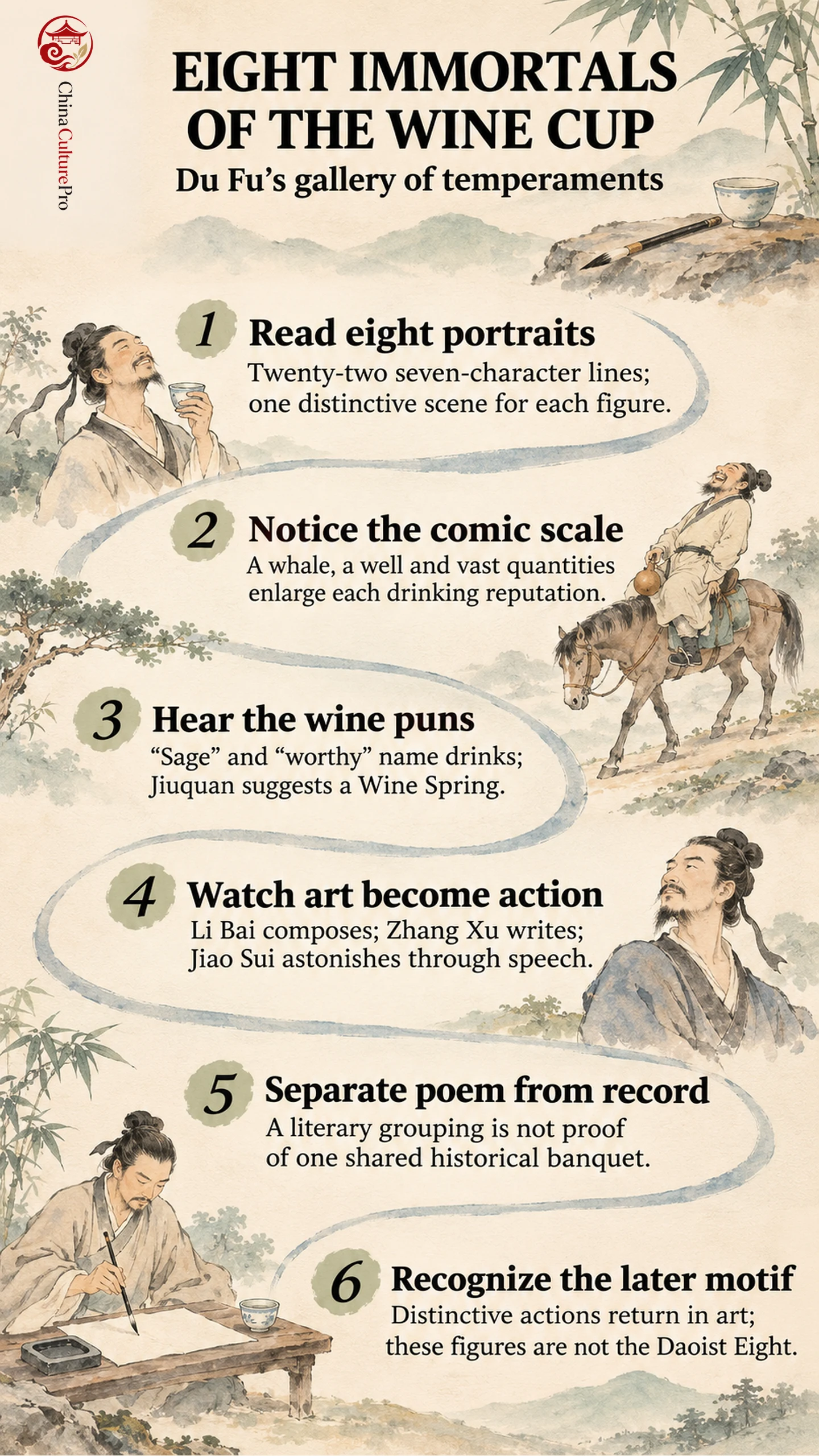
One man sways on horseback, another dreams of a place named Wine Spring, and a third makes his brush move like clouds. This poem creates a gallery of temperaments. The shared drink gives each figure a different way to step outside ordinary composure.
The Complete Poem: Eight Figures and an English Sense Translation
The poem has 22 seven-character lines, 154 characters in all. It is seven-character ancient-style verse (七言古詩, qīyán gǔshī), with unequal space given to each person. The table preserves all the lines, grouped into their eight portraits, with an original English sense translation.[1]
The volume measure dou (斗, dǒu) is retained rather than converted into modern litres. These extravagant quantities belong to the poem’s characterization, not to a reliable account of anyone’s intake.
| Figure | Chinese text | English sense |
|---|---|---|
| He Zhizhang (賀知章, Hè Zhīzhāng) | 知章騎馬似乘船, 眼花落井水底眠。 | Zhizhang rides a horse as though aboard a boat; his vision swims, he tumbles into a well and sleeps beneath the water. |
| Li Jin (李璡, Lǐ Jīn), Prince of Ruyang (汝陽王, Rǔyáng Wáng) | 汝陽三斗始朝天, 道逢麴車口流涎, 恨不移封向酒泉。 | Only after three dou does Ruyang attend the imperial audience; a brewer’s cart on the road makes his mouth water; he regrets that his fief cannot be moved to Jiuquan (酒泉, Jiǔquán), “Wine Spring.” |
| Li Shizhi (李適之, Lǐ Shìzhī), Minister of the Left | 左相日興費萬錢, 飲如長鯨吸百川, 銜杯樂聖稱避賢。 | The Left Minister’s daily pleasure costs ten thousand cash; he drinks like a great whale drawing in a hundred streams; cup to his lips, he delights in the “sage” and says he shuns the “worthy.” |
| Cui Zongzhi (崔宗之, Cuī Zōngzhī) | 宗之瀟灑美少年, 舉觴白眼望青天, 皎如玉樹臨風前。 | Zongzhi is a handsome, carefree young man; raising his cup, he turns the whites of his eyes toward the blue sky; bright as a jade tree standing in the breeze. |
| Su Jin (蘇晉, Sū Jìn) | 蘇晉長齋繡佛前, 醉中往往愛逃禪。 | Su Jin keeps long abstinence before an embroidered Buddha; yet in drunkenness he often likes to escape religious discipline. |
| Li Bai (李白, Lǐ Bái) | 李白一斗詩百篇, 長安市上酒家眠, 天子呼來不上船, 自稱臣是酒中仙。 | A dou brings Li Bai a hundred poems; he sleeps in a tavern in Chang’an (長安, Cháng’ān); the emperor summons him, but he will not board the boat; he declares, “Your subject is an immortal of wine.” |
| Zhang Xu (張旭, Zhāng Xù) | 張旭三杯草聖傳, 脫帽露頂王公前, 揮毫落紙如雲煙。 | After three cups, Zhang Xu’s fame as a sage of cursive spreads; he removes his cap and bares his head before princes and dukes; his brush moves across paper like cloud and smoke. |
| Jiao Sui (焦遂, Jiāo Suì) | 焦遂五斗方卓然, 高談雄辨驚四筵。 | Only after five dou does Jiao Sui stand out; his lofty talk and forceful arguments astonish the whole gathering. |
Some transmitted texts have different wording. This version follows the selected edition, including 避賢 in the minister’s portrait.[1] The Tang poetry guide explains the wider formal context.
What the Wine Puns and Exaggerations Do
The prince’s wish depends on a place name: Jiuquan sounds like a destination designed for a drinker. The minister’s “sage” and “worthy” also have a second meaning. These were names for clear and cloudy alcoholic drinks, so a statement that sounds like moral discrimination can become a preference between drinks.[1]
These jokes give the portraits different shapes. The prince responds to an enticing cart and an enticing name; the minister becomes a whale swallowing rivers. Cui Zongzhi, by contrast, appears as a luminous tree in the wind. The poem can change from appetite to elegance within a few lines.
The opening fall into a well is comic impossibility pushed to an extreme. Read it as a picture of total loss of composure, rather than evidence that He Zhizhang literally slept safely underwater. Likewise, the quantities and the hundred poems magnify reputations. Their imaginative scale is part of the pleasure of the verse.
Li Bai, Zhang Xu and Freedom from Formality
Li Bai receives four lines, more than any other figure. His miniature scene brings artistic abundance, tavern sleep and an imperial summons together. Even the formal address “your subject” becomes part of his unconventional self-presentation. The Li Bai overview helps distinguish this memorable portrait from a complete account of his life.
Zhang Xu’s performance is equally bodily: cap removed, head exposed, brush in motion. His association with cursive script (草書, cǎoshū) matters because the poem makes the movement of writing visible.[1] The artist’s profile and the guide to Chinese cursive script offer two different next steps: the person and the written form.
The last portrait shifts from written art to speech. Jiao Sui surprises the people around him through argument. This ending broadens the gallery beyond poetry and calligraphy: personality can reveal itself in conversation too.
A Literary Group, Not a Recorded Banquet
The poem moves from person to person without establishing one shared room, date or occasion. Its eight portraits should not be turned automatically into a report of eight friends drinking together. Historical discussions of their lives and the changing membership attached to this label give further reason for caution.[3]
The grouping is certain within this poem: these are its eight subjects. Claims about exactly when all eight met require separate evidence. The Du Fu biography gives the author’s context without making him a ninth participant in the poem’s cast.
This distinction also leaves room for its mixed tone. Admiration, wit and possible discomfort with social roles can coexist. A reader need not choose between a wholly approving toast and a wholly condemning lecture.
Why These Portraits Reappear in Painting and Ceramics
The actions are easy to recognize visually: a swaying rider, a raised cup, a sleeping poet and an energetic brush. They give artists distinct poses instead of eight interchangeable drinkers.
A handscroll attributed to Ren Renfa (任仁發, Rèn Rénfā) carries the theme into painting, with the poem recorded in its inscriptions.[4] A Kangxi-period bowl also presents the Wine Cup figures as a decorative subject.[5] These later objects show the poem’s continuing life in visual culture; they do not turn its portraits into eyewitness images of a single Tang gathering.
How to Read the Poem as a Sequence of Portraits
- Separate the eight subjects: Use the names in the table to notice where each miniature scene begins and ends.
- Find each defining action: Riding, wishing, drinking, gazing, slipping from discipline, composing, writing and speaking create different personalities.
- Read the exaggeration as technique: Ask what a whale, a jade tree or a hundred poems makes vivid about its subject.
- Compare the social settings: Notice the court, religious observance and public gathering, then consider how each figure behaves within them.
FAQs About Eight Immortals of the Wine Cup
Are these the same as the Daoist Eight Immortals?
No. This poem’s cast consists of Tang human figures associated with drinking. The familiar religious and legendary group has different members.[2]
Is Du Fu one of the eight figures?
He is the author, not one of the eight people portrayed. The poem ends its sequence with Jiao Sui.[1]
Does the poem claim that drinking produces artistic talent?
It associates drinking with the exaggerated reputations of particular figures. That literary portrayal does not establish a general cause of talent or provide instructions for making art.
Sources
[1] Du Fu; Stephen Owen, editor and translator. The Poetry of Du Fu, volume 1, poem 2.1, Chinese text and notes, pages 54–57
[2] Ministry of Education. Revised Mandarin Dictionary: 八仙
[3] 趙睿才; Shandong University. The changing group of Drinking Immortals and Li Bai’s court service
[4] National Palace Museum. Handscroll attributed to Ren Renfa: Depiction of Eight Immortals Having Drinks
[5] Metropolitan Museum of Art. Bowl with Eight Immortals of the Wine Cup