


Quick Answer: Who Was the Duke of Zhou?
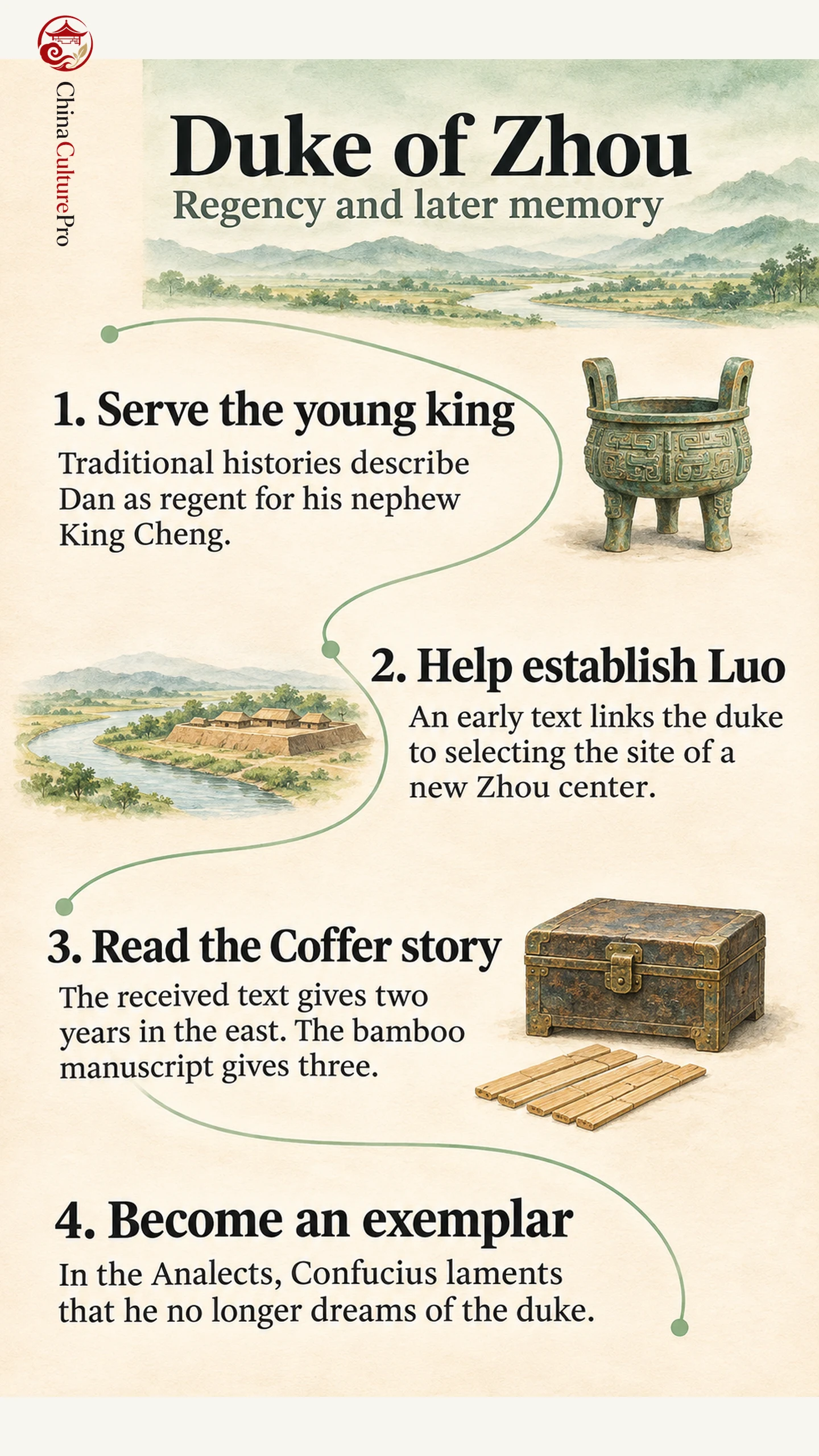
The Duke of Zhou (周公, Zhōugōng), personal name Dan (旦, Dàn), was a member of the royal family in the early Western Zhou (西周, Xī Zhōu). Traditional histories describe him as the brother of King Wu (武王, Wǔwáng) and regent for his nephew, King Cheng (成王, Chéngwáng).[1]
- Regency: The traditional account gives Dan charge of government during the new king’s youth.[5]
- Consolidation: One early text associates him with the choice of a site at Luo.[3]
- Legacy: Later writers remembered him as a model of service and ritual order.[8]
His story is about how an adviser with exceptional power could serve a young king.
The Zhou had won a kingdom and still had to hold it. The histories portray the young king’s uncle as both a protector of the court and the target of accusations.
From the Shang Conquest to the Regency
The Records of the Grand Historian (史记, Shǐjì) presents Dan as a son of King Wen (文王, Wénwáng) and an adviser to King Wu. In its account, he assists Wu in the campaign that overthrew the Shang dynasty (商, Shāng).[1]
The early Zhou bronze known as the Li gui (利簋, Lì guǐ) carries an inscription about Wu’s victory. The inscription is evidence from near the conquest itself. For the account of Dan’s service and regency, readers turn to the transmitted histories and speeches.[2]
The Eastern Campaign and the Zhou Court at Luo
Sima Qian’s history describes an uprising involving Wu Geng (武庚, Wǔ Gēng), a son of the defeated Shang king, and members of the Zhou royal family. Dan led a campaign in the east and later helped establish a Zhou center at Luoyi (洛邑, Luòyì).[1]
The “Announcement at Luo” (洛诰, Luògào) in the Book of Documents (尚书, Shàngshū) depicts the duke reporting on divination at candidate sites. The duke and the king then discuss rites at the new settlement. It places the work of settling the new center alongside the duty to uphold the Mandate of Heaven (天命, tiānmìng).[3]
What the Metal-Bound Coffer Can Tell Us
“The Metal-Bound Coffer” (金縢, Jīnténg) tells how Dan offers to die in place of the sick King Wu. A record of the offer is shut in a chest. Later a storm leads King Cheng to open it. Reading the pledge changes the king’s view of his uncle.[4]
A Warring States manuscript among the Tsinghua bamboo slips (清华简, Qīnghuá Jiǎn) gives Dan three years in the east. The received Book of Documents gives him two. Edward Shaughnessy notes that some accounts make the eastern residence sound like exile.[4][5][6]
Kuan-yun Huang reads the later transmission as clarifying the duke’s duty to remain subordinate to the ruler. The opened chest serves that purpose in the story. Its contents let the king judge the duke’s conduct for himself.[5]
Why Confucius Remembered the Duke of Zhou
In the Analects (论语, Lúnyǔ), Confucius (孔子, Kǒngzǐ) laments that he has grown old and no longer dreams of the duke. Readers took the remark as a sign of how much the duke mattered to Confucius. Later scholarly traditions made Dan a model of government by rites, a reputation Michael Nylan distinguishes from the more divided portraits in early texts.[7][8]
FAQs About the Duke of Zhou
Was the Duke of Zhou a Zhou king?
The traditional account gives him royal powers as regent for King Cheng. Sima Qian says he eventually returned authority to the king and resumed a minister’s position.[1]
Did the Duke of Zhou write the Rites of Zhou?
Tradition credited him with the Rites of Zhou (周礼, Zhōulǐ). Michael Nylan notes that most modern scholars date the text to the late Warring States period or later, centuries after Dan.[9]
What was his connection to the state of Lu?
According to Sima Qian, Dan was granted Lu (鲁, Lǔ) but remained at the Zhou court. His son Bo Qin (伯禽, Bó Qín) went there in his place.[1]
Sources
[1] Sima Qian. Records of the Grand Historian, chapter 33, Hereditary House of the Duke of Zhou of Lu
[2] Su Qiang, National Museum of China. Li vessel, Early Western Zhou
[3] Book of Documents. Announcement at Luo, Chinese text
[4] Book of Documents and Tsinghua manuscript. The Metal-Bound Coffer, received text and manuscript transcription
[5] Kuan-yun Huang. Poetry, The Metal-Bound Coffer, and the Duke of Zhou, Early China
[6] Edward L. Shaughnessy. The Duke of Zhou’s Retirement in the East, Early China
[7] Analects. Book 7, section 5, Chinese text
[8] Michael Nylan. The Many Dukes of Zhou in Early Sources, chapter preview
[9] Michael Nylan. The Five Confucian Classics, chapter 4 notes on the ritual classics