


Quick Answer: Where Did Chinese Chicken Salad Develop?
The lettuce-and-crunch dish commonly called Chinese chicken salad developed through California’s Chinese-American restaurant culture. It combines cooked chicken with crisp vegetables and Chinese-associated seasonings, but its changing recipes resist a neat single-inventor story.[4]
- Historical setting: Santa Monica’s Madame Wu’s Garden helped popularize a version in the 1960s.[4]
- Classic contrast: Shredded chicken, lettuce and fried noodle or wrapper toppings meet a savory dressing.[1]
- Later variations: Cabbage, citrus, ginger and nuts change the flavor and texture.[4]
It is a Chinese-American dish, not a standard salad recipe shared by every region of China.
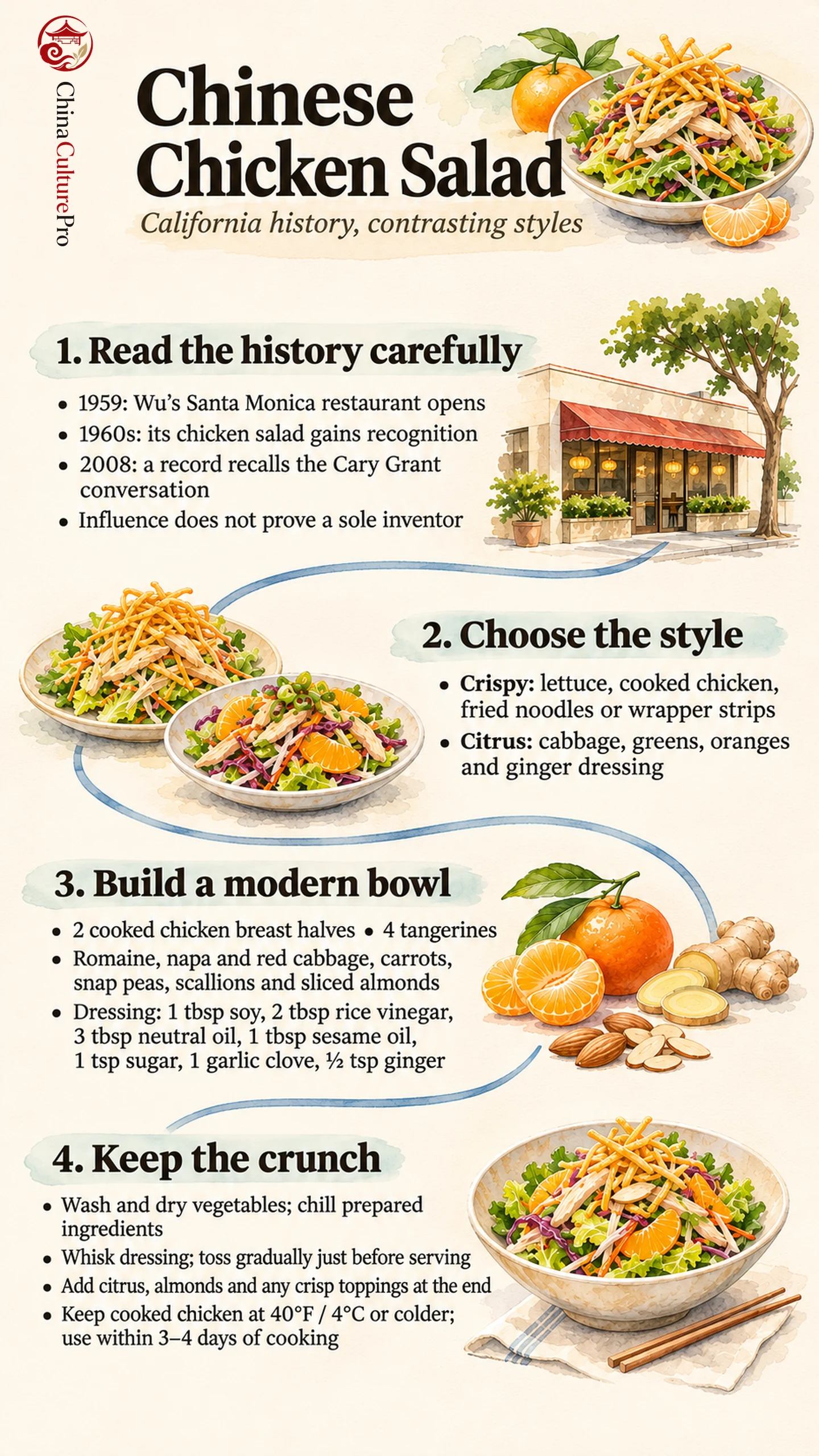
Its restaurant history explains why one bowl arrives with puffed noodles while another emphasizes cabbage and orange segments.
California Restaurants and the Origin Story
Sylvia Wu’s Santa Monica restaurant opened in 1959. By the 1960s, its chicken salad had become part of the restaurant’s identity. The opening date and the dish’s popularization are separate milestones; neither establishes the first occasion on which anyone combined chicken, lettuce and Chinese seasonings.[2][4]
A 1997 survey traced a recipe to Serve It Cold! (1968), by June Crosby and Ruth Conrad Bateman.[3]
A 2008 account based on direct contact with Wu records that a conversation with her customer and friend Cary Grant inspired her fusion salad. Her published recipe paired cooked chicken with mustard, soy sauce (酱油, jiàngyóu), sesame oil (香油, xiāngyóu), almonds, scallions and crisp toppings.[1]
Together, these records place the dish within Chinese-American food history. Wu deliberately adjusted her restaurant’s food to American guests; adaptation was part of her work, rather than an accidental departure from it.[2]
How the Main Styles Differ
- Crispy restaurant style: Cooked shredded chicken sits over lettuce with mustard, soy and sesame seasoning. Fried rice noodles and strips of wonton wrappers (馄饨皮, húntun pí) provide crunch; these are wrapper strips, rather than filled dumplings.[1]
- Citrus-and-vegetable style: Romaine and shredded cabbage carry chicken, orange segments and a ginger-led dressing. Peppers, herbs and peanuts can replace the emphasis on fried toppings. This is a variation, not a reconstruction of the earliest restaurant plate.[4]
The Chinese seasonings matter, but so does the salad’s structure. A leafy bowl tossed at the table is not interchangeable with the broader range of Chinese cold dishes. Compare the dressing, vegetables and toppings before assuming that two cold chicken dishes are the same.
Ingredients for a Citrus-and-Cabbage Version
This four-serving assembly uses already-cooked chicken and a single measured batch of ginger dressing. Use US tablespoons of 15 ml and teaspoons of 5 ml.
- Salad: 1 shredded romaine head; ¼ head each napa and red cabbage; 2 julienned carrots; 4 segmented tangerines; 2 cups sliced snap peas; 2 sliced scallions; ½ cup sliced almonds; 2 cooked, shredded chicken breast halves.[5]
- Dressing: 1 finely minced garlic clove, ½ teaspoon grated ginger, 1 tablespoon soy sauce, 2 tablespoons rice vinegar, 3 tablespoons neutral oil, 1 tablespoon sesame oil and 1 teaspoon sugar.[5]
If cooking the chicken yourself, use a food thermometer to confirm 165°F/74°C. Keep it separate from the ready-to-eat vegetables while raw.[6]
How to Assemble the Salad Without Losing Crunch
- Wash and thoroughly dry the vegetables. Slice them, peel the tangerines and shred the cooked chicken. Keep the prepared ingredients chilled until assembly.[5][6]
- Whisk the dressing ingredients together. Add a little water only if needed for a pourable consistency.[5]
- Toss the vegetables and chicken with dressing gradually, stopping when lightly coated. Add citrus and almonds gently, then serve promptly. If using crisp toppings, add them at serving time.[1][5]
Dry leaves and last-minute dressing preserve the texture. For a packed lunch, carry the dressing separately; preparing everything early does not mean mixing everything early.
FAQs About Chinese Chicken Salad History
Did Cary Grant invent Chinese chicken salad?
The documented connection is that a conversation with Grant inspired Wu’s version. That is evidence about her recipe’s development, not proof that he invented the wider salad category.[1]
Is it the same as bang bang chicken?
No. Sichuan-style bang bang chicken (棒棒鸡, bàngbàng jī) centers on shredded chicken with a spicy sesame dressing. California-style chicken salad usually makes a larger feature of lettuce, cabbage or crisp toppings.[4][9]
Does it always contain mandarin oranges?
No. Citrus is one way to add sweetness and acidity, not a defining requirement. Earlier-style chicken, lettuce and crisp-noodle versions need not include it.[1]
Can I make the salad ahead?
Keep chicken, vegetables, dressing and crisp toppings separate. Refrigerate within two hours, or one hour above 90°F/32°C, at 40°F/4°C or colder. Use cooked chicken within 3–4 days of cooking; assembling a salad does not restart that clock.[6][7][8]
Sources
[1] USC US-China Institute. Happy Thanksgiving: Recipes from Madame Wu
[2] PBS SoCal. The Remarkable Madame Wu
[3] Los Angeles Times. What’s in a Salad?
[4] PBS SoCal. Weekend Recipe: Chinese Chicken Salad
[5] Temecula Valley Winegrowers Association. Chinese Chicken Salad
[6] CDC. Chicken and Food Poisoning
[7] CDC. Preventing Food Poisoning
[8] USDA FSIS. Suggested Refrigerator Storage Times for Chicken
[9] ABC. Tony Tan’s Bang Bang Chicken