

Quick Answer: How Do Chinese Boy Names Work?
Chinese boy names are best understood through their written characters, pronunciation and family context. A pleasant English meaning is a starting point, not a complete explanation of a person’s name.
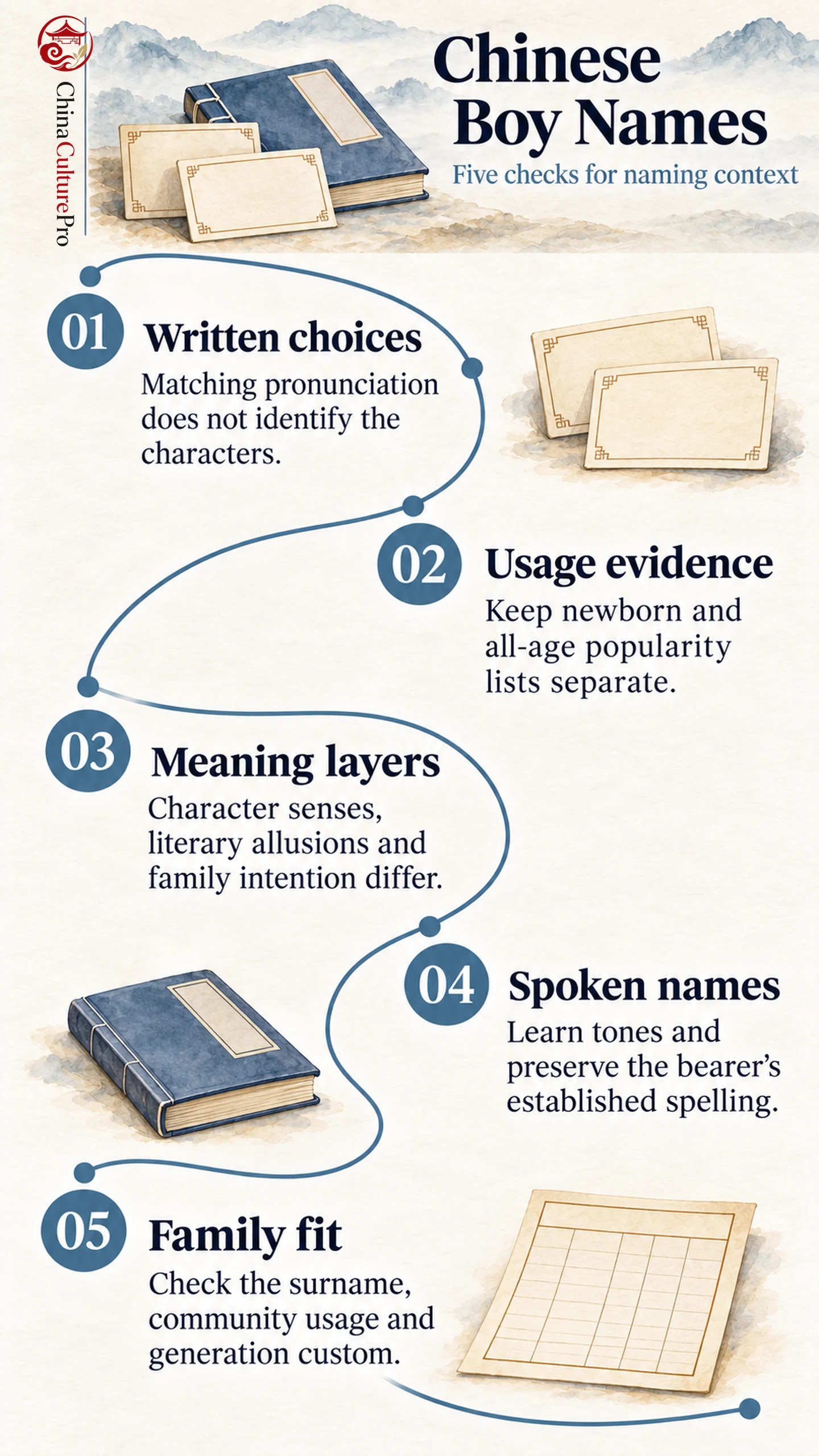
- Keep the exact characters beside tone-marked pinyin (拼音, pīnyīn).
- Separate individual character meanings from literary associations and family intention.
- Read popularity figures with their year, region and age group.
- Test the given name together with its surname and the languages the family uses.
The examples below are documented given names with Mandarin reference readings. They are not full names, a current popularity ranking or a promise about a child’s personality.
Two names can sound identical while carrying different written associations. That makes characters essential when comparing Chinese boy names, whether you are naming a child, adopting a Chinese name or learning someone else’s.
In common mainland naming practice, a family name precedes a given name of one or two characters. The examples here focus on that given-name portion; the broader Chinese names guide explains the overall structure.[1]
Documented Two-Character Boy Names
The following four names appear among the ten most frequently registered male-newborn given names in the 2021 national name report. The cohort covers babies born in 2021 and registered by December 31 that year. It does not represent every Chinese-speaking community or children born today.[2]
Two forms of Muchen illustrate the spelling problem: 沐宸 (Mùchén) and 沐辰 (Mùchén) share the same Mandarin reading, but their second characters differ. Keep those characters visible when comparing the options.
| Given name and Mandarin pinyin | Selected character senses, in written order |
|---|---|
| Muchen (沐宸, Mùchén) | Wash the hair or receive; an imperial residence.[3][4] |
| Muchen (沐辰, Mùchén) | Wash the hair or receive; day or time.[3][5] |
| Haoyu (浩宇, Hàoyǔ) | Vast or abundant; space or spatial extent.[6][7] |
| Haoran (浩然, Hàorán) | Vast; a suffix expressing a state or manner.[6][8] |
These are selected dictionary senses, not official English translations of the names. A family may have a more specific association in mind.
One-Character Names and Dated Popularity
Shorter given names are also well established. The same report lists Wei (伟, Wěi) and Jie (杰, Jié) among common single-character names used more often by men in the registered population. That is an all-age population, rather than the newborn group used above.[2]
| Given name and Mandarin pinyin | Selected dictionary senses |
|---|---|
| Wei (伟, Wěi) | Grand, outstanding or tall.[9] |
| Jie (杰, Jié) | Outstanding; a person of exceptional ability.[10] |
A short name is not automatically easier to pronounce, more traditional or more suitable. Listen to the full name and consider how it is written and used. These meanings also describe associations, not requirements that a boy must be physically strong or unusually successful.
If you want an uncommon name, decide what comparison matters: a newborn cohort, a school, a generation or a particular language community. Absence from a top-ten list does not prove rarity. A dated report can document use without establishing a timeless preference.
Character Meaning, Literary Allusion and Family Intention
Keep three questions separate: what do the characters mean, what established phrases might they evoke, and why did this family choose them? A Chinese dictionary helps with the first question. The last question usually needs the name bearer or family.
Haoran offers a concrete literary example. The Mencius (孟子, Mèngzǐ) discusses haoran zhi qi (浩然之气, hàorán zhī qì), an expansive moral force cultivated through righteous conduct. That passage supplies a possible association for the name; it does not show that every family choosing Haoran intended that allusion.[11]
The same care applies to nature and achievement imagery. A name can suggest breadth or distinction without being a sentence that translates as “destined for greatness.” A polished English explanation may be an interpretation assembled from several senses. Ask which characters, phrase or family story actually supports it.
For a claimed classical source, check the original passage before repeating the explanation. A similar phrase alone does not establish why a particular person received their name. The guide to Mencius provides broader philosophical context for that example.
Pronouncing and Writing the Whole Name
The tone marks in the tables belong to the Mandarin reference readings. Use the pinyin guide and tone guide for pronunciation, then listen to a knowledgeable speaker or the person whose name you are learning. English sound approximations cannot preserve every distinction.
Write a two-syllable given name as one unit in these pinyin examples. It is not automatically a Western first name plus middle name. Confirm the family-name boundary before filling in a form; Chinese name order explains the distinction.[1]
The article on Chinese homophones explains why shared sounds can correspond to different written words and names.
Mandarin pinyin is not the only spelling tradition. For an existing person, keep their preferred pronunciation and established spelling rather than replacing it with your own reconstruction. See regional name romanization for that context.[1]
Choosing a Name That Fits Its Family and Community
Try each candidate as a complete name with its surname. Ask speakers familiar with the relevant community to assess the sound, unintended wordplay and written associations. A combination that looks appealing in translation may need adjustment when spoken naturally.
Discuss family expectations before finalizing the characters. Some families use a shared generation character; others do not. The article on generation names explains that particular custom without making it compulsory.
Treat labels such as “strong,” “scholarly” or “gentle” as contextual impressions. Documented male usage is useful evidence about a name, but it does not make every character exclusively male or prescribe a child’s temperament. The companion girl-name guide uses the same distinction between usage and expectation.
An adult adopting a Chinese name may want a connection to an existing name, an interest or a personal association. Check that connection in the complete written and spoken name. For the wider selection process, continue to how to choose a Chinese name.
FAQs About Chinese Boy Names
What is a popular Chinese boy name?
Muchen written 沐宸 headed the male-newborn list in the 2021 national name report. That is a dated finding about registered births, not a current ranking for all Chinese-speaking regions.[2]
Are Muchen names always written the same way?
No. 沐宸 and 沐辰 both have the Mandarin reading Mùchén. Ask for the actual characters before discussing the name’s meaning.
Does a strong-sounding name determine a boy’s character?
No. A name may express an association or family hope, but its meaning is not evidence of the bearer’s personality or future achievements.
Sources
[1] IFLA Cataloguing Section. Names of Persons—Chinese Names, 2020
[2] Ministry of Public Security Household Registration Research Center. National Name Report 2021, Official Republication
[3] Ministry of Education, Taiwan. Concise Mandarin Chinese Dictionary: 沐
[4] Ministry of Education, Taiwan. Concise Mandarin Chinese Dictionary: 宸
[5] Ministry of Education, Taiwan. Concise Mandarin Chinese Dictionary: 辰
[6] Ministry of Education, Taiwan. Concise Mandarin Chinese Dictionary: 浩
[7] Ministry of Education, Taiwan. Concise Mandarin Chinese Dictionary: 宇
[8] Ministry of Education, Taiwan. Concise Mandarin Chinese Dictionary: 然
[9] Ministry of Education, Taiwan. Concise Mandarin Chinese Dictionary: 偉
[10] Ministry of Education, Taiwan. Concise Mandarin Chinese Dictionary: 傑
[11] Chinese Text Project. Mengzi: Gong Sun Chou I