


Quick Answer: How Do Chinese Family Terms Work?
Common Mandarin family terms identify relationships more precisely than English words such as “aunt,” “uncle” or “cousin.” The right term depends on how the person is connected to the speaker.
- Identify the generation and the route through a parent or spouse.
- Check age where it matters: older and younger relatives may have different titles.
- For cousins, trace the connecting relatives rather than relying on “father’s side” alone.
- Follow the family’s own spoken form when addressing someone.
This is a Mandarin reference guide, not a vocabulary list for every Chinese language or a rule about how close different relatives should be.
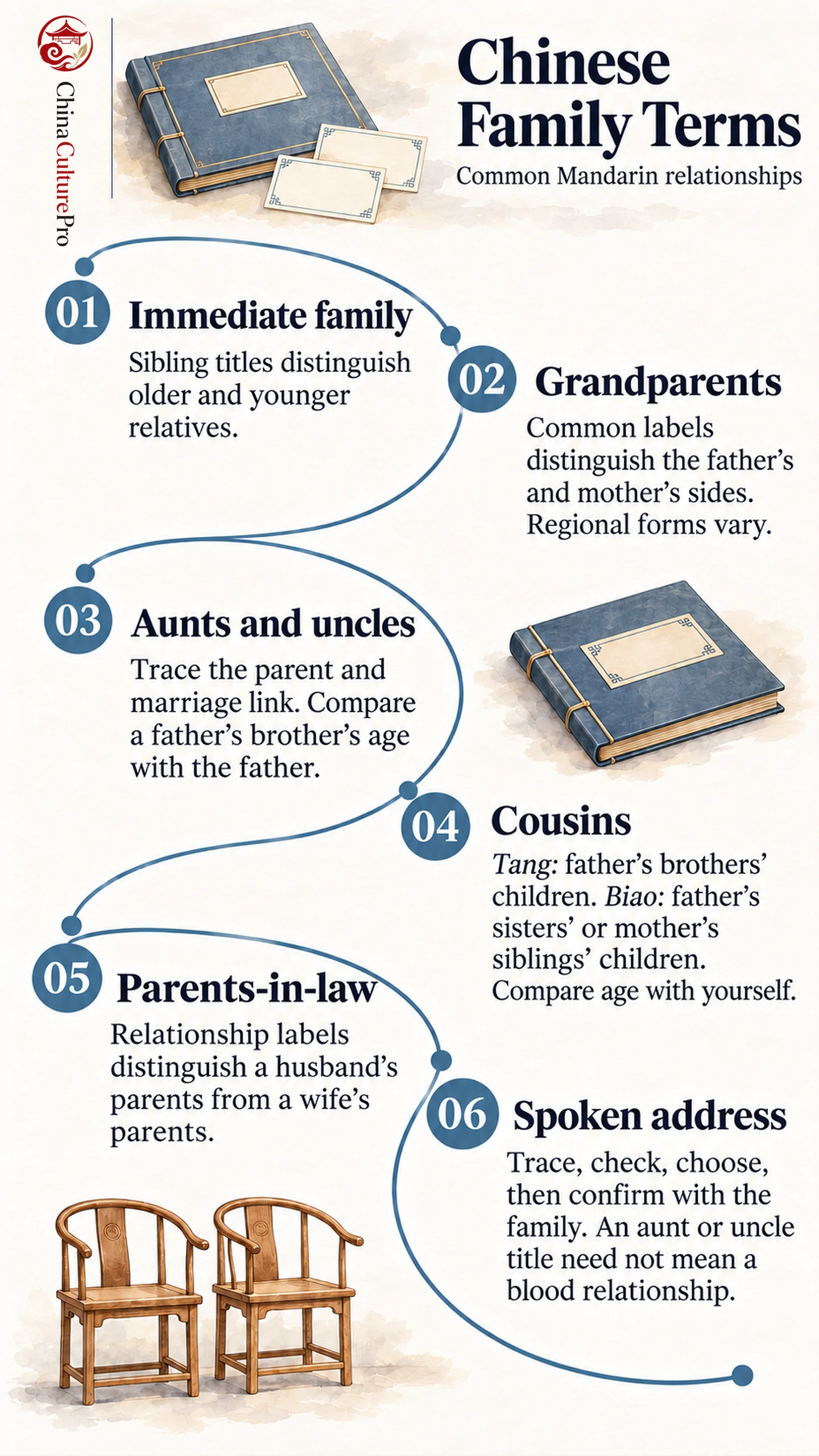
At a family gathering, the same person may be someone’s aunt, someone else’s sister and another person’s mother. A Chinese relationship title starts from the person speaking, so changing the speaker can change the correct word.
The tables below use simplified characters and Mandarin pinyin (拼音, pīnyīn). An unmarked syllable may have a neutral tone. Learn the labels with their relationships rather than treating them as interchangeable translations; the Chinese names guide covers personal names separately.
Parents, Siblings and Children
Start with the immediate family. The sibling terms distinguish age relative to you: an older brother remains your older brother even after both of you become adults. The first six entries are common everyday forms.[1]
| Mandarin term | Relationship |
|---|---|
| 爸爸 (bàba) | Father |
| 妈妈 (māma) | Mother |
| 哥哥 (gēge) | Older brother |
| 弟弟 (dìdi) | Younger brother |
| 姐姐 (jiějie) | Older sister |
| 妹妹 (mèimei) | Younger sister |
| 儿子 (érzi) | Son |
| 女儿 (nǚ’ér) | Daughter |
The final two entries identify your children, rather than your siblings.[6] Relationship labels can be used when talking about someone; they are not necessarily what you say when calling that person across a room.
Do not infer a family’s level of affection from the vocabulary alone. A precise title tells you where someone sits in the relationship, while the family’s actual practices supply the social context. See Chinese family traditions for the wider setting.
Grandparents and Regional Names
These four common Mandarin forms distinguish grandparents through the father and mother. Read the relationship from your own position in the family.[2][3]
| Mandarin term | Relationship |
|---|---|
| 爷爷 (yéye) | Father’s father |
| 奶奶 (nǎinai) | Father’s mother |
| 外公 (wàigōng) | Mother’s father |
| 外婆 (wàipó) | Mother’s mother |
Other forms are also established. For example, laolao (姥姥, lǎolao) is used for a maternal grandmother in northern usage.[4] A family may use a regional term or a different spoken language, so learn its actual form rather than correcting it from this table.
Pinyin here represents Mandarin pronunciation. It is not a pronunciation key for Cantonese or every other Chinese language. If you are preparing to meet a particular family, ask someone to say the title naturally and repeat it back.
Aunts, Uncles and Their Spouses
English “uncle” can hide several different connections. For the father’s brothers, older or younger means older or younger than your father, not than you. A spouse’s title follows the relevant family connection.[2]
| Mandarin term | Relationship |
|---|---|
| 伯伯 (bóbo) | Father’s older brother |
| 叔叔 (shūshu) | Father’s younger brother |
| 姑姑 (gūgu) | Father’s sister |
| 舅舅 (jiùjiu) | Mother’s brother |
| 阿姨 (āyí) | Mother’s sister |
| 伯母 (bómǔ) | Father’s older brother’s wife |
| 婶婶 (shěnshen) | Father’s younger brother’s wife |
| 姑父 (gūfu) | Father’s sister’s husband |
| 舅妈 (jiùmā) | Mother’s brother’s wife |
| 姨父 (yífu) | Mother’s sister’s husband |
The table gives useful reference forms, not the only acceptable words. If several people share a title, ask the family how to distinguish them instead of inventing a ranking number.
For a wedding tea ceremony, prepare a list of actual participants and ask the family to confirm each title. The tea-ceremony script guide can then help with spoken wording; a generic chart cannot determine the ceremony’s order.
Cousins: Tang and Biao Are Not Simply Paternal and Maternal
For these common first-cousin terms, tang (堂, táng) identifies children of your father’s brothers. Biao (表, biǎo) covers children of your father’s sisters and of your mother’s siblings. A father’s sister’s child is therefore a biao cousin, even though the connection begins on the father’s side.[5]
Add the age and gender distinction below. “Older” and “younger” compare the cousin’s age with yours, not the ages of your parents.[5]
| Cousin | Through father’s brother | Through father’s sister or mother’s sibling |
|---|---|---|
| Older male | 堂哥 (tánggē) | 表哥 (biǎogē) |
| Younger male | 堂弟 (tángdì) | 表弟 (biǎodì) |
| Older female | 堂姐 (tángjiě) | 表姐 (biǎojiě) |
| Younger female | 堂妹 (tángmèi) | 表妹 (biǎomèi) |
Use the relationship path to make the distinction. A shared surname by itself does not establish which cousin term applies. For more distant relationships, start again with the actual family connections rather than extending this first-cousin table mechanically.
Parents-in-Law and the Speaker’s Perspective
Common relationship labels distinguish a husband’s parents from a wife’s parents:[2]
- 公公 (gōnggong): Husband’s father.
- 婆婆 (pópo): Husband’s mother.
- 岳父 (yuèfù): Wife’s father.
- 岳母 (yuèmǔ): Wife’s mother.
These labels describe the connection; they do not prescribe what every couple must call their parents-in-law directly. Ask the family which spoken address feels appropriate. A label encountered in a dictionary, a written introduction and a familiar household call may serve different purposes.
Keep the viewpoint clear when translating. “My father-in-law” and “her father-in-law” may refer to different people, and the English phrase does not supply all the information needed to select a Chinese term. Describe the relationship in ordinary words first if the speaker’s position is unclear.
Finding and Using the Right Family Title
Use this lookup process when a direct English translation leaves several possibilities:
- Trace the connection. Start with yourself and follow the parent or spouse who connects you to the relative.
- Check generation and relative age. Identify the generation, then use the relevant older-or-younger distinction. For cousins, compare their age with yours.
- Choose the relationship term. Use the tables to select the Mandarin label for that relationship, rather than translating aunt or cousin word for word.
- Confirm the family’s form. Ask a family member which spoken title and pronunciation they actually use, especially before a formal introduction or ceremony.
Relationship words can also become social forms of address. In Taiwan, for example, a friend’s parents may be addressed with familiar uncle or aunt forms depending on the relationship and degree of closeness.[3] Hearing ayi or shushu does not by itself prove a blood relationship.
For a first meeting, follow an introduction and the person’s preference. Guessing an age-based title for every stranger can create an awkward impression. The greetings and introductions guide covers the wider choice of address.
Use the pinyin and tone guides for pronunciation practice. A family’s generational relationship is also different from a shared character in personal names; see generation names for that naming custom.
For contemporary household arrangements and changing roles, continue to Chinese family life today.
FAQs About Chinese Family Terms
Is a father’s sister’s child a tang cousin?
No. In the common first-cousin distinction explained here, that child is a biao cousin. Tang applies to the children of your father’s brothers.[5]
Are ayi and shushu always blood relatives?
No. Uncle and aunt forms can also address people outside the family. Identify the context before assuming a biological connection.[3]
Should everyone use the same word for a grandparent?
No. Mandarin has several forms, and regional or household usage may differ. Ask which title the family uses rather than treating one reference table as universal.[3][4]
Sources
[1] The Open University. Getting Started with Chinese 3: Week 1, Preparation
[2] Ministry of Education, Taiwan. Revised Mandarin Chinese Dictionary: Family Member Appellation Chart
[3] Learning Mandarin in Taiwan. Lesson Nine: Culture Note on Family Terms and Forms of Address
[4] Ministry of Education, Taiwan. Concise Mandarin Chinese Dictionary: 姥姥
[5] The Open University. Getting Started with Chinese Business Culture Essentials: The Importance of Family
[6] UCL Institute of Education. Key Stage 3 Chinese Vocabulary and Grammar: Family