

Quick Answer: What Is a Chinese Courtesy Name?
A Chinese courtesy name (字, zì) is an additional name associated with adult social identity. It differs from the personal name (名, míng) and the sobriquet (号, hào), often translated as an art name or alias.[1][6]
- Personal name: The name used with the surname to identify the person.
- Courtesy name: A name connected with adult status and respectful address.
- Sobriquet: An alternative appellation, often literary or artistic.
- Historical reading: Several recorded names may identify one person.
These categories describe historical practices with changing contexts, not three compulsory parts of every Chinese name.
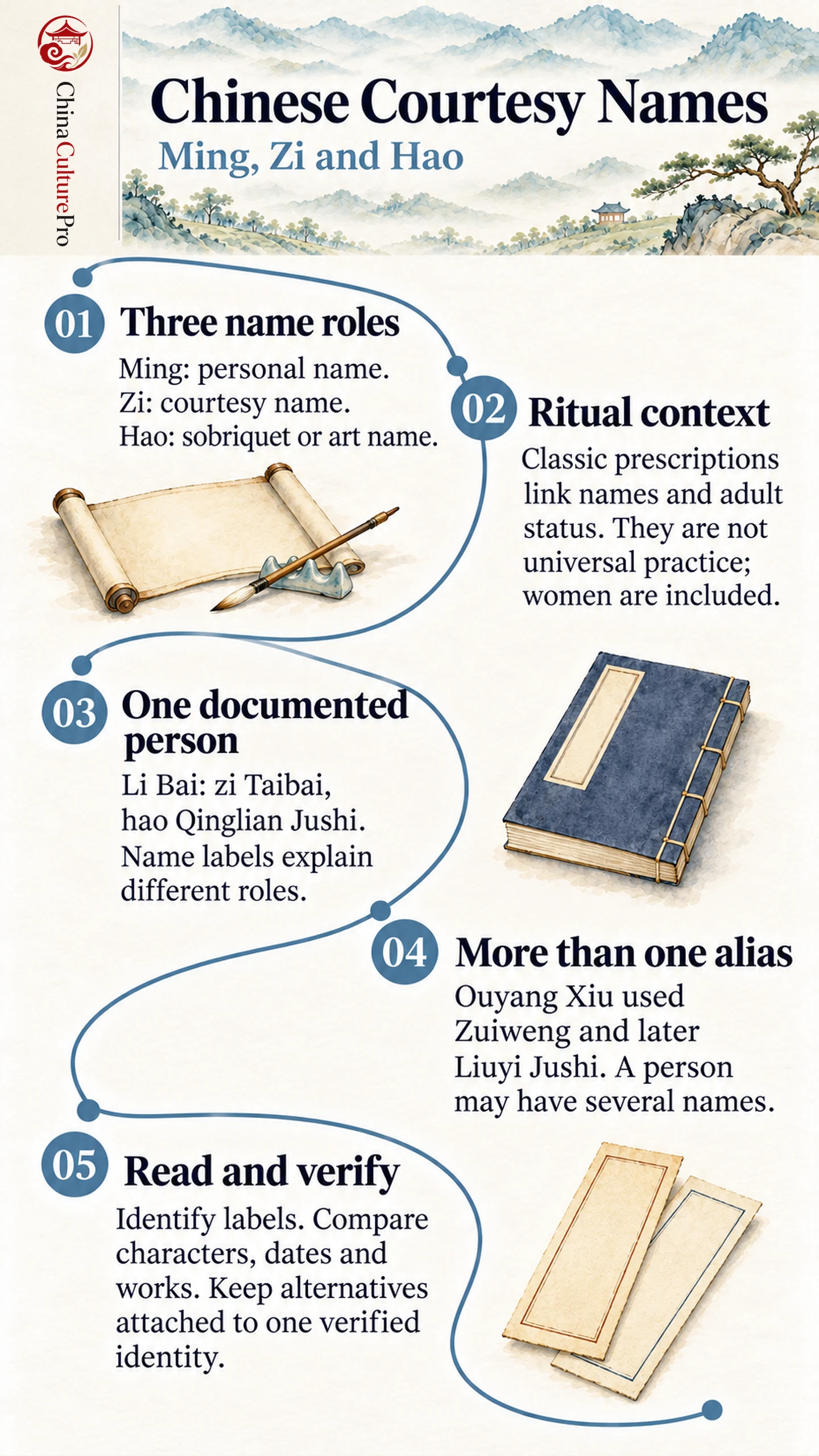
A poet’s biography, a painting label and a letter may appear to introduce different people when they are using different names for the same person. The useful first question is what each name does in its source. Learning the category labels makes those references easier to follow without turning every alternative name into a new identity.
This guide focuses on historical supplementary names. For present-day surname and given-name structure, start with Chinese names and the explanation of Chinese name order.
Ming, Zi and Hao Mean Different Things
The personal name identifies the person within the surname-and-personal-name combination. This is the role of ming in the comparison here.[1]
A courtesy name is an additional name associated with adult social identity and address. This is the role of zi, which English biographies may also call a style name. A sobriquet is an alternative appellation that may express a literary, artistic or personal identity. This is the role of hao. Library guidance distinguishes zi as a courtesy name from hao as an alias or pseudonym.[6]
English translations can overlap, so the Chinese category label helps resolve an ambiguous description. “Style name” in one reference and “sobriquet” in another should prompt a check of the original entry, rather than an assumption that the terms are interchangeable.
A hao was often assumed by its bearer, but friends could also confer one. Avoid a rigid rule that every courtesy name came from parents and every sobriquet was entirely self-created.[1]
Coming of Age and Respectful Address
The Book of Rites (礼记, Lǐjì), in its opening ritual material, connects a man’s capping at twenty with receiving a courtesy name. It also connects a betrothed woman’s hairpin ceremony with receiving one. The passage preserves distinctions of relationship and address, including the use of a personal name before a father or ruler.[2]
Read this as a ritual prescription. It does not establish that every man in every dynasty received a courtesy name on his twentieth birthday, or that every woman received one at fifteen. Nor does it provide a complete description of naming across regions, classes and centuries.
The connection with adult recognition explains why courtesy names concern social relationships as well as identity. It is a poor guide to modern conversation, however, to turn an ancient prescription into a rule that using someone’s given name is always disrespectful.
Three Historical Names in Context
These examples connect each documented identity with a courtesy name and a sobriquet. The first column gives the surname plus personal name; the other columns are additional appellations, not extra given-name fields.
| Person | Courtesy name | Sobriquet |
|---|---|---|
| Li Bai (李白, Lǐ Bái) | Taibai (太白, Tàibái) | Qinglian Jushi (青莲居士, Qīnglián Jūshì).[3] |
| Su Shi (苏轼, Sū Shì) | Zizhan (子瞻, Zǐzhān) | Dongpo Jushi (东坡居士, Dōngpō Jūshì).[4] |
| Ouyang Xiu (欧阳修, Ōuyáng Xiū) | Yongshu (永叔, Yǒngshū) | Zuiweng (醉翁, Zuìwēng); later Liuyi Jushi (六一居士, Liùyī Jūshì).[5] |
The table also shows why character counting cannot identify a name’s function. Ouyang is the two-character surname in Ouyang Xiu; it is not a courtesy name. The guide to Chinese compound surnames explains that separate structural issue.
A spelling shared across two entries is only a clue. Keep the Chinese characters and the source’s category labels with your notes, particularly when comparing editions that use different romanization systems.
Why One Person May Have Several Names
Ouyang Xiu’s two recorded sobriquets show that hao does not mean a single permanent alternative assigned once at adulthood. A reference can identify an earlier appellation and another associated with later life without introducing another author.[5]
Even the courtesy-name column need not be a complete lifetime inventory. Li Bai’s museum biography records another courtesy name, Changgeng (长庚, Chánggēng), in addition to Taibai. The table selects one familiar zi for comparison; it does not claim that he had only one.[3]
Do not force every other label into these categories. A nickname may have a different context, while imperial naming introduces further distinctions. Preserve the source’s specific description when it supplies one.
Reading Names in Biographies and Museum Labels
- Find the category labels: Look for the Chinese labels for personal name, courtesy name and sobriquet, or their English equivalents. Record which label belongs to each name rather than treating every form as a separate person.
- Cross-check the identity: Compare the Chinese characters, dates and associated works with a museum biography or library authority record. A shared spelling alone does not establish that two names identify the same person.
- Keep the context when citing: Use the identifying name in your source and explain a relevant alternative at first mention. Keep the alternative attached to the same person in your notes, with its category and source.
A concrete example is Su Shi’s letter to Jichang (季常, Jìcháng). The museum identifies the recipient as Chen Zao (陈慥, Chén Zào), whose style name was Jichang. The name in the work’s title therefore points to its recipient, not to another calligrapher named as its maker.[4]
Library authority records can be useful here because they record variant names and their relationships to an identified person. Their instructions about formatting those references serve cataloging; they are not a universal formula for how every historical person was addressed in conversation.[6]
FAQs About Chinese Courtesy Names
Is a courtesy name a middle name?
No. A courtesy name is a separate historical naming category. It should not be inserted between a surname and given name as though it were another component of the same modern full name.
Did women have courtesy names?
Yes. The ritual passage discussed above explicitly connects a betrothed woman’s hairpin ceremony with receiving a courtesy name. That establishes women’s inclusion in the prescription, not identical practice among all women in every period.[2]
Do I need a courtesy name when learning Chinese?
Learning Chinese does not depend on adopting a courtesy name. If a course, artistic practice or historical fiction project uses one, clarify that purpose first. For an everyday personal name, the more useful starting point is choosing a Chinese name with attention to meaning, sound and context.
Sources
[1] David K. Jordan, University of California San Diego. Chinese Personal Names and Titles
[2] Li Ji, preserved in Li Ji Pang Xun; Shidian Guji. Ritual passage on capping, hairpin ceremonies and names
[3] The Palace Museum. Li Bai
[4] National Palace Museum. The Ancient Art of Writing: Selected Works
[5] The Palace Museum. Ouyang Xiu
[6] Library of Congress. CJK NACO Best Practices