

Quick Answer: How Should You Read Chinese Girl Names?
Read a Chinese girl’s name through its exact characters, pronunciation and usage context. A name list can offer starting points, but an attractive English gloss does not establish a family’s intended meaning.
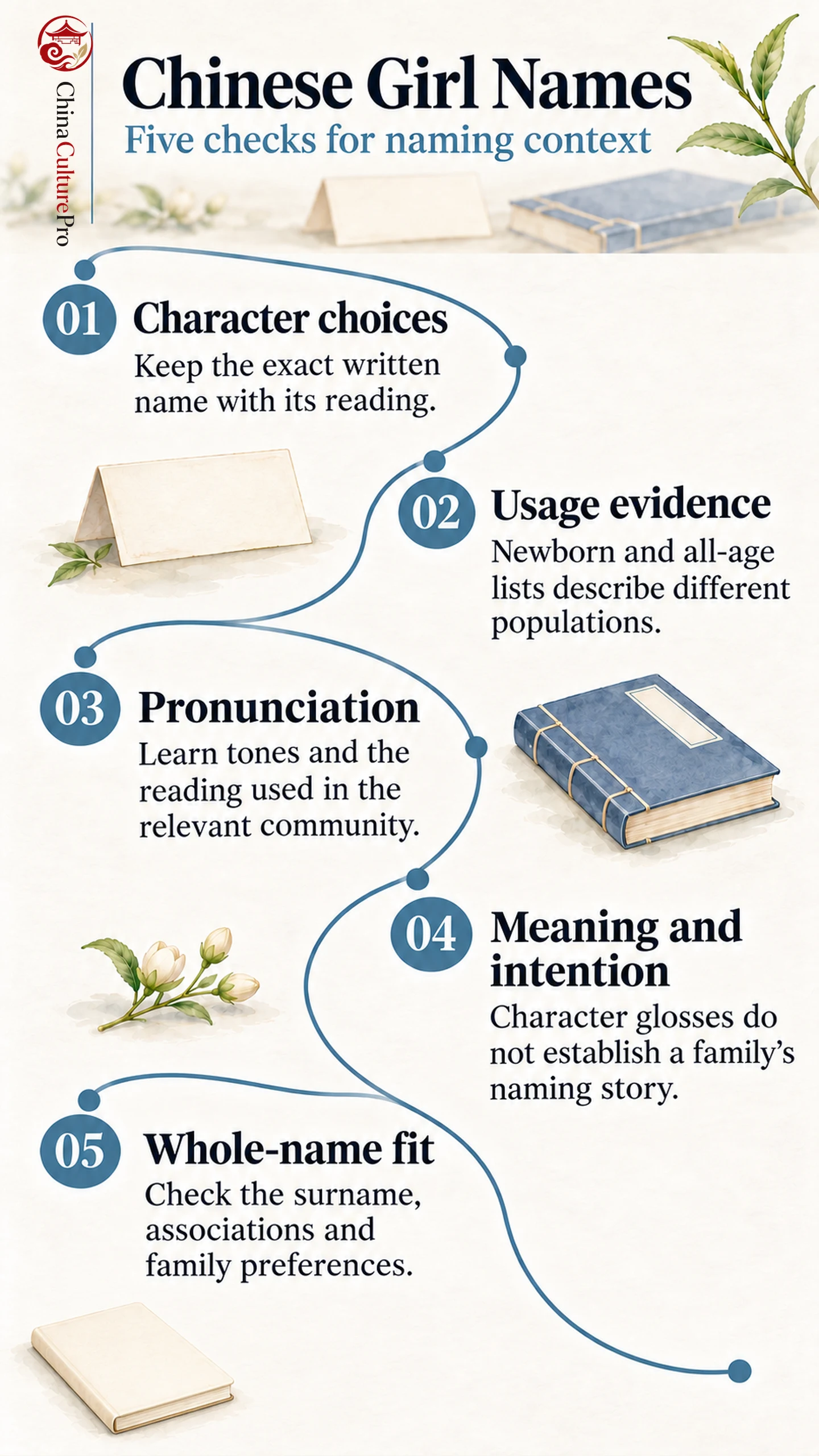
- Keep the Chinese characters beside tone-marked pinyin (拼音, pīnyīn).
- Distinguish a character’s dictionary sense from a poetic interpretation of the whole name.
- Check which year, region and age group supports a popularity claim.
- Try the given name with the surname and ask knowledgeable speakers about its associations.
The examples below use mainland Mandarin reference readings and documented 2021 usage. They are given names, not complete surname-and-given-name combinations or a current ranking.
A two-character name may be given a polished English explanation such as “graceful destiny,” even when that phrase is an interpretation rather than a translation. Begin with the exact characters and reading before deciding what associations the name carries.
This guide supplies documented examples and short character glosses, then explains what still needs checking. The broader Chinese names guide covers surname and given-name structure.
Documented Two-Character Girl Names and Their Meanings
These seven names appear among the ten most frequently registered given names for female newborns in the 2021 national name report. The report concerned births that year already registered by December 31, 2021. This is a dated cohort, not all Chinese women or babies born today.[1]
Two pairs show why the characters matter: Yinuo may be 一诺 (Yīnuò) or 依诺 (Yīnuò), while Yutong may be 雨桐 (Yǔtóng) or 语桐 (Yǔtóng). Matching the Latin spelling does not distinguish the written choices.
| Given name and reference pinyin | Character glosses, in written order |
|---|---|
| Ruoxi (若汐, Ruòxī) | Like or as; evening tide.[2][3] |
| Yinuo (一诺, Yīnuò) | One; promise or agreement.[4] |
| Yinuo (依诺, Yīnuò) | Rely on or follow; promise or agreement.[4][5] |
| Yihan (艺涵, Yìhán) | Skill or art; contain or accommodate.[6][7] |
| Yutong (雨桐, Yǔtóng) | Rain; a character used in tree names.[8][9] |
| Xinyi (欣怡, Xīnyí) | Joyful; pleased or happy.[10][11] |
| Yutong (语桐, Yǔtóng) | Speech or words; a character used in tree names.[9][12] |
These glosses identify selected dictionary senses, not fixed translations of the whole names. The tree-name character should not automatically be translated as one botanical species without checking the intended reference.
Shorter Names and Different Age Groups
A given name can also contain one character. The same 2021 report identified the following among common single-character names used more often by women in its registered population. This broader population is different from that year’s newborn cohort.[1]
| Given name and reference pinyin | Selected dictionary senses |
|---|---|
| Min (敏, Mǐn) | Quick, clever or diligent.[13] |
| Jing (静, Jìng) | Still or quiet.[14] |
If you want an uncommon name, first decide what “uncommon” means: among newborns, adults, a school cohort or a particular language community. A name missing from one short list is not necessarily rare. Nor does a familiar name become unsuitable merely because many other people use it.
Pronunciation: Tones, Shared Sounds and Regional Readings
Use pinyin as a pronunciation system, rather than reading its letters with ordinary English sound values. The marks identify tones; an English approximation cannot preserve every sound distinction. The Chinese tones guide provides the spoken-language background.
The table gives reference forms, while connected speech and a person’s own pronunciation should be learned through listening. Ask someone to say the full name naturally, then repeat it back for correction.
There are also regional dictionary differences. The character 汐 is read xī in the mainland reference form used above, while the cited Taiwan Mandarin dictionary gives xì. Its evening-tide sense remains recognizable, but the tone differs. Do not combine regional readings casually or treat the bearer’s established pronunciation as an error.[3][15]
The repeated Yinuo and Yutong examples also show why spelling alone cannot recover a name’s meaning. See Chinese homophones and regional name spellings for related questions.
Meaning, Imagery and Family Intention
The examples offer several kinds of association: rain and tides, trees, joy, skill and promises. These are ways to begin a conversation about a name, rather than fixed categories that every family uses.
If a name is said to come from a poem or classical phrase, check the original wording and context before repeating the explanation. Two attractive characters are not enough to prove an allusion. Likewise, a pleasant literal gloss does not tell you whether the combination sounds natural as a name in the intended community.
For an existing person, their own explanation is more useful than a generic meaning page. For a proposed name, discuss the chosen characters, sound and intended association together. A Chinese dictionary supports the character check; knowledgeable speakers can help evaluate the full combination.
Descriptions such as “feminine,” “classic” or “gentle” should be treated as impressions with a context. A record of female usage does not make a character exclusively female, and a name does not impose a gendered temperament. The same distinction between usage and prescription applies when comparing Chinese boy names.
Checking a Name with Its Surname and Community
Try a shortlist as full names. Confirm which characters belong to the family name and how the given name is written as a unit; the surname guide and name-order guide address those structural questions.[16]
Ask about pronunciation in the languages the family uses, possible unintended wordplay and whether the written form is convenient for everyday use. Consider family expectations too: a shared generation character may matter in one family and be absent in another. The guide to generation names explains that context.
An adult adopting a Chinese name may also want a connection with an existing name, a personal interest or a chosen association. Such a connection should be checked rather than generated from personality claims. See how to choose a Chinese name for the wider selection process.
FAQs About Chinese Girl Names
Are these the most popular Chinese girl names today?
The two-character examples come from a 2021 female-newborn cohort. They document usage in that report, not a current ranking for every Chinese-speaking region or age group.[1]
Can the same pinyin spelling have different meanings?
Yes. The two Yinuo forms and two Yutong forms above use different characters. Keep the exact written name beside the pinyin before discussing its meaning.
Does a girl’s name have to express beauty or gentleness?
No. The documented examples include varied associations, and usage patterns do not prescribe someone’s personality. Discuss the actual characters and family intention rather than imposing a narrow category.
Sources
[1] Ministry of Public Security Household Registration Research Center. National Name Report 2021, Official Republication
[2] Ministry of Education, Taiwan. Mandarin Mini Dictionary: 若
[3] Han Dian. 汐: Basic Definition and Pronunciation
[4] Ministry of Education, Taiwan. Concise Mandarin Chinese Dictionary: 諾
[5] Ministry of Education, Taiwan. Concise Mandarin Chinese Dictionary: 依
[6] Ministry of Education, Taiwan. Concise Mandarin Chinese Dictionary: 藝
[7] Ministry of Education, Taiwan. Concise Mandarin Chinese Dictionary: 涵
[8] Ministry of Education, Taiwan. Concise Mandarin Chinese Dictionary: 雨
[9] Ministry of Education, Taiwan. Concise Mandarin Chinese Dictionary: 桐
[10] Ministry of Education, Taiwan. Concise Mandarin Chinese Dictionary: 欣
[11] Ministry of Education, Taiwan. Concise Mandarin Chinese Dictionary: 怡
[12] Ministry of Education, Taiwan. Concise Mandarin Chinese Dictionary: 語
[13] Ministry of Education, Taiwan. Concise Mandarin Chinese Dictionary: 敏
[14] Ministry of Education, Taiwan. Concise Mandarin Chinese Dictionary: 靜
[15] Ministry of Education, Taiwan. Concise Mandarin Chinese Dictionary: 汐
[16] IFLA Cataloguing Section. Names of Persons—Chinese Names, 2020